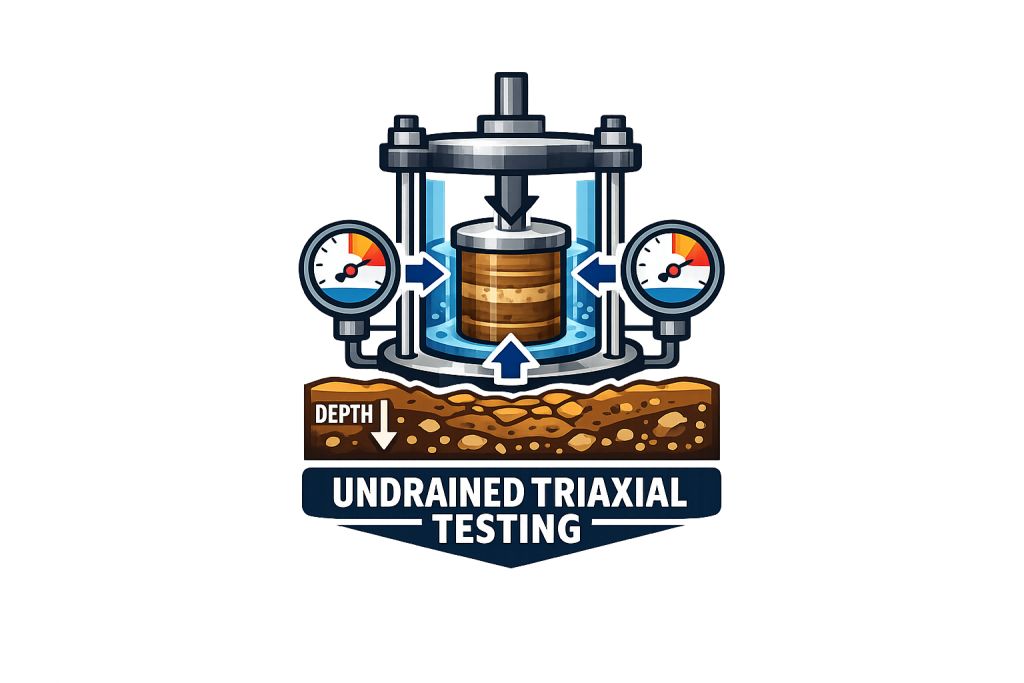

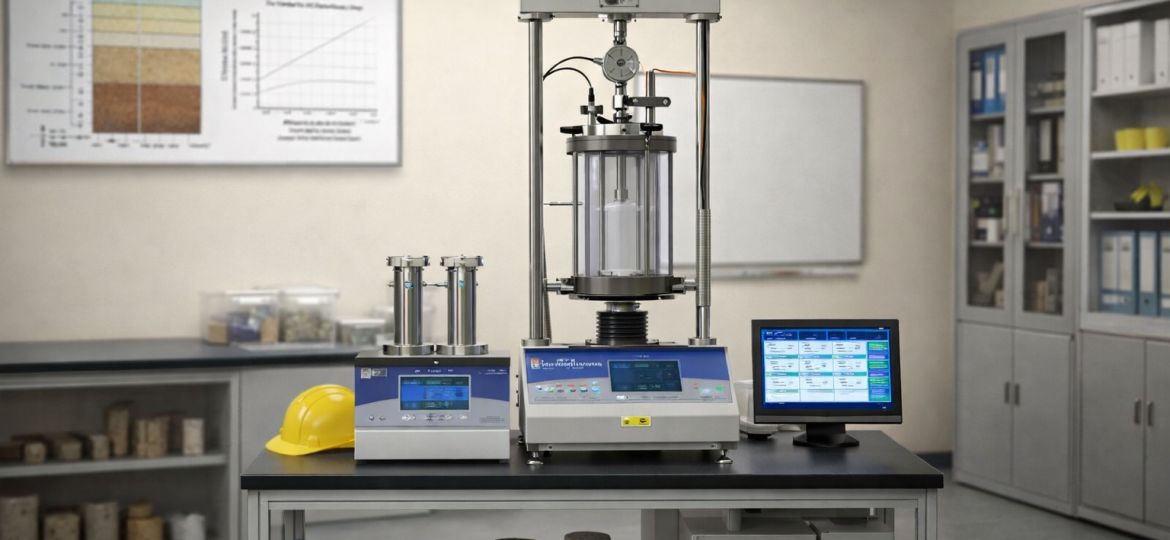
Quick Undrained Triaxial (QUT/UUT) Testing: Fast Strength Data for Design
The Quick Undrained Triaxial Test (QUT)—also known as an Unconsolidated Undrained Triaxial (UUT)—is used to determine a soil’s undrained shear strength when it is loaded quickly under an all-round confining pressure. The confining pressure is typically selected to represent the in-situ stress at the depth the sample was recovered.
“Undrained” means no drainage is allowed during loading, so pore water pressures build up within the specimen. This makes QUT/UUT testing particularly relevant for short-term loading conditions and rapid construction scenarios.
Tests can be carried out as a single determination or commonly as a set of three, using different confining pressures to provide a more robust strength profile.
Where QUT/UUT testing is used
QUT results are widely used to support:
- foundation design in cohesive soils
- embankment stability and short-term slope assessments
- bearing capacity checks for earthworks and temporary works
- earthworks compliance where undrained strength is referenced in specification requirements (including SHW Series 600, Clause 633)
For projects requiring deeper insight into stress paths and pore pressure behaviour, consolidated drained (CD) or consolidated undrained (CU) triaxial testing can be undertaken.
Why choose The Testing Lab PLC?
At The Testing Lab PLC, we deliver QUT/UUT testing with careful sample handling and clear, decision-ready reporting, helping your team make confident choices on stability, bearing capacity, and construction risk.
Need QUT/UUT testing? Contact The Testing Lab PLC to discuss sample type, confining pressures, and turnaround.