
One-Dimensional Consolidation Testing: Predict Settlement with Confidence
One-dimensional consolidation testing (often called the oedometer test) is a core geotechnical laboratory test used to evaluate how saturated soils—especially clays—compress over time under applied loading. It helps engineers understand both short-term and long-term settlement: how much the ground is likely to move, and how long it will take to stabilise.
How the test works
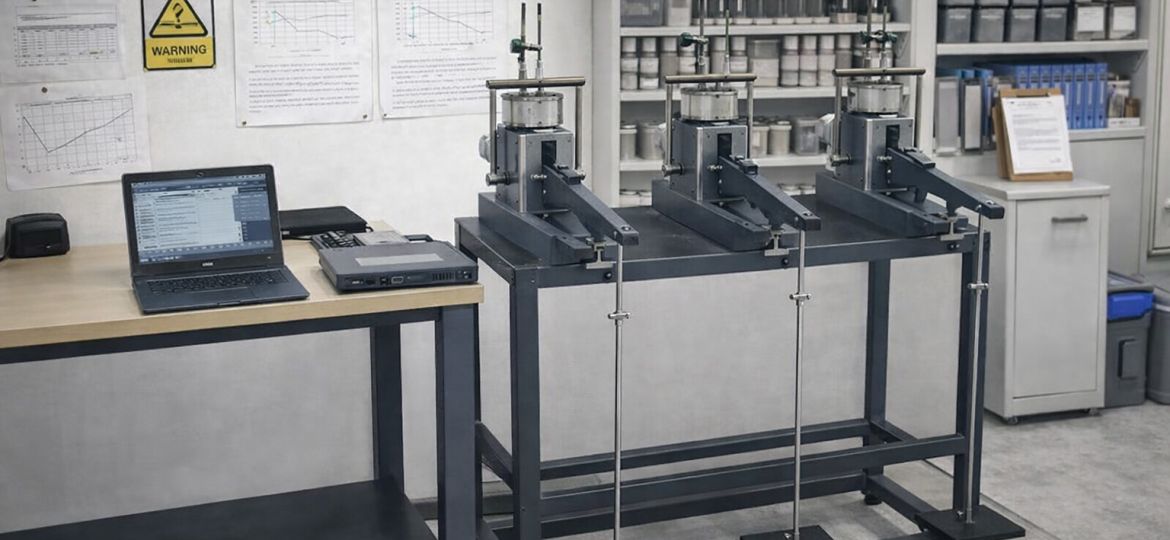
A cylindrical soil specimen is placed in a rigid steel ring and fitted with porous stones at the top and base to allow controlled drainage. The sample is submerged and subjected to a sequence of incremental loading cycles. Settlement is measured over time under each load step until the rate of movement becomes negligible, building a settlement–time and settlement–stress profile.
Key outputs
Consolidation testing provides parameters used directly in design, including:
- Compression Index (Cc)
- Coefficient of Volume Compressibility (mv)
- Coefficient of Consolidation (Cv) (the rate at which consolidation occurs)
These values support predictions of total settlement, settlement rate, and soil stiffness under load.
Where it’s used
Oedometer data is essential for:
- foundations and structural loading assessments
- roads, railways, and embankments, where long-term settlement can affect performance
- bridges and heavy structures
- selecting and designing ground improvement solutions
- estimating both magnitude and time to completion of settlement
Why choose The Testing Lab PLC?
At The Testing Lab PLC, we provide consolidation testing with careful sample handling and clear, decision-ready reporting—helping you design with confidence, manage risk, and avoid costly settlement surprises.
Need consolidation (oedometer) testing? Contact The Testing Lab PLC to discuss your samples and turnaround.