

Maximum & Minimum Density Testing: Relative Density for Sands and Gravels
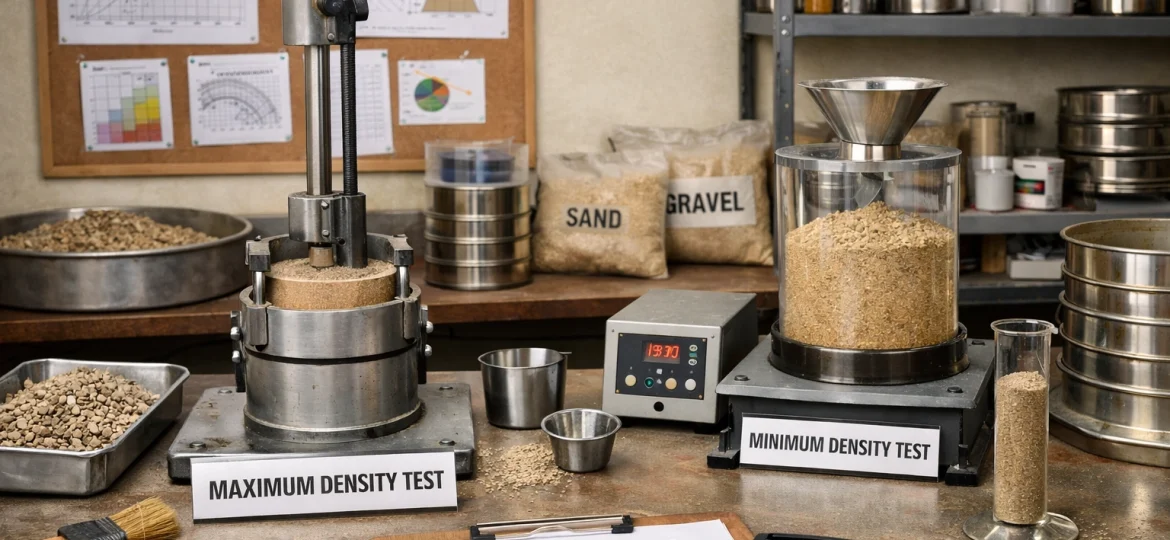
Maximum and Minimum Density testing is carried out on granular soils such as sands, gravels, or mixed granular materials. The test determines the soil’s densest (maximum) state and loosest (minimum) state, allowing engineers to calculate Relative Density—a key measure of how compact a granular soil is compared with its possible limits. This is especially useful when comparing laboratory limits to field density results during earthworks and ground improvement works.
How the test is performed
Samples are typically oven dried at ~105°C to standardise moisture conditions.
-
Maximum density is achieved by vibrating the soil into a steel mould using a mechanical vibrating hammer, commonly submerged in water to remove trapped air and reach the densest achievable packing.
-
Minimum density is determined by gently pouring the dry soil into a cylinder with minimal disturbance to achieve the loosest stable arrangement.
Results are reported as density (often in Mg/m³) and used to calculate relative density, helping assess whether field-compacted granular soils are achieving the required performance.
Why choose The Testing Lab PLC?
At The Testing Lab PLC, we deliver maximum/minimum density testing with careful preparation and clear, decision-ready reporting. Our results help you validate compaction targets, understand granular soil behaviour, and reduce risk on projects involving sands and gravels.
Need max/min density testing? Contact The Testing Lab PLC to discuss your samples and turnaround.

Dear The Testing Lab PLC,
Many thanks for your prompt and professional asbestos survey report service, I would not hesitate to recommend your company in this regard.

This must be an absolute record for getting a report back, considering the surveyor arrived around 3pm – very well done!
Thank you for the very quick response for the quote and scheduling the survey. There’s never any fuss, and always straight forward. Thanks again.
Thank you for offering such a prompt turnaround for ACM testing and for your courteous service in doing so – I had a nervous client to placate and knowing the report would be back with them in such a short time was very reassuring to them, and for no more than a basic service from the competition!
Bradley, thank you for your efforts at short notice today, please pass on our gratitude to your surveyor Tim who did your company proud!
Thank you very much for the air sampling results – and please accept our grateful thanks for resolving this issue so quickly and for the promptness of the report.
Your analyst, Lee, was very helpful and his suggestions and advice appreciated.
We would have no hesitation in recommending The Testing Lab and will be in touch soon with regards arrangements for a full asbestos survey for the rest of the site.
TTL have been working directly as my analyst for the last 12 months on a very complex asbestos removal scheme, they have achieved all of their KPI’s without fail and on a number of occasions surpassed their SLA in acting for us on planning issues associated with the demolition in regard to contamination which cannot be removed as part of the normal sequence of operation.
There reports are always issued within timescales and they have policed the reports by the Licensed asbestos contractor faultlessly sometimes in very difficult circumstances.
Send Us Some Feedback
Please use the below form to give us your feedback.