

Project timelines are tight, and every delay costs. So why are you still waiting on slow sample results and wrestling with unclear reports? With the updated 2026 UK building regulations looming, the margin for error is shrinking, and the fear of non-compliance is a significant pressure for any project manager. This is where a high-performance construction material testing laboratory becomes your most valuable partner, transforming a potential bottleneck into a streamlined process that guarantees quality and peace of mind.
In this definitive guide, we cut through the complexity. We will show you exactly how to select a testing partner that secures structural integrity, ensures full regulatory compliance, and prevents those costly project delays. You’ll discover the key to receiving fast, accurate certificates of analysis, what expert guidance on failed samples should look like, and how to achieve a smooth, confident handover to building control. Consider this your blueprint for material testing success in 2026 and beyond.
Key Takeaways
- Learn to identify the essential tests for concrete, soil, and aggregates that are non-negotiable for ensuring structural safety and UK regulatory compliance.
- Understand the critical difference between basic on-site checks and the precision analysis provided by an accredited construction material testing laboratory.
- Discover proven strategies for scheduling material tests and preparing samples correctly to prevent costly re-testing and significant project delays.
- Get an inside look at the advanced processes used to verify material specifications, ensuring your build is founded on scientifically validated components.
What is a Construction Material Testing Laboratory?
A construction material testing laboratory is a critical partner in the modern building lifecycle, serving as an independent, scientific authority that verifies the safety, compliance, and long-term performance of a structure’s core components. It provides the empirical data that architects, engineers, and contractors require to build with confidence, mitigate risk, and meet increasingly stringent UK regulations.
While on-site field tests offer immediate feedback on properties like concrete workability, a controlled laboratory analysis delivers definitive, quantifiable results. This distinction is vital. As building standards evolve towards 2026, demanding higher precision in material verification, the lab’s role becomes paramount. The data it produces carries significant legal weight, with a UKAS-accredited certificate being an essential document for structural handovers and regulatory sign-off.
The Core Functions of a Testing Facility
A dedicated materials lab is equipped to perform a range of sophisticated analyses that are impossible to conduct on-site. Its primary responsibilities are to provide objective evidence of material quality through:
- Component Analysis: Identifying the precise chemical composition and physical properties of raw construction materials, from aggregates and soils to reinforcement steel, ensuring they meet project specifications.
- Performance Simulation: Subjecting finished products-such as concrete cubes or masonry units-to simulated long-term environmental and mechanical stresses to accurately predict their durability and load-bearing capacity.
- Independent Verification: Acting as an impartial third party to validate a supplier’s claims and support internal Quality Assurance (QA) protocols, preventing substandard materials from entering the supply chain.
Why UKAS Accreditation (ISO 17025) is Non-Negotiable
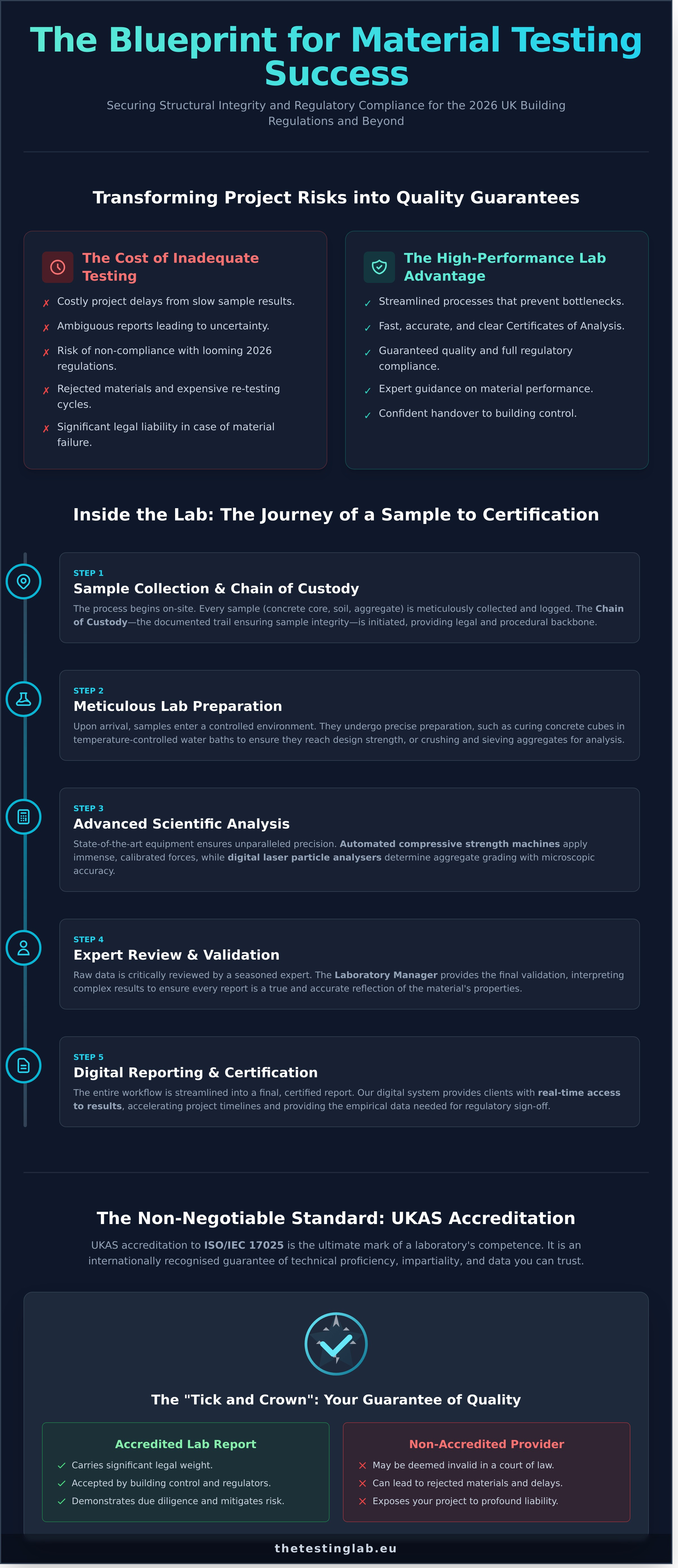
In the UK, the ultimate mark of a laboratory’s competence is its UKAS accreditation to the ISO/IEC 17025 standard. The presence of the UKAS “Tick and Crown” logo on a test report is an internationally recognised guarantee of technical proficiency and impartiality. This accreditation ensures that the lab’s equipment is meticulously calibrated, its testing methodologies are validated, and its technicians are demonstrably competent.
Engaging a non-accredited facility for compliance testing is a profound project risk. It can lead to rejected materials, costly programme delays, and significant legal liability in the event of a failure. A certificate from a non-accredited provider may be deemed invalid by building control or in a court of law, rendering it worthless for demonstrating due diligence.
Inside the Lab: How Materials are Scientifically Verified
Transforming a raw sample from a Doncaster construction site into a certified data point is a meticulous, multi-stage process. The journey begins the moment a sample-be it a concrete core, soil aggregate, or steel rebar-is collected and logged. Upon arrival at our facility, it enters a controlled environment where every step is tracked, from initial preparation to final analysis. This is where the core function of a construction material testing laboratory comes to life: providing objective, scientific proof of a material’s performance and compliance.
By 2026, our laboratory leverages state-of-the-art equipment to ensure unparalleled precision. Automated compressive strength machines apply immense, calibrated forces to concrete cubes, while digital laser particle analysers determine aggregate grading with microscopic accuracy. This technology generates vast amounts of raw data, which is then critically reviewed. The Laboratory Manager, a seasoned expert in materials science, provides the final validation, ensuring that complex results are interpreted correctly and that every report is a true and accurate reflection of the material’s properties. This entire workflow is streamlined through our digital reporting system, which provides clients with real-time access to test results and accelerates project timelines significantly.
The backbone of such a high-tech, data-driven operation is its IT infrastructure. For any modern laboratory, ensuring the reliability and security of digital systems is paramount to preventing delays. This is where managed IT services become essential for maintaining complex networks and software; for a look at how these providers operate, you can visit kastec-it.com.
The Science of Sample Preparation
The integrity of a test result is determined long before the sample reaches a machine. Critical factors like moisture content and temperature must be meticulously controlled during transit to prevent environmental contamination that could skew results. Once in the lab, samples undergo precise preparation, such as crushing and sieving aggregates to analyse their distribution or curing concrete cubes in temperature-controlled water baths to ensure they reach their specified design strength. Chain of Custody is the documented, chronological trail that provides the legal and procedural backbone for sample integrity from collection to disposal.
Standardized vs. Bespoke Testing Methods
To ensure results are universally comparable and meet regulatory requirements, we rigorously follow established protocols like BS EN and ISO standards. These benchmarks are essential for standard compliance testing. However, innovation in construction demands flexibility. For novel materials like polymer composites or proprietary concrete admixtures, we design bespoke stress-testing programmes to evaluate performance under specific, real-world conditions. These impartial, third-party data sets are invaluable, not only for R&D but also for resolving contractual disputes and verifying that materials conform to both established benchmarks and global best practices, such as ASTM International standards.
Essential Tests Every Construction Project Requires
Material testing is not merely a compliance step; it’s a foundational pillar of risk management in construction. By verifying the properties of materials before they are incorporated into a structure, we mitigate the risk of latent defects-critical failures that may only surface years after completion. Skipping this stage can lead to catastrophic structural issues and repair costs that far exceed the initial investment in testing. A professional construction material testing laboratory provides the essential data needed to build with confidence, ensuring longevity and safety from the ground up.
Concrete and Structural Integrity Testing
Concrete forms the backbone of most modern structures, and its performance is non-negotiable. Key tests include:
- Concrete Cube Strength Testing: We assess compressive strength at 7 and 28 days. The 7-day test provides an early indication of quality, while the 28-day test confirms if the concrete has achieved its full design strength, a critical factor for load-bearing elements. Learn more by reading our guide on What is Concrete Cube Strength Testing?
- Fresh Concrete Analysis: Tests for slump, flow, and air entrainment ensure the concrete has the correct workability for placement and will be durable enough to withstand environmental factors like freeze-thaw cycles.
Geotechnical and Soil Analysis
The ground beneath a structure is as crucial as the materials within it. Geotechnical analysis prevents costly foundation failures and ensures long-term stability.
- California Bearing Ratio (CBR): This test determines the load-bearing capacity of soil, which is fundamental for designing durable roads, pavements, and foundations that won’t deform under traffic. For more details, see our overview of Soil Analysis for Construction in Doncaster.
- Contaminant Screening: Identifying asbestos and other hazardous materials in the soil before excavation is vital for site safety and prevents unexpected project delays and significant remediation costs.
Aggregate and Bituminous Testing
The quality of aggregates and bitumen directly impacts the performance of roads, car parks, and other infrastructure. Our construction material testing laboratory ensures these materials meet stringent specifications.
- Grading and Shape Analysis: The size, shape, and distribution of aggregate particles affect the compaction and stability of sub-base layers. Proper grading is essential for creating a solid, interlocking foundation. You can explore this further in our A Guide to Aggregate Testing Methods.
- Asphalt Durability: We assess bitumen for properties like binder content and softening point. This ensures the final asphalt mix can withstand heavy traffic and the UK’s variable climate without cracking or rutting, often following rigorous standards such as the AASHTO testing protocols used in highway construction.
How to Manage Lab Testing to Avoid Project Delays
In construction, unforeseen delays are costly. While many factors are outside your control, managing your materials testing schedule is a powerful way to mitigate risk and maintain momentum. Integrating testing into your initial project plan, rather than treating it as an afterthought, transforms it from a potential bottleneck into a quality assurance asset.
The most damaging misconception is that testing is only for when something looks wrong. Proactive, scheduled testing is your first line of defence against substandard materials, ensuring compliance and structural integrity from day one. Waiting for a visible defect means the problem is already embedded in your project, leading to expensive rework and significant delays.
Common mistakes that force re-testing and halt progress often occur on-site, long before a sample reaches a construction material testing laboratory. These include:
- Incorrect Sampling Technique: Taking a sample that isn’t representative of the entire batch, leading to skewed results.
- Contamination: Using dirty tools or containers, which can compromise the sample’s integrity.
- Poor Labelling: Missing or incorrect information (date, time, location, batch number) can render a sample untraceable and legally invalid.
Finally, a lab analysis certificate shouldn’t require a PhD to understand. A good report clearly indicates whether a material has passed or failed against specified standards (e.g., British Standards). It will highlight key performance indicators, such as the 28-day compressive strength of a concrete cube, and place the result in the context of your project’s requirements.
Best Practices for Site Sampling
Precision starts on site. Ensure your team is trained on correct sampling procedures, such as those outlined in BS EN 12350-1 for fresh concrete. A representative sample is crucial; a single, poorly taken sample can misrepresent an entire delivery, leading to incorrect assumptions. Meticulous labelling is not just administrative; it provides a clear chain of custody, which is essential for traceability and quality disputes.
Choosing the Right Lab Partner
When selecting a construction material testing laboratory, looking beyond the cost-per-sample is critical. Evaluate a lab’s typical lead times and assess their capacity to handle your project’s volume without delay. A true partner offers more than raw data; they provide technical consultancy to help you interpret results and make informed decisions. A lab’s location, like our facility in Doncaster, provides a logistical advantage, with proximity to major transport links ensuring fast, reliable sample transit from sites across the UK. For a partnership that prioritises your project timeline, explore our comprehensive testing services.
The Testing Lab PLC: Your Strategic Partner in Compliance
Choosing a testing provider is more than a procurement decision; it’s a strategic partnership in quality and compliance. From our headquarters in Doncaster, The Testing Lab PLC is perfectly positioned to serve as a central hub for projects across the entire UK. Our logistical efficiency ensures that whether your site is in Scotland or Cornwall, you receive the same rapid, reliable service that has become our hallmark.
Our commitment is to deliver more than just data; we provide clarity and confidence. Every analysis-from asbestos identification and soil contamination to water quality testing-is conducted with UKAS-accredited precision. We bridge the critical gap between complex laboratory findings and the practical realities of your construction site, translating raw data into actionable insights that inform your decisions, mitigate risk, and ensure regulatory adherence.
The Testing Lab PLC advantage is built on three core pillars:
- Independence: As a fully independent construction material testing laboratory, our results are impartial, objective, and solely focused on technical accuracy.
- Expertise: Our team consists of seasoned specialists who offer expert interpretation and guidance, helping you navigate complex compliance landscapes.
- Rapid Reporting: We understand that project timelines are critical. Our streamlined processes are designed for fast, accurate turnarounds, minimising delays and keeping your schedule on track.
Comprehensive Environmental and Structural Services
Our capabilities extend far beyond standard material analysis. We offer a holistic suite of services to support the full asset lifecycle, from initial ground investigation and environmental screening to pre-demolition audits. This includes critical safety assessments such as Asbestos Surveys, Legionella Risk Assessments, and Fire Risk Assessments, ensuring your project is compliant and safe from start to finish.
Get Started with a Professional Consultation
Whether you require a bespoke testing schedule for a unique project or a high-volume agreement for ongoing works, our team is ready to assist. We operate a nationwide sample collection service, managed from our Doncaster hub, to ensure a seamless and efficient process. To discuss your project’s specific requirements and discover how our expertise can benefit you, contact our team for expert guidance. For more information, visit us at thetestinglab.eu.
Building Confidence from the Ground Up: Your Next Steps
As we’ve explored, the integrity of any construction project hinges on the quality of its materials. Proactively managing scientific verification and understanding essential tests are not just best practices; they are foundational to avoiding delays, ensuring compliance, and guaranteeing long-term structural safety. Choosing the right construction material testing laboratory is a strategic decision that safeguards your investment and reputation from the very beginning.
At The Testing Lab PLC, we’ve been that strategic partner for projects across the UK and Ireland since 2002. As an independent, UKAS Accredited Laboratory (No. 2686), our team delivers the precision and expertise your project demands. From our strategic hub in Doncaster, we provide the clear, reliable data you need to move forward with absolute confidence, taking the burden of quality assurance off your shoulders.
Ensure your project is built on a foundation of verified quality. Request a quote for your accredited material testing today and let our expertise become your project’s greatest asset. Let’s build a future of certainty, together.
Frequently Asked Questions About Construction Material Testing
Is UKAS accreditation mandatory for all construction material testing?
While not legally mandatory for every single test, UKAS accreditation is the industry’s gold standard and is often required by project specifications, local authorities, and structural engineers. It provides an impartial validation of a laboratory’s competence, procedures, and quality systems. For many public sector contracts and critical structural assessments, using a UKAS-accredited lab is an essential requirement to ensure the reliability and defensibility of test results, providing crucial peace of mind for all stakeholders involved in the project.
What is the typical turnaround time for concrete cube testing results?
The standard testing schedule for compressive strength involves testing cubes at 7 and 28 days after they are cast. You will typically receive an indicative 7-day strength result shortly after that test is completed. The full, formal report, including the crucial 28-day characteristic strength results, is issued promptly after the final test. We understand project deadlines are critical, so we ensure our reporting is both precise and efficient. Expedited services may be available upon request for specific project needs.
Can I collect my own soil samples for asbestos in soil testing?
We strongly advise against collecting your own samples for asbestos testing. Asbestos fibres pose a significant health risk if disturbed, and safe sampling requires specialist training (such as P402 certification) and equipment to prevent exposure and cross-contamination. Our qualified technicians follow strict protocols outlined in guidance like HSG 248 to ensure samples are taken safely and are representative of the area, guaranteeing both personal safety and the accuracy of the laboratory analysis.
What happens if a material sample fails its laboratory test?
If a sample does not meet the required specification, we issue a non-conformance report immediately. This document clearly details the test performed, the standard it was tested against, and the specific values by which it failed. This enables your project’s structural engineer and management team to make a timely and informed decision. This may involve quarantining the material batch, conducting further investigative testing on-site, or arranging for the material’s removal and replacement.
How much does construction material testing usually cost per project?
The cost of material testing is entirely dependent on the project’s specific requirements. A simple set of concrete cube tests may cost around £50-£100, while a comprehensive ground investigation could run into several thousand pounds. Factors influencing the final price include the type and quantity of tests, whether on-site attendance is needed, and the complexity of the final report. We provide a transparent, itemised quotation based on your project’s testing schedule to ensure there are no hidden costs.
That’s a crucial point. The high-pressure environment of construction management means personal health is paramount for performance. While our expertise is in material and site safety, many professionals also seek support in their personal health journey. For those exploring structured, medically-supported options for weight management, the programs offered by foundry are an example of the kind of modern, clinical support available in the UK.
Beyond project materials, what about the well-being of the project team?
What is the difference between a site survey and a laboratory analysis?
A site survey is the on-location phase where our technicians perform in-situ tests (like CBR or plate bearing tests) and carefully collect physical samples from your construction site. This is the data and material gathering stage. A laboratory analysis is the subsequent phase where those collected samples are subjected to a range of controlled scientific tests back at our Doncaster facility. The survey provides context and raw material, while the analysis provides the precise, quantitative data on its properties and performance.
How do I ensure my samples remain valid during transport to the lab?
To maintain sample integrity, it is crucial to use clean, appropriate, and securely sealed containers to prevent contamination or loss of moisture. Each sample must be clearly and indelibly labelled with a unique identifier, the date, time, and exact location of sampling. For materials like fresh concrete or certain soil types, they must be protected from extreme temperatures and delivered to our laboratory promptly. We can provide specific guidance and appropriate containers to ensure your samples arrive in perfect condition.
What standards do you use for aggregate testing in the UK?
Our construction material testing laboratory operates in strict accordance with current British and European Standards to guarantee regulatory compliance. For aggregates, key standards include the BS EN 933 series for geometrical properties and the BS EN 1097 series for mechanical and physical properties. We also test to specifications within BS 8500 for concrete and the Specification for Highway Works (SHW), ensuring our results are accurate, reliable, and suitable for any UK construction project.