

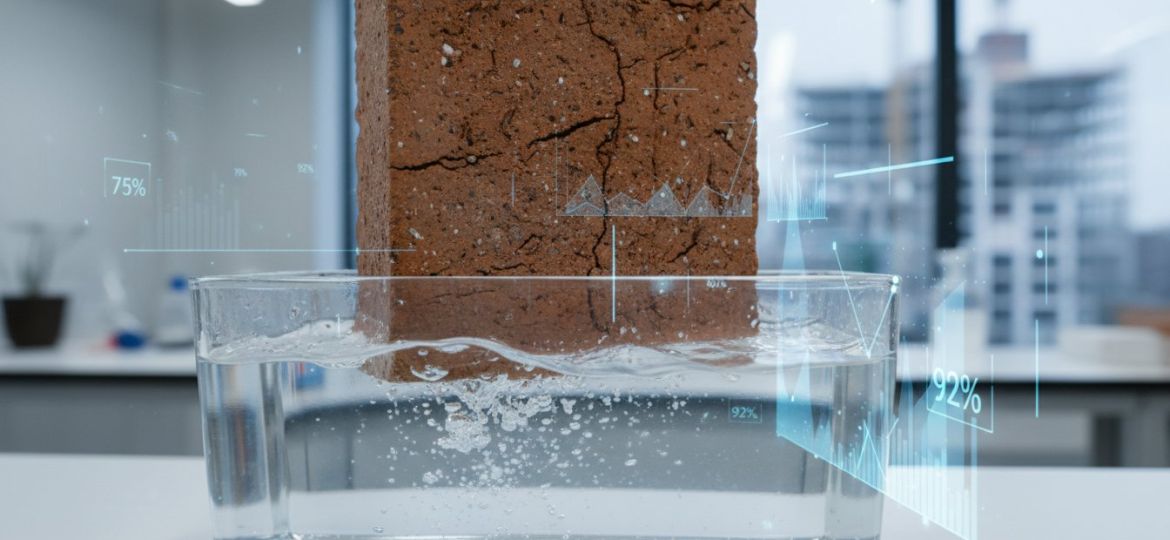
Could a 0.5% variance in porosity be the difference between a century-long facade and a structural failure within five years? You’re likely aware that matching the right material to the British climate is a high-stakes decision. It’s frustrating when the complexity of UKAS requirements and British Standards feels like an obstacle to your project’s timeline. You need certainty that your materials won’t succumb to freeze-thaw damage, which is why a precise water absorption test for bricks is non-negotiable for site safety.
We’ve designed this guide to help you master these technical requirements, ensuring every batch meets the rigorous durability standards required for UK-wide construction in 2026. By following these benchmarks, you’ll secure the clear lab reports necessary for insurance and warranty providers. We’ll examine the specific nuances of BS EN 772-7 and BS EN 772-21 to give you total confidence in your material specifications and full compliance with UK Building Regulations.
Key Takeaways
- Understand why moisture resistance is a critical factor for structural durability and how UK-wide weather conditions dictate masonry performance requirements.
- Navigate the regulatory transition from BS 3921 to current harmonised standards, including the specific applications of BS EN 772-7 for clay masonry units.
- Master the technical distinctions between cold water immersion and 5-hour boiling to select the appropriate water absorption test for bricks for your specific project.
- Learn how to accurately interpret laboratory certificates of analysis and validate test results against manufacturer-declared values and British Standard thresholds.
- Identify how UKAS-accredited laboratory services and nationwide sample collection can mitigate structural risk and ensure your project meets all UK compliance benchmarks.
Understanding the Importance of Water Absorption Testing for Bricks in the UK
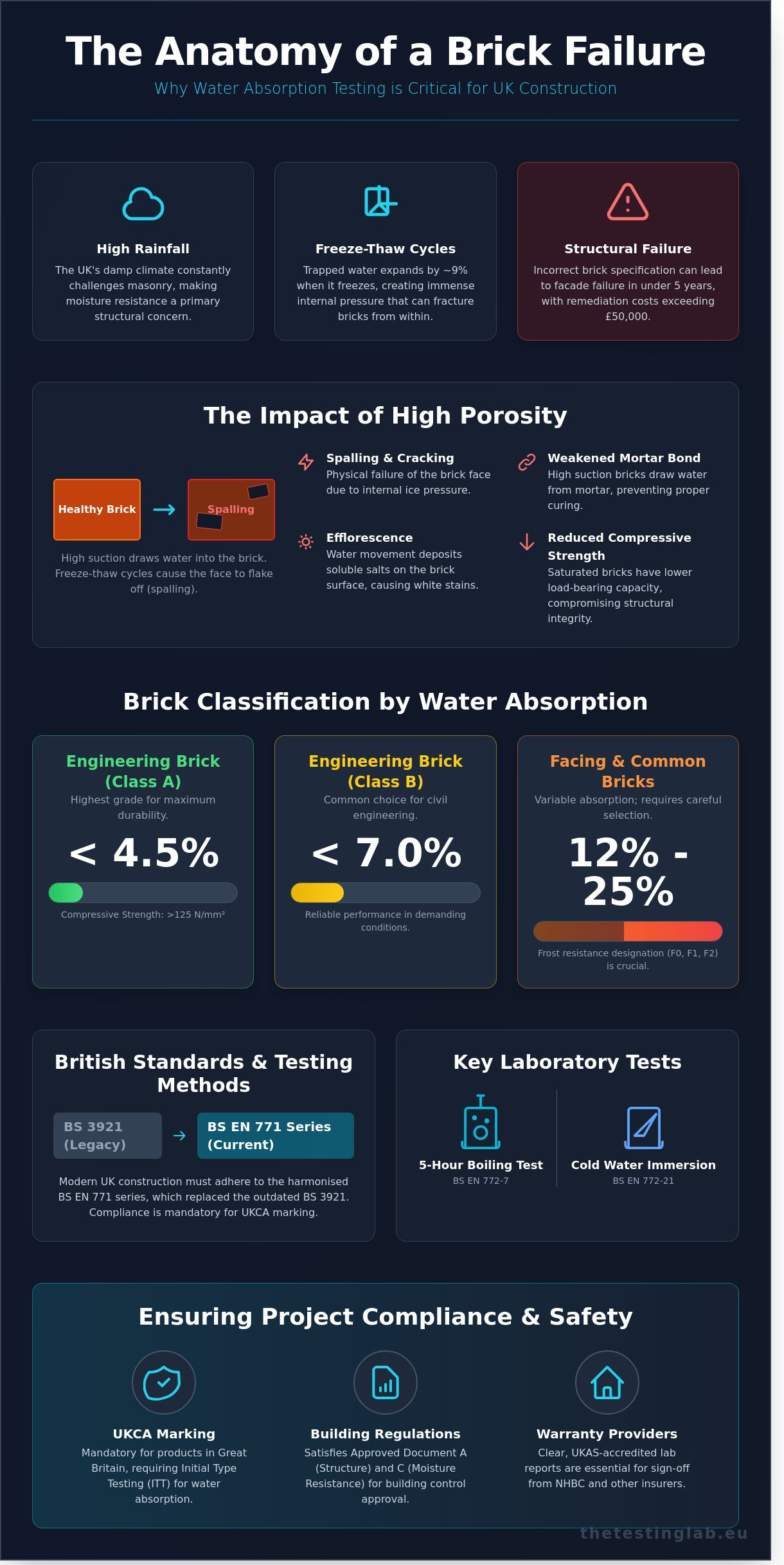
Water absorption measures a brick’s porous structure and its capacity to intake moisture. In UK-wide construction, this metric is a primary structural concern because of the country’s high annual rainfall and frequent temperature fluctuations. A water absorption test for bricks determines how much liquid a specimen absorbs when immersed, expressed as a percentage of its dry mass. This data is critical. High absorption rates often correlate with lower frost resistance and reduced long-term durability of the building envelope. When bricks take in excessive water, they become susceptible to efflorescence, internal dampness, and a noticeable decline in compressive strength. Engineering teams rely on these figures to predict how a facade will age over a 60-year design life.
The Impact of Porosity on Structural Integrity
Capillary action varies significantly between different Clay brick types used across the UK. If a brick’s suction rate is too high, it can aggressively draw water from the mortar during the curing process. This prevents the mortar from hydrating correctly, which weakens the structural bond and creates micro-cracks. In UK-wide projects, this often leads to spalling, where the brick face flakes off during freeze-thaw cycles. Water expands by roughly 9% when it freezes; if that expansion happens inside a highly porous brick, the internal pressure causes physical failure. Choosing a brick with the wrong porosity profile for a specific exposure zone can lead to structural remediation costs exceeding £50,000 for even modest residential blocks.
Regulatory Driving Forces: Building Control and Warranty Providers
Compliance isn’t optional. Developers must meet the strict requirements of Approved Document A for structure and Approved Document C for resistance to moisture. These UK-wide regulations ensure that masonry remains stable and dry throughout its lifespan. National House Building Council (NHBC) standards and other major warranty providers won’t sign off on a project without accredited material test data. They require proof that the chosen materials can withstand local exposure levels. Much like the necessity for UKAS accredited asbestos testing during site preparation and safety audits, a rigorous water absorption test for bricks provides the technical certainty needed to mitigate risk. Our laboratory approach ensures that every data point satisfies building control officers and protects the developer’s professional indemnity.
British Standards and Regulatory Frameworks for Masonry Testing
The regulatory landscape for masonry testing in the UK relies on BS EN 772-7. This specific standard outlines the boiling water method for determining the water absorption of clay masonry damp proof course (DPC) units. It forms a vital part of the BS EN 771 series, which replaced the legacy BS 3921 standard in 2005. While some older specifications still reference BS 3921, modern UK-wide construction projects must comply with these harmonised European standards to meet current Building Regulations.
Legal compliance hinges on the UKCA marking system, which became the mandatory requirement for products placed on the market in Great Britain after the post-Brexit transition period. A critical stage of this process is Initial Type Testing (ITT). Manufacturers must conduct a water absorption test for bricks to verify the performance data declared in their Declaration of Performance (DoP). At The Testing Lab PLC, we help manufacturers and developers navigate these legal hurdles by providing precise data that aligns with the Construction Products Regulation (CPR).
Classification of Bricks by Absorption Performance
Bricks are categorised based on their intended use and their ability to resist moisture penetration. The limits are strictly defined to ensure structural integrity in damp environments:
- Engineering Bricks Class A: These are the highest grade units, requiring a water absorption limit of less than 4.5% and a compressive strength greater than 125 N/mm².
- Engineering Bricks Class B: A more common choice for civil engineering, these units must maintain absorption levels below 7.0%.
- Facing and Common Bricks: These don’t have a singular limit but typically range from 12% to 25% absorption. Their performance is often linked to frost resistance designations (F0, F1, or F2).
- DPC Bricks: These units face the most rigorous standards. Under BS EN 772-7, they must demonstrate extremely low suction to prevent rising damp at the base of a structure.
UKAS Accreditation: Why It Is Non-Negotiable
Choosing between “in-house” testing and a UKAS-accredited laboratory is a matter of legal and financial risk management. UKAS ISO 17025 accreditation confirms that a laboratory operates with technical competence and produces valid results. This standard requires that all equipment, such as ventilated drying ovens and analytical balances, is calibrated to traceable national standards. For instance, balances must provide precision to 0.1g, and ovens must maintain a constant temperature of 105°C ± 5°C to ensure every water absorption test for bricks is repeatable and accurate.
Without this accreditation, test results may be challenged in structural failure investigations or insurance claims. You can find detailed insights on these quality benchmarks in our Definitive Guide to UKAS Accredited Laboratories. If you’re managing a large-scale development and need to verify material compliance, you can consult our specialist team to ensure your masonry meets all current UK legislative requirements.
Laboratory Methodology: Cold Water Immersion vs. 5-Hour Boiling Tests
The 24-hour cold water immersion test, governed by BS EN 772-21, serves as the primary benchmark for standard masonry units. This method measures the water a brick absorbs under ambient conditions, reflecting its performance in typical UK weather. For projects requiring rapid results or deeper analysis of pore structures, labs employ the 5-hour boiling water test. This accelerated procedure forces water into smaller capillaries that cold water cannot reach, providing a “boiled absorption” value that represents near-total saturation.
Specialist engineering data often requires the vacuum saturation method. This technique removes air from the brick’s internal structure before immersion, achieving the absolute maximum water absorption capacity possible. By comparing cold absorption (C) to boiled absorption (B), we calculate the C/B ratio, also known as the Saturation Coefficient. A ratio below 0.88 suggests the brick has enough unfilled pore space to accommodate expanding ice. This is a critical indicator of frost resistance for UK-wide construction in exposed environments.
The Step-by-Step Lab Procedure
Precision begins with specimen selection. We pull representative samples from the UK-wide delivery lot to ensure the data reflects the entire batch. These specimens undergo oven drying at a controlled 105°C. We don’t stop until they reach a constant mass, defined as a weight change of less than 0.1% between two weighings 24 hours apart. This ensures all baseline moisture is gone. Once cooled, we submerge the bricks in water for the specified duration. The final water absorption test for bricks calculation uses the formula (M2 – M1) / M1 x 100, where M2 is the saturated mass and M1 is the dry mass.
Equipment Calibration and Precision
Accurate results depend on strictly calibrated hardware. Our laboratory uses high-precision balances accurate to 0.1% of the sample mass. Ventilated ovens are mandatory to maintain a uniform 105°C environment, preventing cool spots that could skew the initial dry weight. For cold immersion, we maintain water bath temperatures between 15°C and 20°C as required by British Standards. Even a 5-degree variance can alter the viscosity of water enough to impact the absorption rate; therefore, we monitor these levels constantly to guarantee compliance. This rigorous approach to the water absorption test for bricks ensures that every data point we provide is legally defensible and technically sound.
Interpreting Results: Acceptance Criteria and Structural Implications
When you receive a laboratory certificate of analysis, look beyond the raw percentages. A professional report compares the test data against the manufacturer’s declared values and the specific requirements of BS EN 771-1. If your water absorption test for bricks reveals a mean value significantly higher than the declared limit, the batch is technically non-compliant. You’ll need to evaluate the structural impact immediately, as high absorption often signals lower density and reduced resistance to environmental stress.
The “Saturation Coefficient” (or C/B ratio) is a vital metric for UK-wide construction projects. It calculates the ratio between water absorbed during a 24-hour cold soak and a 5-hour boil. A ratio exceeding 0.88 suggests the brick’s internal pore structure is almost entirely filled with water, leaving no “expansion room” for ice. In the British climate, this leads to rapid frost damage, causing the brick face to spall or “blow” within just a few freeze-thaw cycles.
If a batch fails to meet the specified limits, don’t proceed with the build. Quarantine the pallets and increase the sampling frequency to determine if the issue is limited to a single kiln run. It’s often necessary to cross-reference these results with compressive strength data to see if the masonry still meets the structural design’s safety factors.
Acceptance Criteria for Common UK Brick Types
UK standards set strict benchmarks for engineering masonry. Engineering Class A bricks must maintain a maximum water absorption of 4.5%, while Engineering Class B units are capped at 7%. These units are vital for damp-proof courses and manholes where moisture ingress must be minimal. Bricks meeting these low absorption thresholds typically deliver high compressive strength, often exceeding 125 N/mm² for Class A. For precise verification of these metrics, it’s best to partner with a UKAS-accredited Construction Material Testing Laboratory.
When to Order Specialist Testing
Standard testing is usually sufficient for new batches, but investigating existing structures requires a deeper dive. If you’re diagnosing rising damp or unexpected rain penetration, a water absorption test for bricks can confirm if the masonry’s protective qualities have degraded. In complex cases, we use XRD analysis to identify chemical impurities or mineralogical changes that increase porosity. When redeveloping brownfield sites, it’s also practical to integrate these structural tests with environmental safety checks, such as identifying asbestos in soils, to ensure a comprehensive site assessment.
UKAS Accredited Brick Testing Services Across the UK
The Testing Lab PLC serves as a critical technical partner for the UK construction sector, delivering high-precision masonry analysis that meets the rigorous standards of BS EN 772-1. Our water absorption test for bricks provides the empirical data necessary to verify material durability and frost resistance before a single brick is laid. We operate a UK-wide logistics network, ensuring that samples collected from sites in London, Manchester, or Edinburgh reach our laboratory facilities within 24 hours. This rapid turnaround prevents project delays while maintaining the scientific integrity required for UKAS accreditation.
Independence is the cornerstone of our operations. Unlike internal quality control teams, our laboratory provides unbiased, third-party reports that satisfy the stringent requirements of UK insurers and building control officers. When legal disputes arise regarding material failure or non-compliance with the Building Regulations 2010, our data stands as the definitive record. We don’t just provide numbers; we offer a robust defence of your project’s structural integrity. Our engineers treat every sample with a laboratory mindset, ensuring that environmental variables are controlled and results are repeatable.
Partnering with The Testing Lab PLC
We provide expert consultancy for complex masonry failures, helping developers identify the root cause of issues like efflorescence or spalling. Our team assists in dispute resolution by providing evidence-based reports that often prevent costly litigation. We offer transparent pricing structures tailored to the specific needs of UK-wide developers, ensuring you only pay for the precision you require. You can contact our team for a bespoke quote for material testing to see how we can support your next project with clear, actionable reporting.
Comprehensive Compliance Solutions
Adhering to the technical requirements of BS EN 772-1 and current UK Building Regulations is essential for preventing long-term moisture damage in new developments. Since 2002, our team has helped developers navigate these standards by providing precise data that eliminates guesswork. A professional water absorption test for bricks ensures your materials can withstand British weather conditions while meeting the strict criteria set by structural insurers. Choosing the right methodology, such as the 5-hour boiling test, provides the empirical evidence needed for total compliance.
The Testing Lab operates a fully UKAS accredited laboratory, offering the technical magistery required for complex masonry projects. We provide UK-wide sample collection services, ensuring that your quality assurance process remains seamless and efficient regardless of your site’s location. We’ve built our reputation on engineering precision and transparent reporting, acting as a strategic partner rather than just a service provider. You’ll find that our independent consultancy approach takes the weight of compliance off your shoulders.
Request a Quote for UKAS Accredited Brick Testing
We’re ready to help you secure the future of your project with data you can trust.
Frequently Asked Questions
What is the standard water absorption for a good quality brick in the UK?
A high-quality UK brick’s water absorption depends entirely on its intended application, with Engineering Class A bricks required to have a rate below 4.5%. Facing bricks typically fall between 12% and 25% depending on the clay type, while Engineering Class B bricks must remain under 7% according to BS EN 771-1. These specific figures ensure the material performs correctly under the environmental stresses found UK wide.
How many bricks are needed for a representative water absorption test?
You need 10 individual bricks to conduct a representative water absorption test for bricks as specified in British Standard BS EN 772-7. This sample size is the industry standard across the UK. It allows technicians to calculate a reliable mean average while identifying any outliers in the batch. Testing fewer than 10 units risks inaccurate data that won’t meet strict UK building compliance requirements or warranty standards.
Can I perform a water absorption test on-site without a laboratory?
You can’t perform a valid water absorption test on-site because the process requires controlled laboratory conditions, including ventilated ovens and precision scales. The methodology involves drying bricks at 105°C until they reach a constant mass before immersion in a temperature-controlled water bath. Field tests lack the thermal precision and measurement accuracy needed for UKAS-accredited results or legal certification required by local authorities.
Is there a legal difference between Class A and Class B engineering bricks?
The legal distinction between Class A and Class B engineering bricks is defined by BS EN 771-1 based on compressive strength and water porosity. Class A units must exceed 125 N/mm² compressive strength and stay below a 4.5% absorption rate. Class B bricks require a minimum 75 N/mm² strength and a maximum 7% absorption rate. Choosing the wrong class for underground work can lead to rapid structural degradation.
How long does a UKAS-accredited water absorption test take to complete?
A standard UKAS-accredited water absorption test typically takes 48 to 72 hours to complete in a professional laboratory. This timeframe includes the initial 24-hour drying period at 105°C to remove all residual moisture and the subsequent 24-hour immersion in water at 20°C. Precise timing is vital to ensure the brick has reached full saturation before the final weighing occurs to calculate the percentage mass increase.
Does water absorption affect the frost resistance of a brick?
High water absorption often reduces a brick’s frost resistance because trapped moisture expands by roughly 9% when it freezes, which causes the brick face to spall. Bricks with absorption rates above 12% are generally more susceptible to damage in the UK’s F2 rating category. However, the internal pore structure also dictates how much pressure the material can withstand during harsh winter months without cracking or crumbling.
Why do Building Control officers ask for water absorption test results?
Building Control officers request these results to verify compliance with Approved Document C of the UK Building Regulations, which governs moisture resistance. They use the data to confirm that the specified materials are durable enough for the specific exposure zone of your project. Providing a certified water absorption test for bricks prevents future legal disputes regarding damp proofing or structural integrity during the final inspection process.
What happens if the bricks I bought exceed the manufacturer’s stated absorption rate?
If your bricks exceed the manufacturer’s stated absorption rate, you should halt installation immediately and issue a formal query to the supplier. This discrepancy suggests the batch doesn’t meet the technical specification or the mandatory requirements of BS EN 771-1. Using non-compliant bricks can void your structural warranty and lead to expensive remedial work if the masonry fails to manage water ingress correctly in the future.