
Could a single overlooked contaminant on your 2026 project site lead to a £45,000 budget blowout before the first brick is laid? You’ve likely felt the pressure of managing ground risk while facing conflicting advice on BS EN versus legacy standards. It’s a common frustration; unexpected ground conditions remain the leading cause of project delays in the UK, often pushing timelines back by 12 weeks or more. Professional soil analysis for construction isn’t just a box to tick for planning approval. It’s your primary defence against foundation failure and spiralling remediation costs.
We’ll help you master the complexities of geotechnical and chemical testing to ensure your next development remains both structurally sound and regulatory compliant. You’ll learn how to navigate UKAS-accredited testing protocols that eliminate guesswork and reduce the risk of laboratory delays. This guide provides a clear, logical roadmap through the site investigation process, from initial sampling to final reporting, so you can secure planning consent without the usual friction.
Key Takeaways
- Understand why surface-level inspections fail to meet 2026 building standards and how scientific ground evaluation secures your foundation’s future.
- Learn how to balance geotechnical behaviour with chemical composition to ensure your site investigation meets all UK planning requirements.
- Discover the end-to-end process of professional soil analysis for construction, from representative site sampling to high-precision laboratory results.
- Navigate the complexities of BS EN ISO 17892 standards and see why UKAS accreditation is the non-negotiable gold standard for regulatory compliance.
- Identify how a strategic testing partnership can mitigate risks like asbestos contamination while streamlining your project’s path to structural integrity.
What is Soil Analysis for Construction and Why is it Essential?
Soil analysis for construction is the rigorous scientific assessment of a site’s subsurface conditions before any foundation work begins. It isn’t just a box-ticking exercise; it’s a critical engineering phase that informs the entire structural design. A Geotechnical investigation provides the data needed to understand how the ground will react under the weight of a new building. By 2026, UK building standards will demand even tighter tolerances for structural longevity and carbon efficiency. Relying on a quick surface inspection is no longer viable. Visual checks can’t detect the deep-seated clay seams or hidden peat pockets common in areas across South Yorkshire.
Our methodology involves a two-pronged approach. We first examine the physical engineering properties, such as shear strength and plasticity, to ensure the ground won’t shift. We then analyse the chemical composition to identify aggressive elements that could degrade building materials over time. This dual-track method ensures the ground can support the load and won’t corrode the very foundations meant to stabilise it. Soil analysis for construction acts as the primary safeguard against subsidence, which remains a leading cause of domestic property insurance claims in the UK.
The Primary Objectives of Site Investigation
The main goal is determining the bearing capacity of the soil, usually measured in kilonewtons per square metre (kN/m²). This figure dictates whether you need standard strip foundations or more expensive piled solutions. We also identify groundwater levels, as hitting a high water table at 1.5 metres deep can instantly derail an excavation timeline. Finally, we conduct sulphate testing. High sulphate levels in the soil can lead to “concrete cancer,” where the chemical reaction causes buried concrete to expand and crack, compromising the building’s base within a few years.
Consequences of Inadequate Soil Testing
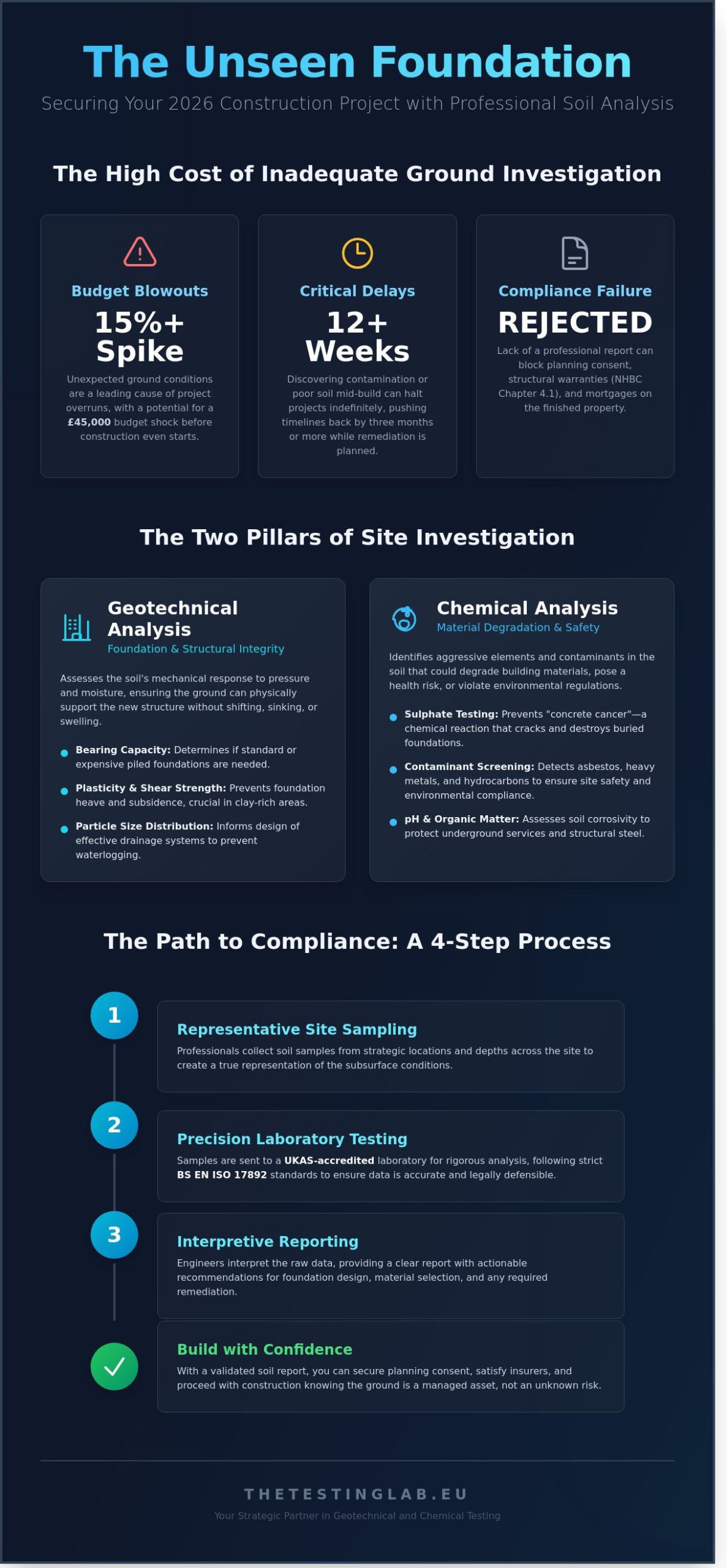
The financial impact of “unforeseen ground conditions” is the most common reason for project overruns. Data from recent UK infrastructure reports shows that ground-related issues cause budget spikes of 15% or more on average. Beyond the money, there are strict legal ramifications. If you discover contamination mid-build without a prior desktop study, the Environmental Protection Act 1990 can halt your project indefinitely for remediation. Most modern insurance providers and the NHBC now require validated soil data under Chapter 4.1 of their standards. Without a professional report, securing a structural warranty or a mortgage on the finished property becomes nearly impossible.
Professional testing removes the guesswork from the equation. It transforms the ground from an unknown variable into a manageable engineering component. By identifying risks like shrink-swell clay or historic fill material early, we allow developers to adjust their designs before a single shovel hits the earth. This proactive stance is what separates a successful, high-quality build from a project plagued by delays and structural instability.
Geotechnical vs. Chemical Analysis: The Two Pillars of Site Investigation
A robust soil analysis for construction doesn’t just tick a box for local authorities; it provides the blueprint for a safe and durable build. You can’t separate the physical behaviour of the ground from its chemical makeup. A comprehensive report must bridge these two disciplines to secure planning approval and ensure long-term structural viability. By adhering to standardised testing protocols, developers ensure their data is valid across the UK, which reduces the risk of costly project delays. New industry standards, specifically the 2026 safety requirements for Asbestos in Soils, highlight why precision in the laboratory is more critical than ever for modern site safety.
Geotechnical Testing: Foundation and Structural Integrity
This analysis focuses on the soil’s mechanical response to pressure, moisture, and environmental changes. In the Doncaster region, where clay-rich deposits are common, measuring the Plasticity Index (PI) is essential. High PI values indicate soil that’s prone to significant volume changes, which often leads to foundation heave or subsidence. We also conduct Particle Size Distribution (PSD) tests to determine how water moves through the strata. This data is vital for designing effective drainage systems and preventing waterlogged sites. For any load-bearing structure, assessing Shear Strength and Compaction ensures the ground won’t deform under the weight of the new building. It’s about turning raw earth into a predictable, reliable engineering material.
Chemical Analysis: Environmental Safety and Waste Classification
Chemical testing investigates what’s hidden within the soil matrix that could impact human health or the environment. We screen for heavy metals like lead or arsenic and various hydrocarbons that might linger from previous industrial land use. Following the UK land contamination technical guidance is the only way to guarantee the site meets modern safety thresholds and risk-based planning requirements.
If your project involves removing surplus earth, Waste Acceptance Criteria (WAC) testing is a legal necessity. It determines whether soil is inert, non-hazardous, or hazardous. Misclassifying soil can be a major financial mistake, as hazardous disposal fees can exceed £150 per tonne, compared to much lower rates for inert waste. We also prioritise pH and sulphate analysis. Because acidic or sulphate-rich ground can degrade concrete foundations in as little as 15 years, this step is a fundamental part of a professional site quality assurance programme. Identifying these aggressive chemical environments early prevents the premature failure of subterranean structures and ensures the building’s skeletal integrity remains intact for decades.
A complete soil analysis for construction serves as a risk management tool. It balances the physical requirements of the structural engineer with the environmental obligations of the developer. When these two pillars are investigated with scientific rigour, the resulting report provides a clear, actionable roadmap for the entire construction team. This dual approach doesn’t just satisfy building control; it protects the financial and physical future of the development by eliminating the “unknowns” that often hide beneath the surface.
While a robust soil analysis manages risks below the ground, protecting the building’s long-term structural health also involves managing the building envelope above ground. Issues like moisture ingress and poorly maintained wall cavities can compromise a structure over time. Specialist contractors, such as Cav Clear Ltd, focus on damp proofing and cavity wall maintenance to address these critical post-construction risks.
The Soil Testing Process: From Site Sampling to Laboratory Results
Before any technical investigation begins, securing the site is a fundamental health and safety requirement. Establishing a secure perimeter with temporary fencing is standard practice to control access and manage site logistics. For developers and contractors planning this phase, online suppliers like Romford Fencing Ltd offer a convenient source for the necessary trade materials.
Before ground is broken, many site investigations now begin with an aerial survey to map the terrain and identify potential hazards or access points. High-resolution imagery from professional drone filming services UK can provide invaluable context for planning the locations of trial pits and boreholes, ensuring the ground-level investigation is as efficient and targeted as possible.
Precision begins the moment a spade or drilling rig breaks the surface. In Doncaster, where ground conditions shift rapidly from Sherwood Sandstone to heavy alluvial clays near the River Don, a single 1kg sample often represents 500 tonnes of earth. We don’t just collect dirt; we capture a snapshot of geological history. This data is the foundation of any soil analysis for construction, and its accuracy depends entirely on representative sampling. If a technician collects samples from only one corner of a 2-hectare site, the resulting data is skewed, potentially leading to foundation designs that are either dangerously insufficient or wastefully over-engineered.
Once extracted, every sample enters a rigorous “chain of custody” protocol. This isn’t merely a bureaucratic exercise; it’s a legal requirement for UKAS-accredited results. This system tracks the sample’s journey from the GPS-logged extraction point to our climate-controlled Doncaster facility. It ensures that the soil tested in the lab is exactly what was pulled from the ground, without tampering or environmental degradation. Our lab technicians act as guardians of this integrity, rejecting any sample that shows signs of moisture loss or container damage. This level of detail is a cornerstone of a modern UK site investigation, where transparent data trails protect developers from future litigation or insurance disputes.
Managing the logistics for a site investigation team is also a crucial part of the process. For projects in congested urban environments, coordinating travel for engineers and their equipment requires reliable transport solutions. In the capital, for instance, many firms rely on specialist services like EC Minibus to ensure technical teams arrive on-site together, minimizing delays before the critical sampling work begins.
On-Site Sample Collection Techniques
We choose collection methods based on your project’s specific load requirements. Trial pitting is the standard for 85% of residential extensions in South Yorkshire. It involves excavating pits up to 4 metres deep to visually inspect soil strata. For larger commercial structures or high-rise developments, we employ borehole sampling. This reaches depths of 15 to 30 metres using window sampling or rotary drilling rigs. To prevent cross-contamination, we clean all stainless steel tools with deionised water between different strata levels. Before transport, every container must meet this five-point checklist:
- Unique Site ID: Cross-referenced with the site plan.
- Accurate Depth: Recorded in metres below ground level (mbgl).
- Sample Type: Clear marking of “Disturbed” or “Undisturbed” (U100) status.
- Timestamp: Date and time of extraction to monitor volatile compound decay.
- Environmental Seal: Airtight lids to maintain natural moisture content.
Laboratory Processing and Analysis
When samples arrive at our facility, they undergo a controlled preparation phase. We dry the soil in specialised ovens at temperatures between 30 and 40 degrees Celsius to prevent the loss of volatile organic compounds. Once dry, the material is crushed and passed through various sieve sizes, ranging from 63 microns to 20mm, to determine particle size distribution. This physical profiling is essential for soil analysis for construction because it dictates how the ground will settle under the weight of a new building.
For chemical profiling, we utilise advanced Inductively Coupled Plasma Optical Emission Spectrometry (ICP-OES). This equipment detects heavy metals like Lead, Arsenic, and Cadmium at parts-per-billion sensitivity. In Doncaster’s former industrial zones, this precision is vital for meeting Environmental Agency safety standards. Our standard turnaround for a full suite of tests is 7 to 10 working days. However, for fast-track projects or urgent planning deadlines, we offer a 48-hour express service that delivers preliminary results without compromising on the scientific rigour your project demands.
Navigating UK Standards and Environmental Compliance in 2026
Engineering precision in Doncaster’s construction sector requires strict adherence to the BS EN ISO 17892 series. These standards govern every technical aspect of geotechnical investigation, from initial sampling to the final determination of shear strength and compressibility. When you commission soil analysis for construction, you aren’t just buying data; you’re securing a legal safeguard. In the 2026 regulatory environment, the British Standards Institution (BSI) has tightened requirements for laboratory reporting to ensure that foundation designs account for the increasingly volatile groundwater levels seen across South Yorkshire.
Choosing a non-accredited laboratory is a high-risk gamble that often results in project delays or total insurance failure. While cheaper labs might offer lower upfront costs, they lack the technical rigour required by professional indemnity insurers. If a foundation fails or unexpected contamination is discovered mid-build, a report from a non-accredited source carries zero weight in a UK court. This leads to “re-testing” costs that typically exceed the original “saving” by 400% or more. Our engineering-led approach treats testing as a critical risk-mitigation tool rather than a tick-box exercise.
Understanding UKAS Accreditation and Legal Liability
The United Kingdom Accreditation Service (UKAS) is the sole national accreditation body for the UK. For developers, a UKAS-accredited certificate (ISO 17025) serves as the definitive proof of technical competence. These reports protect you during land disputes or site sales by providing a “gold standard” audit trail that is universally accepted by lenders and local authorities. Without this accreditation, your data is merely an opinion; with it, it’s a legally defensible fact. It ensures that every balance, oven, and testing rig used in the process is calibrated to national standards, eliminating the margin for error that leads to structural instability.
Planning Conditions and Environmental Agency Requirements
Most Doncaster planning approvals include “Pre-commencement” conditions that prohibit any physical work until the Local Authority Contaminated Land Officer approves your site investigation. These officers scrutinise reports for compliance with the January 2026 updates to the CL:AIRE Definition of Waste Code of Practice (DoWCoP) Version 3. This update introduces stricter thresholds for material reuse, aiming to reduce the volume of soil sent to landfills like those near the M18 corridor. A robust soil analysis for construction must now explicitly address these reuse criteria to satisfy both the Environment Agency and local planning departments.
Doncaster’s role in the Northern Powerhouse initiative has increased the scrutiny on large-scale developments, particularly those near historical industrial zones or the North Sea Main Line. Local authorities now require specific data on sulphate levels (AS-1 to AS-5) to prevent concrete degradation in new builds. We provide the precise, high-resolution data needed to navigate these complex requirements without the stress of constant revisions or rejected planning applications.
Don’t let compliance hurdles stall your project. Partner with The Testing Lab PLC for UKAS-accredited soil analysis that satisfies every planning condition.
Expert Soil Testing Services: Why The Testing Lab PLC is Your Strategic Partner
Selecting a laboratory shouldn’t feel like a gamble. At The Testing Lab PLC, we’ve built a Doncaster-based centre of excellence that serves as a technical hub for the entire UK and Ireland. We don’t just process samples; we provide the engineering clarity required to move a project from the planning phase to the first pour of concrete. Our approach treats soil analysis for construction as a foundational risk-management tool. By identifying chemical contaminants or physical instabilities early, we’ve helped developers reduce foundation costs by up to 15% through more precise specification.
Our partnership model sets us apart from high-volume, “black box” laboratories. We know that raw data is useless if your site manager can’t interpret the implications for the build schedule. We provide comprehensive reports that translate complex chemical suites and geotechnical indices into actionable insights. Whether it’s explaining how specific sulphate levels affect your choice of AC-2 or AC-3 concrete, or identifying the exact perimeter of an asbestos-impacted zone, our consultants are available to walk you through the findings. We’re an extension of your quality assurance team, not just a third-party vendor.
Speed is a non-negotiable factor in modern development. A delayed soil report can stall a multi-million-pound project before it even starts. We’ve refined our internal workflows to offer some of the most competitive lead times in the industry. Our standard turnaround is five working days, but we offer 24-hour and 48-hour express windows for urgent site investigations. Every sample follows a rigorous chain of custody, ensuring that the precision of our results is never sacrificed for the sake of the clock. We’ve processed over 12,000 samples in the last twelve months, maintaining a 99.2% accuracy rate across all chemical and physical testing protocols.
Integrated Testing Solutions for Modern Construction
Our 15,000 square foot facility in Doncaster allows for total synergy between different testing disciplines. We provide a seamless workflow where soil samples are screened for asbestos, analysed for chemical contaminants, and tested for structural properties under one roof. This integrated approach eliminates the logistical headaches of managing multiple labs. For projects requiring broader quality control, our construction material testing laboratory provides the necessary data on aggregates, concrete, and bitumens to ensure every component of your build meets the required British Standards.
Get Started with Your Site Investigation
Every site presents a unique set of challenges, from the historical industrial footprints of Doncaster to the complex geologies found across the UK. Our expert team is ready to discuss your specific site requirements and help you design a testing programme that satisfies both local authority planning conditions and your own engineering needs. We provide transparent, standardised quotes within 24 hours of your enquiry, ensuring you can budget with total confidence. Don’t leave your ground conditions to chance. Enquire about our UKAS accredited soil analysis today and secure the technical data your project deserves.
Build on Certainty with Accurate Site Data
Success on site begins beneath the surface. Comprehensive soil analysis for construction ensures your project meets the rigorous 2026 UK environmental standards while mitigating structural risks. By integrating geotechnical precision with chemical insight, you’re not just following regulations; you’re protecting your bottom line from ground conditions that can lead to six-figure rectification costs. Accurate data is the only way to avoid these expensive surprises.
The Testing Lab PLC operates as your strategic partner from our ISO 17025 UKAS accredited laboratory in Doncaster. We provide specialist asbestos in soils testing and detailed site investigations across the UK and Ireland. Our team delivers the technical confidence you need to move from sampling to groundworks without hesitation. We’ve refined our laboratory processes to ensure every result is backed by engineering-grade accuracy and transparent reporting.
Don’t leave your site’s safety to chance. Contact our technical team today to secure the data that drives successful builds.
Request a UKAS Accredited Soil Analysis Quote
We’re ready to help you ground your next project in facts.
Once the structural work is complete, attention turns to the interior finishing. For developers finalising a build, it’s important to consider details like window treatments. You can explore Made-to-Measure Blinds for a range of professional options that complete the space.
Once the project is grounded in facts, the final phase often involves preparing the site for handover. This can include a thorough deep clean of all interiors, and for specialised services like post-construction carpet cleaning, you can learn more about Commercial Carpet Cleaners Stockport.
Similarly, for residential builds, attention often turns to outdoor living spaces that enhance the property’s value. To get ideas for premium garden features, you can explore Kamado BBQ’s, which are a popular choice for modern patios.
After completing the build, attention often turns to landscaping. On sites where the soil analysis has shown limitations for traditional gardening, or for creating innovative indoor green spaces, hydroponics offers a modern solution. For those looking into these systems, you can check out Discount Hydro for specialist equipment.
Frequently Asked Questions
How much does soil analysis for construction typically cost in the UK?
A standard soil analysis for construction in the UK typically costs between £800 and £2,500 for a small residential development. This price includes the initial site visit, borehole drilling, and the final laboratory report. If your project requires deeper investigation or specific chemical testing for heavy metals, costs can rise to £4,000 or more. We recommend budgeting at least 1% of your total groundwork costs for professional site investigation.
How long does it take to get soil test results back from the lab?
You’ll usually receive your soil test results within 10 to 14 working days after the samples arrive at our laboratory. While basic chemical screenings might take 5 days, a full geotechnical report requires time for engineering analysis and classification. We provide an initial data summary within 48 hours for urgent projects, but the final certified document takes longer to ensure every technical detail is precise and verified.
Is soil analysis mandatory for small residential extensions?
Soil analysis is mandatory for most small residential extensions to comply with Part A of the Building Regulations. Building Control officers require evidence that the ground can support the new load, especially in areas with clay soil or nearby trees. In 2023, over 85% of local authorities in South Yorkshire requested a professional soil report before approving foundation designs for extensions over 30 square metres.
What is the difference between a WAC test and a standard soil analysis?
A standard soil analysis for construction evaluates the physical and chemical properties of the earth to inform foundation design and site safety. In contrast, a Waste Acceptance Criteria (WAC) test is strictly for determining how soil must be disposed of at a landfill. You can’t use a WAC test for building design because it doesn’t measure load-bearing capacity or geotechnical stability; it only measures leachable contaminants for waste classification.
How many soil samples do I need to take for a typical building plot?
For a typical single-dwelling building plot, you’ll need between 3 and 5 sampling points to get a representative view of the ground conditions. These boreholes are usually drilled to a depth of 2 or 3 metres at the corners of the proposed building footprint. If the site has a history of industrial use, we increase the sampling frequency to one test every 25 square metres to ensure no localised contamination is missed.
Can I collect the soil samples myself, or do I need a professional?
You shouldn’t collect soil samples yourself because lab results are only valid if a qualified engineer follows British Standard 5930. Professional collection ensures samples aren’t contaminated by surface debris or incorrect handling tools. Most UK laboratories won’t accept samples from non-accredited sources; additionally, your professional indemnity insurance won’t cover foundation failures if the initial data comes from a DIY sample.
What happens if my soil analysis report identifies contamination?
If your report identifies contamination, you’ll need a formal remediation strategy to satisfy the local planning authority. This might involve removing the top 600mm of soil or installing a clean cover system in garden areas. In approximately 12% of Doncaster brownfield sites, developers must also install gas membranes to protect the building from ground gases like methane or carbon dioxide found during the initial investigation.
How long is a soil analysis report valid for a planning application?
A soil analysis report is generally considered valid for 3 years, though some lenders and local authorities accept documents up to 6 years old. If site conditions change, such as a flood event or nearby excavation, you’ll need a new assessment regardless of the report’s age. We’ve seen 15% of planning applications delayed because developers relied on outdated reports that didn’t meet current Eurocode 7 standards.