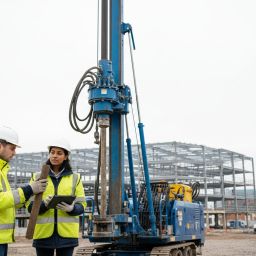


A single overlooked soil strata can inflate foundation costs by more than £50,000 during the first week of excavation. You’re likely aware that the success of any development depends on the precision of the data gathered beneath the surface before a single brick is laid. It’s a common frustration when unforeseen ground conditions lead to massive budget overruns or when laboratory reports fail to meet the 10 day turnaround expected for modern construction schedules. By integrating professional geotechnical site investigation services into your workflow, you transform these geological risks into manageable data points. Our engineering led approach ensures that every UK wide project adheres strictly to BS 5930 and Eurocode 7 standards, providing the technical confidence you need to proceed.
We understand that securing regulatory approval feels like a constant bottleneck, especially when non-compliance with UKAS standards threatens your project timeline. This guide reveals how to obtain a clear, actionable ground report that satisfies local authorities and protects your structural integrity. We’ll examine the precise methodologies used to mitigate environmental risks and explain why a laboratory led strategy is the most efficient path to project success.
Key Takeaways
- Understand how evaluating physical ground properties prevents structural failure and identifies geo-hazards before construction begins on your UK wide projects.
- Learn how professional geotechnical site investigation services use a phased approach to determine the most efficient and cost-effective foundation designs for any site.
- Discover why UKAS-accredited laboratory testing is the critical link in creating legally defensible soil analysis reports that satisfy UK regulatory requirements.
- Identify the essential criteria for selecting a service provider, including the necessity of verified accreditation for both sampling and analysis across the UK.
- Explore how integrating geotechnical data with environmental safety assessments can mitigate long-term risks and ensure total structural integrity.
What are Geotechnical Site Investigation Services?
Professional geotechnical site investigation services represent the scientific evaluation of a site’s subsurface conditions before any structural work begins. This process analyzes the physical and chemical properties of soil, rock, and groundwater to ensure the ground can support the intended loads. A comprehensive Geotechnical investigation provides the raw data required for foundation design, retaining wall specifications, and the identification of potential geo-hazards like sinkholes or slope instability. In a UK wide context, these services aren’t optional; the National Planning Policy Framework (NPPF) 2023 update mandates that developers demonstrate a site is suitable for its new use, taking account of ground conditions.
It’s vital to distinguish between geotechnical and geo-environmental investigations. Geotechnical work focuses on physical mechanics, such as shear strength and compressibility. Geo-environmental investigations assess chemical risks, often involving asbestos in soils or other contaminants. Integrating both ensures a project meets both structural and safety requirements from the outset. By identifying these factors early, developers avoid the 25% increase in foundation costs that typically occurs when ground issues are discovered mid-construction.
The Role of Geotechnical Services in UK Construction
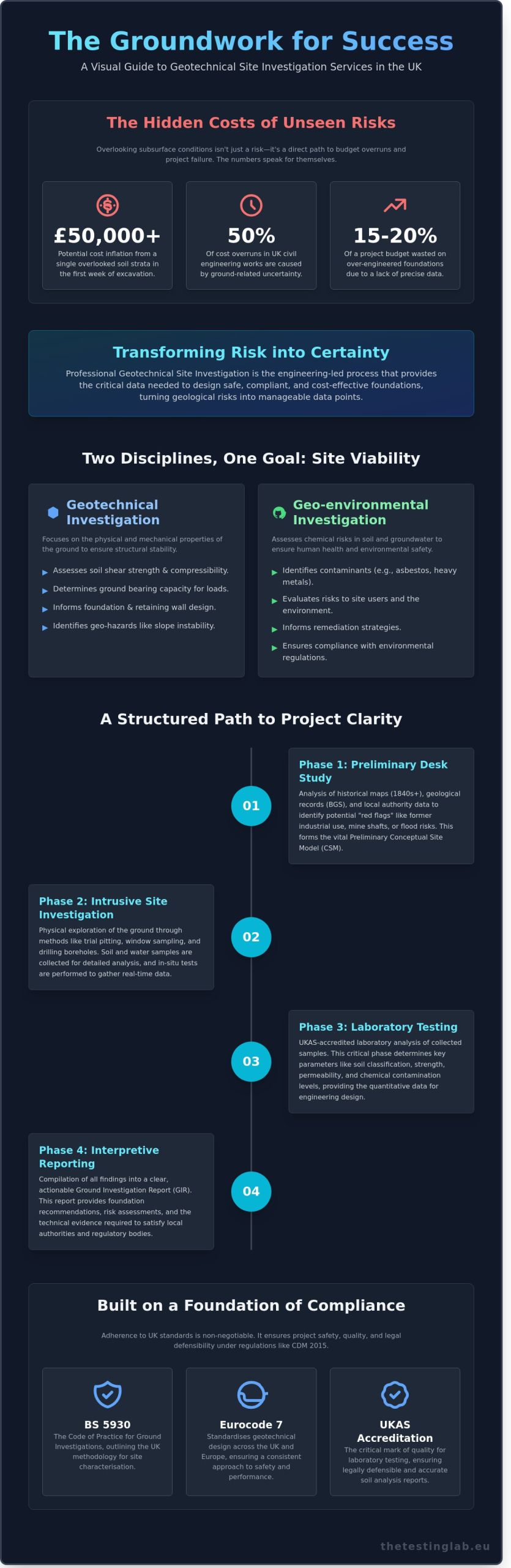
Ground-related uncertainty remains the primary cause of project delays in the UK construction sector, accounting for 50% of cost overruns in civil engineering works. Geotechnical site investigation services mitigate this risk by mapping historical land use issues. This includes identifying 18th-century mining shafts or industrial contamination that could compromise a modern build. By providing precise data, these services allow engineers to design foundations that are neither under-engineered, risking collapse, nor over-engineered, wasting 15% to 20% of the project budget on unnecessary materials.
Key British Standards and Legislation
UK wide projects must adhere to strict regulatory frameworks to ensure safety and quality. The primary standard is BS 5930, the Code of Practice for Ground Investigations, which outlines the methodology for site characterisation. This works alongside Eurocode 7, which standardises geotechnical design across the UK and Europe. Compliance isn’t just about quality; it’s a legal necessity under the Construction (Design and Management) Regulations 2015 (CDM 2015). These regulations place the responsibility on the client to ensure that a thorough investigation is conducted, protecting workers and the public throughout the project lifecycle.
Core Components of a Ground Investigation
Effective geotechnical site investigation services rely on a structured, phased methodology. This approach ensures that every project budget is targeted toward reducing specific geological risks rather than generic testing. By moving from theoretical research to physical sampling, engineers build a robust dataset that dictates the structural viability of UK wide developments. This systematic progression is essential for compliance with BS 5930:2015+A1:2020, the code of practice for ground investigations.
The data gathered during these stages directly informs the selection of foundation types. If the investigation reveals high-strength bedrock at shallow depths, simple strip foundations may suffice. However, if the team identifies deep layers of compressible peat or soft clay, the design must pivot toward piling solutions. Professional standards are maintained by following guidelines from the British Geotechnical Association, which ensures that all data collection meets rigorous UK safety benchmarks. Precision in this phase prevents the 25% cost overruns often seen in projects with inadequate ground data.
Phase 1: Preliminary Desk Studies
This stage involves reviewing historical Ordnance Survey maps dating back to the 1840s and British Geological Survey (BGS) borehole records. We identify “red flags” such as former heavy industrial use, unrecorded mine shafts, or flood risks. This research forms the Preliminary Conceptual Site Model (CSM). The CSM is a vital requirement under UK planning policy; it identifies potential pathways between contaminants and future site users. Identifying a former 19th-century tannery or gasworks early allows for a more targeted intrusive strategy later.
Phase 2: Intrusive Fieldwork and Sampling
Fieldwork brings the CSM to life through the physical recovery of soil and rock. We use window sampling for shallow investigations or cable percussion boring to reach depths exceeding 30 metres. In-situ testing, particularly the Standard Penetration Test (SPT) and vane shear tests, provides immediate data on soil density and shear strength. High-quality logging is critical because a single misclassification of soil plasticity can lead to over-engineered foundations or unexpected structural settlement.
It’s now standard practice to integrate asbestos in soils testing during this initial fieldwork phase. Since roughly 70% of brownfield sites in the UK contain some form of anthropogenic fill, early detection is the only way to prevent stop-work orders during the construction phase. Representative sampling ensures that the laboratory data reflects the actual site conditions rather than isolated anomalies. If you’re preparing a site for development, you can request a technical quote to see how these investigation phases apply to your specific location.
Laboratory Testing and Soil Analysis
Laboratory analysis is the engine room of the entire investigation process. While site technicians observe soil conditions in the field, lab results provide the empirical data needed for structural safety. Professional geotechnical site investigation services rely on this data to turn visual descriptions into precise engineering parameters. Without these numbers, designers risk over-specifying foundations or underestimating ground movement risks. For every UK wide project, we ensure that data is legally defensible through UKAS accreditation. This certification proves that testing methodologies meet ISO 17025 standards, which is a requirement for most local authority planning conditions and insurance warranties across the country.
Physical Soil Testing Methods
Physical tests define the mechanical properties of the ground. We establish Atterberg limits to understand how soil plasticity changes with water content. This is crucial for building on UK clays where shrinkage is a constant threat. Moisture content and particle size distribution (PSD) tests help classify the soil type accurately. For transport infrastructure, compaction testing and California Bearing Ratio (CBR) measurements are essential. These results dictate the thickness of road pavements and hardstanding areas. Triaxial testing provides the shear strength data required to calculate the bearing capacity of deep foundations under high pressure.
Environmental and Chemical Soil Analysis
Chemical analysis ensures that soil is safe for both people and the environment. We help developers manage costs by conducting WAC (Waste Acceptance Criteria) testing for landfill disposal. This process identifies whether waste is inert or hazardous, preventing the massive financial penalties associated with incorrect classification under UK waste regulations. Our teams also screen for heavy metals, hydrocarbons, and organic contaminants that could hinder development. For landscaping phases, BS 3882:2015 topsoil testing is used to verify that soil supports plant growth and meets safety standards. This rigorous approach to geotechnical site investigation services protects the budget and the legal standing of the project from the outset.
- UKAS Accreditation: Ensures all results are compliant with British Standards.
- Waste Classification: Minimises landfill tax through accurate chemical profiling.
- Data Integration: Bridges the gap between field samples and engineering software.
How to Choose a Geotechnical Service Provider in the UK
Selecting a partner for geotechnical site investigation services is a strategic decision that dictates the safety and financial viability of your construction project. You must verify UKAS accreditation for both on-site sampling and laboratory testing. This certification ensures the provider adheres to BS EN ISO 17025 standards, which is the benchmark for technical competence in the UK. Don’t settle for a generalist. Check for a proven track record in your specific sector, whether you’re developing a 150-unit residential estate or a high-load industrial warehouse. Experience in similar ground conditions UK wide allows a provider to anticipate risks before they become expensive delays.
A comprehensive, end-to-end service model is the most effective way to reduce hand-off errors. When the team that performs the drilling also manages the analysis and reporting, data integrity remains intact. A 2023 industry analysis found that projects using fragmented service providers experienced 18% more data discrepancies than those using integrated firms. Evaluate your provider’s reporting speed and the clarity of their technical recommendations. You need actionable engineering data delivered within a 10 to 14 day window, not a vague document that requires further interpretation. High-quality reports should translate complex soil mechanics into clear foundation or remediation strategies.
The Value of Independent Laboratory Analysis
Independent testing eliminates the inherent bias often found in internal consultancy departments. By using a dedicated testing facility, you ensure that results are based purely on empirical data. This model facilitates direct communication with lab technicians, allowing for rapid clarification on specific sample behaviors. It also guarantees a robust chain of custody for every sample collected UK wide. Maintaining this rigorous trail is vital for compliance and for projects requiring specialized asbestos in soils testing to meet environmental safety standards.
Avoiding Common Procurement Pitfalls
The cheapest quote rarely represents the best value. Low-cost bids often omit essential testing phases, leading to expensive “variations” that can inflate the final bill by 30% or more. Using non-accredited labs for contaminated land assessments carries significant legal risk. If your data doesn’t meet the standards of the National Planning Policy Framework (NPPF), your local planning authority may reject your application. Always ensure the proposed scope of work is exhaustive enough to satisfy both your structural engineers and regulatory bodies.
Request a technical quote for your UK wide site investigation today.
Integrated Geotechnical Solutions from The Testing Lab PLC
The Testing Lab PLC operates from a centrally located, UKAS accredited facility in Doncaster. This strategic position allows us to deliver geotechnical site investigation services UK wide, supporting everything from small residential builds to large scale infrastructure projects. We provide the engineering precision required to transform raw ground data into actionable construction intelligence. Our team bridges the gap between physical soil mechanics and environmental safety, ensuring your project complies with the latest UK legislative frameworks and the National Planning Policy Framework (NPPF).
Developers often face unexpected ground risks that stall production. We mitigate this by providing a single point of contact for both geotechnical and chemical analysis. Our engineering excellence ensures that foundation designs are neither under-specified nor unnecessarily costly. We treat every sample with scientific rigor, maintaining a transparent chain of custody from the site to the final report. This laboratory-led approach provides the confidence needed to build on even the most challenging brownfield sites.
Our Specialist Laboratory Services
We provide a comprehensive suite of soil and material testing tailored to BS 1377 and other relevant UK building standards. Our Doncaster facility handles high volumes of samples with 24 to 48 hour turnaround options for critical data points to keep your construction programme on schedule. Beyond standard classification, we offer advanced chemical analysis such as HMRC LOI fines testing to help contractors manage waste costs effectively. This precision allows UK wide developers to classify materials accurately, avoiding the heavy financial penalties associated with misidentified waste streams.
Partnering with The Testing Lab PLC
Choosing us means you aren’t just hiring a contractor; you’re gaining a strategic partner. Our qualified geotechnical specialists offer direct technical support, helping you interpret complex reports long after the testing is complete. We focus on clear communication and logical data presentation. This approach removes the burden of quality assurance from your team, allowing you to focus on delivery. If you’re ready to secure your project’s foundation, you can request a quote for your geotechnical site investigation today to see how our expertise can streamline your UK wide project.
Securing Your Project Foundations with Technical Precision
Successful construction starts beneath the surface. Navigating UK legislation requires more than just a cursory glance at the ground; it demands a rigorous, laboratory-led approach to mitigate risk. By integrating comprehensive soil analysis with specialist asbestos and environmental chemistry testing, you protect your investment from unforeseen geological liabilities. Our geotechnical site investigation services provide the data-driven certainty needed for UK wide developments. Every structural decision should rest on a foundation of scientific fact.
The Testing Lab PLC operates as an independent UK-based Public Limited Company. We act as your strategic partner in quality assurance. We hold UKAS Accreditation (No. 4022), which guarantees our testing protocols meet the highest national standards for accuracy. Don’t leave your site’s safety to chance. Leverage our specialist expertise to streamline your planning process and satisfy regulatory requirements efficiently.
Contact The Testing Lab PLC for UK Wide Geotechnical Services and let our team handle the complexities of ground investigation for you. We’re ready to help you build with total confidence.
Frequently Asked Questions
What is a geotechnical site investigation and why do I need one?
A geotechnical site investigation is a scientific assessment of the physical properties of soil and rock to determine a land’s suitability for construction. You need one to comply with UK Building Regulations Part C and Eurocode 7 standards. These investigations identify risks like sinkholes or shrinkable clays before you build. Without this data, foundation designs often fail, leading to 30% higher repair costs later in the project lifecycle.
How much do geotechnical site investigation services cost in the UK?
Professional geotechnical site investigation services for UK wide projects typically range from £1,500 for a small residential plot to over £10,000 for complex industrial sites. Costs depend on the drilling depth and the number of lab tests required. A standard Phase 1 desk study usually starts at £500; however, physical intrusive works represent 0.2% to 1.5% of the total construction budget. We provide clear quotes to ensure your project stays on track.
How long does a typical ground investigation take to complete?
A standard investigation takes 4 to 6 weeks from the initial desk study to the final report delivery. Site works usually require 1 to 3 days of drilling or trial pitting. Laboratory analysis of samples takes 10 working days, followed by 7 days for engineering analysis. We ensure every timeline remains transparent. This helps you maintain your project schedule without facing unexpected delays during the planning phase.
Is a geotechnical report mandatory for residential planning permission?
Yes, a geotechnical report is mandatory for most UK wide residential developments under the National Planning Policy Framework. Local Planning Authorities require these documents to validate that the land is safe and stable for its intended use. In 85% of cases, planning departments won’t discharge pre-commencement conditions until a Phase 1 Desk Study is submitted. This prevents building on unstable or hazardous ground.
What is the difference between a Phase 1 and Phase 2 site investigation?
Phase 1 is a non-intrusive desk study involving historical map reviews and British Geological Survey records. Phase 2 is a physical, intrusive investigation involving boreholes, trial pits, and soil sampling. While Phase 1 identifies potential risks, Phase 2 provides the hard data needed for foundation design. Most UK wide lenders require a Phase 2 report before they’ll release development finance for brownfield sites.
Can you test for asbestos during a geotechnical site investigation?
Yes, we test for asbestos fibers in soil as part of our integrated geotechnical site investigation services. This is crucial for compliance with the Control of Asbestos Regulations 2012 (CAR 2012). Our laboratory technicians identify chrysotile, amosite, and crocidolite at detection limits of 0.001%. Identifying these contaminants early prevents legal liabilities and keeps your workforce safe during the excavation phase of your project.
What happens if my site investigation reveals contaminated soil?
If contamination is found, you must develop a remediation strategy following the Environment Agency’s Land Contamination Risk Management (LCRM) framework. This involves quantifying risks to human health and the environment. Solutions include soil washing, capping, or off-site disposal at licensed facilities. We provide the precise data needed to negotiate with regulators; this often reduces waste disposal costs by 20% through accurate waste classification.
How often should geotechnical data be updated for an existing site?
Geotechnical data is typically considered reliable for 2 to 3 years depending on the site’s environmental changes. Groundwater levels fluctuate annually, and nearby developments can alter soil pressure or drainage patterns. If your report is older than 36 months, UK wide building insurers like the NHBC may require a supplementary investigation. Re-validating data ensures your structural calculations remain accurate for current ground conditions.
While our focus is on providing reliable geotechnical data to minimize project stress, we understand it’s a demanding industry. When it’s time to unwind after a complex job, you can discover modern ways to relax.
How do you manage the stress of high-stakes construction projects?
Managing the stress of high-stakes projects involves mitigating risks on all fronts, not just geological ones. Ensuring the integrity and trustworthiness of key personnel is also a critical component of risk management. While outside the scope of geotechnical services, some industries utilize specialized screening to verify information and build a reliable team. For readers interested in these parallel verification processes, you can learn more about Morgan Polygraph.