

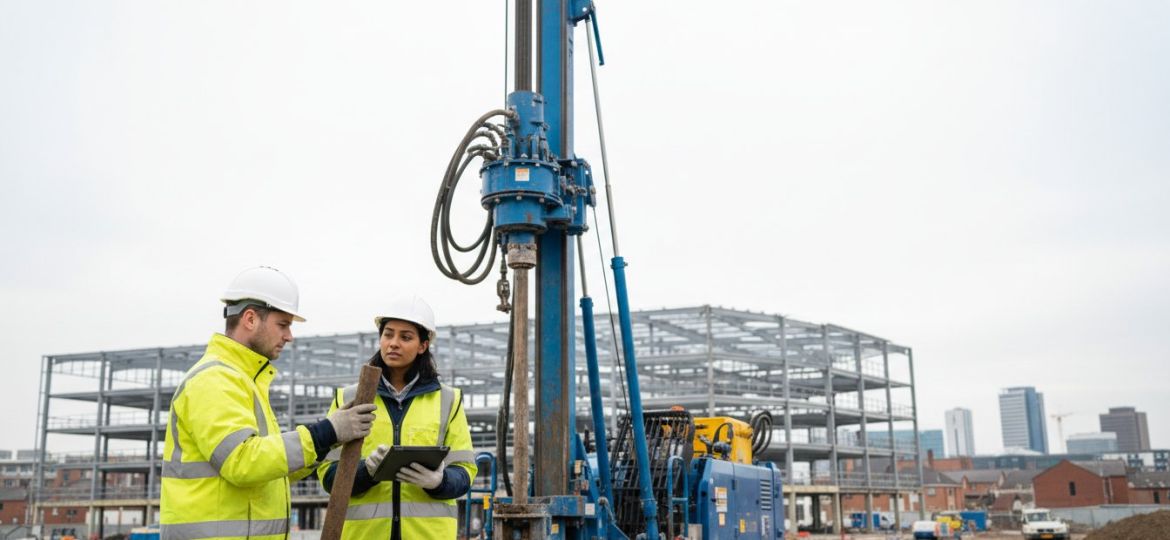
The success of any construction project is built from the ground up-literally. Yet, what lies beneath the surface often represents the single greatest risk to your budget and timeline. Unforeseen ground conditions can lead to spiralling costs, frustrating planning delays, and complex engineering challenges that threaten to derail a project before the first foundation is poured. This is precisely where a methodical and comprehensive geotechnical site investigation becomes your most critical asset. It’s not just a box-ticking exercise for planning permission; it’s the strategic key to mitigating risk and safeguarding your investment.
This ultimate guide is designed to demystify the entire process. We will provide you with a clear, actionable roadmap-from initial desk studies to intrusive ground testing-equipping you to navigate complex technical reports with confidence. You will master the essentials of UK compliance, including Eurocode 7 and BS 5930, transforming subsurface uncertainty into a predictable, well-managed, and secure foundation for your project’s success.
Key Takeaways
- Understand why unexpected ground conditions are a primary cause of project delays and how to mitigate this financial risk from day one.
- Master the systematic 3-phase process, from initial desk studies to intrusive sampling, that underpins every robust ground investigation.
- Discover how a UKAS-accredited geotechnical site investigation delivers the precise soil mechanics data essential for safe foundation design and regulatory approval.
- Learn how to effectively use your site investigation report to discharge critical UK planning conditions and streamline the local authority approval process.
What is Geotechnical Site Investigation and Why is it Critical?
A geotechnical site investigation is a systematic process of evaluating the soil, rock, and groundwater conditions of a site. Its primary goal is to gather precise data to inform the design and construction of foundations, ensuring a structure is safe, stable, and cost-effective. Ignoring this foundational step is a high-stakes gamble; it’s widely cited in the construction industry that unexpected ground conditions contribute to a significant portion of project delays and budget overruns.
The scope of a comprehensive geotechnical investigation serves a dual purpose. On one hand, it assesses the physical properties of the ground-such as its strength and stability-to determine its load-bearing capacity for the proposed structure. On the other, it identifies potential geohazards and environmental risks hidden beneath the surface, from unstable slopes to contaminants left by previous industrial use.
In the UK, this process is not just best practice; it is guided by rigorous standards. Key regulatory drivers like Eurocode 7 (BS EN 1997) for Geotechnical Design and BS 5930 (Code of Practice for Ground Investigations) set the framework, ensuring all investigations are conducted with technical precision and professional diligence.
The Consequences of Skipping Site Investigation
Attempting to build without this critical data can lead to catastrophic and costly outcomes. The primary risks include:
- Structural Failure: Unforeseen issues like subsidence (sinking), heave (swelling), or differential settlement can compromise the integrity of the entire structure.
- Legal and Financial Liability: Proceeding without due diligence can invalidate professional indemnity insurance and expose developers and contractors to significant legal claims.
- Planning Roadblocks: Local authorities almost universally require site investigation data as a condition of planning permission, halting projects before they even begin.
Geotechnical vs. Geo-environmental: Knowing the Difference
While often conducted together, it’s important to distinguish between the two core disciplines. A purely geotechnical focus is on engineering properties: soil strength for foundation design, groundwater levels, and slope stability. A geo-environmental assessment, however, focuses on contamination, ground gas monitoring (like radon or methane), and the associated risks to human health and the wider environment.
A modern, effective geotechnical site investigation integrates both. This holistic approach ensures a project is not only structurally sound but also safe, compliant, and environmentally responsible from the ground up.
The 3-Phase Process of a Professional Ground Investigation
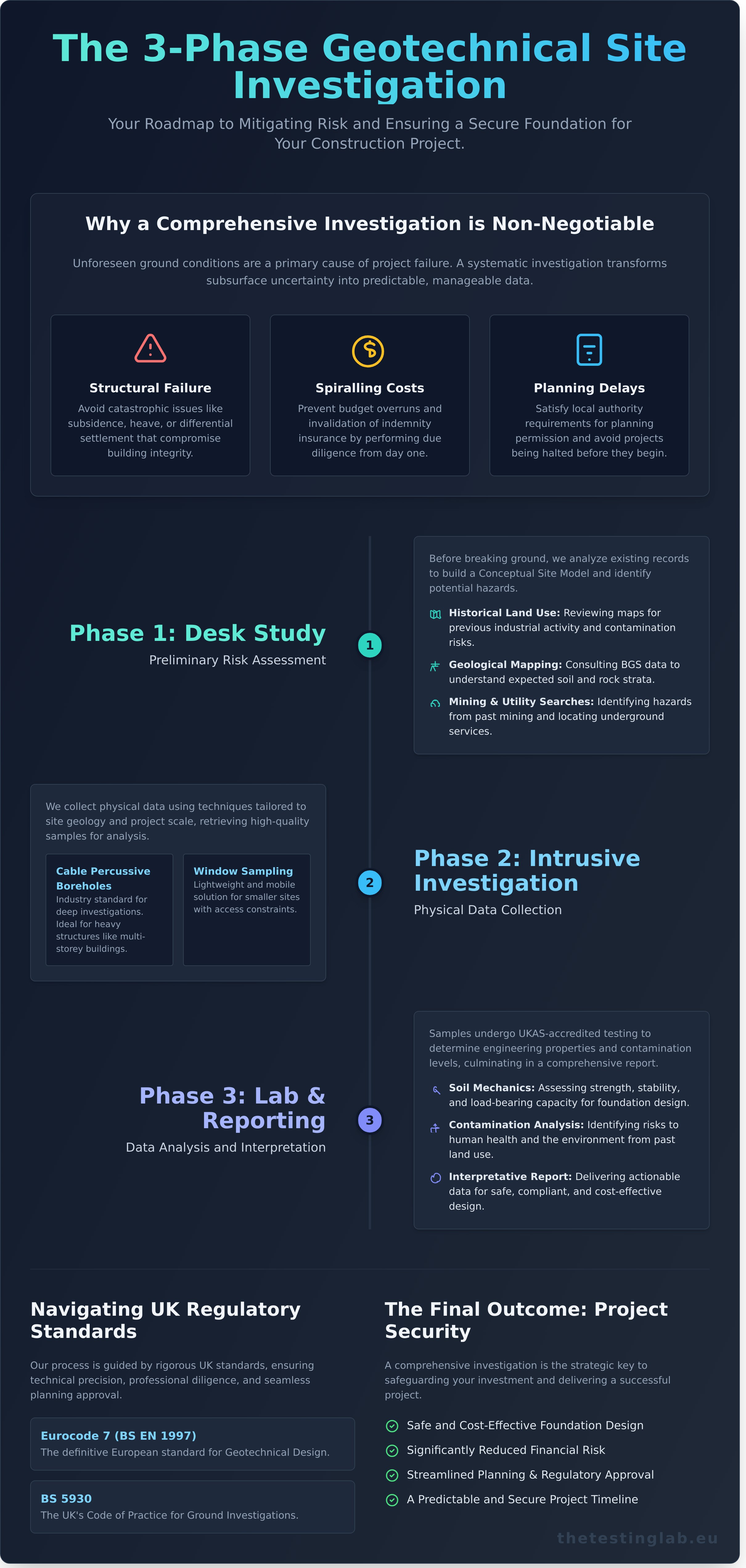
A successful geotechnical site investigation is not a single action but a methodical, three-phase process. This structured approach ensures that every decision is based on robust data, systematically reducing risk and uncertainty from the project’s outset. Each phase builds upon the last, creating a comprehensive picture of the ground conditions and transforming raw information into a precise engineering foundation plan.
Phase 1: The Preliminary Risk Assessment (Desk Study)
Before breaking ground, we look back in time. The desk study is a crucial first step, forming the initial conceptual site model. By analysing existing records, we identify potential risks and inform the design of the physical investigation. Key areas of research include:
- Historical Land Use: Reviewing historical Ordnance Survey maps to uncover previous industrial activity, which could indicate potential ground contamination or buried structures.
- Geological Mapping: Consulting British Geological Survey (BGS) data to understand the expected sequence of soil and rock strata beneath the site.
- Mining and Utility Searches: Identifying potential hazards from historical mining activities and locating existing underground services to prevent costly and dangerous strikes.
Phase 2: Intrusive Site Techniques
With the desk study complete, we move to physical data collection. The choice of technique depends on the project’s scale, access constraints, and the anticipated geology. Our engineers select the most appropriate methods to retrieve high-quality samples and in-situ test data.
- Cable Percussive Boreholes: The industry standard for deep investigations, ideal for collecting soil samples and performing in-situ testing (SPTs) for heavy structures like multi-storey buildings.
- Window Sampling: A more lightweight and mobile solution, using smaller rigs perfect for sites with restricted access or for shallower investigations, such as for low-rise housing.
- Trial Pitting: Excavating shallow pits allows for direct visual inspection of the soil strata in bulk, ideal for assessing existing foundations or mapping near-surface features.
The final phase bridges the gap between the field and the engineering design. Samples collected on-site are carefully transported to a UKAS-accredited laboratory for analysis. This is where the critical importance of a strict Chain of Custody comes into play; every sample is meticulously logged and tracked to guarantee its integrity. In the lab, tests determine key soil parameters like strength, compressibility, and contamination levels. This raw data is then analysed by a geotechnical engineer and compiled into a comprehensive Geotechnical Interpretative Report (GIR), providing clear, actionable recommendations for foundation design, earthworks, and risk mitigation.
Laboratory Precision: Analyzing Soil Mechanics and Contamination
Once physical samples are recovered from the site, the focus of a geotechnical site investigation shifts from the field to the controlled environment of the laboratory. This is where raw soil and water samples are transformed into precise engineering data. To ensure every result is reliable and defensible, all testing should be conducted in a UKAS-accredited laboratory. This accreditation is the industry benchmark for quality, guaranteeing that procedures and calibrations meet the highest standards, providing you with data you can trust for critical design and safety decisions.
The core purpose of this phase is to convert physical materials into mathematical models. Data from in-situ tests, like the Standard Penetration Test (SPT), is combined with laboratory analysis to calculate crucial parameters such as soil bearing capacity, settlement potential, and shear strength. This detailed analysis forms the bedrock of a safe and cost-effective foundation design.
Core Geotechnical Lab Tests
Geotechnical engineers use a suite of tests to understand how soil will behave under structural loads. Key analyses include:
- Atterberg Limits: These tests determine the moisture content at which a fine-grained soil transitions between solid, semi-solid, plastic, and liquid states. This is fundamental for assessing soil plasticity and predicting its response to changes in water content.
- Triaxial Testing: Considered a definitive test for shear strength, this process applies pressure to a soil sample from all directions to simulate the stresses it will experience deep underground, providing vital data for slope stability and foundation design.
- Compaction and CBR Testing: The California Bearing Ratio (CBR) test is essential for designing roads, car parks, and pavements. It measures the strength of subgrade soils to ensure the ground can support the required trafficking loads without failure.
Environmental Analysis: Asbestos and Chemicals
A modern geotechnical site investigation must also identify “hidden” threats that pose risks to human health and project budgets. Our environmental laboratory specialises in uncovering these contaminants:
- Asbestos in Soil: We conduct bulk identification of asbestos fibres within soil matrices, a critical step for ensuring site worker safety and complying with regulations during earthworks.
- Chemical Suites: We screen for a wide range of common industrial pollutants, including heavy metals (e.g., lead, arsenic), total petroleum hydrocarbons (TPH), and polycyclic aromatic hydrocarbons (PAHs), which can impact human health and the environment.
- WAC Testing (Waste Acceptance Criteria): If surplus soil needs to be removed from a site, WAC testing is a legal requirement. It classifies the soil to determine whether it can be disposed of as inert, non-hazardous, or hazardous waste, directly impacting disposal costs.
Navigating UK Regulatory Standards and Planning Permission
A professional geotechnical site investigation is more than just a technical exercise; it’s a critical tool for navigating the UK’s complex planning and building control landscape. A comprehensive report provides the robust evidence needed to satisfy Local Planning Authorities, often helping to discharge specific pre-commencement conditions, such as those relating to ground stability or contamination (commonly referred to as Condition 12).
The credibility of this report hinges on it being prepared by a “Qualified Person”—typically a chartered engineer or geologist—whose credentials give weight to the findings. This is non-negotiable for Building Control, who rely on this expert assessment to approve foundation designs for everything from residential extensions to large-scale commercial builds. For sites with a history of industrial use, early liaison with the Local Authority’s Contaminated Land Officer and the Environment Agency is essential. Our reports provide the precise data needed to facilitate these discussions and ensure a smooth path to approval.
Interpreting Your Geotechnical Report
Your report translates complex ground data into actionable engineering advice. We ensure you can understand the key elements, which typically include:
- The Conceptual Site Model (CSM): A clear summary of the site’s geology, hydrology, and potential contamination risks and pathways.
- Borehole & Trial Pit Logs: These logs detail the soil and rock layers encountered at specific depths, identifying their strength, composition, and stability.
- Foundation Recommendations: Based on the data, we provide clear guidance on the most suitable foundation type—whether cost-effective strip footings, a raft foundation for variable ground, or piled foundations for deep, unstable soils.
Health and Safety Compliance (CDM 2015)
Safety is paramount during any intrusive site work. At The Testing Lab PLC, we operate strictly within the Construction (Design and Management) Regulations 2015. Our site-specific Risk Assessments and Method Statements (RAMS) proactively manage hazards like buried utility strikes and the risks associated with open excavations. This meticulous approach ensures not only the safety of our team and the public but also full legal compliance for your project, de-risking the entire pre-construction phase. For a partner who understands both the ground beneath your feet and the regulations that govern it, visit thetestinglab.eu.
Choosing a UKAS Accredited Partner for Site Investigation
The data from your geotechnical site investigation is the foundation upon which your entire project is built. For this reason, independence and accreditation are the gold standards. UKAS (United Kingdom Accreditation Service) accreditation guarantees that testing methods are precise, repeatable, and impartial, providing you with data you can trust for planning applications, structural designs, and risk mitigation.
At The Testing Lab PLC, we combine national coverage across the UK and Ireland with the technical excellence of our state-of-the-art, Doncaster-based laboratory. We are not just a consultancy that subcontracts testing; we are a lab-first investigation partner. This integrated approach allows us to deliver a comprehensive service, from the initial desk study and intrusive investigation right through to the final interpretive report and structural risk assessment.
The Benefits of a Lab-First Investigation Partner
Working directly with a testing laboratory removes unnecessary layers of communication and cost. Our model provides distinct advantages for developers, engineers, and project managers:
- Direct Access to Technicians: Your site team communicates directly with our lab experts. This eliminates the risk of third-party misinterpretation and ensures a seamless transition from sample collection to data analysis.
- Cost-Efficiency: Our high-volume, in-house laboratory capacity allows us to reduce the “per-sample” fees often inflated by external consultants. This translates into more predictable and competitive project costs.
- Unquestionable Reliability: We employ fully UKAS accredited methods for all critical analyses, including soil classification, contamination testing (including asbestos), and water analysis, ensuring your data meets the highest regulatory standards.
Of course, underpinning this streamlined communication and data management is a robust digital infrastructure. For businesses in the construction and engineering sectors looking to enhance their operational efficiency, flexible IT and telecommunications support from firms like SolaaS LTD can be a significant advantage.
Next Steps for Your Project
Initiating a professional geotechnical site investigation is a straightforward process. To provide an accurate quote, our team typically requires key information such as the site address, a description of the proposed development, and any existing reports or drawings you may have.
From the initial site visit, you can expect a rapid turnaround on sample analysis, with a clear timeline provided for the delivery of your final interpretive report. We are committed to helping you keep your project on schedule and on budget.
Ready to build your project on a foundation of certainty? Contact The Testing Lab for a Geotechnical Quote today.
Secure Your Project’s Foundation with Expert Diligence
As we’ve explored, a professional geotechnical site investigation is not merely a preliminary step; it is the cornerstone of successful risk management and regulatory compliance in the UK. Understanding the systematic three-phase process and the necessity of precise laboratory analysis transforms unknown subsurface variables into a clear, actionable dataset. Ultimately, securing planning permission and ensuring long-term structural integrity hinges on the quality of this foundational work.
Of course, a solid foundation is only the first step; the quality of the build itself depends on highly skilled tradespeople. For professionals looking to expand their team’s capabilities or their own qualifications in various trades, you can check out YTA Training for accredited, intensive courses.
Don’t leave your project’s stability to chance. At The Testing Lab, our UKAS Accredited laboratory provides the certainty you need. From our Doncaster headquarters, we deliver comprehensive UK & Ireland coverage, applying specialist expertise to complex challenges like asbestos in soils and structural risk. Partner with a team dedicated to precision and safety. Book Your Geotechnical Site Investigation Today and build your future on solid ground.
Frequently Asked Questions About Geotechnical Site Investigations
What is the difference between a site investigation and a ground investigation?
A “site investigation” is a broad term that can cover all aspects of a development plot, including ecology, archaeology, and utility mapping. A “ground investigation” is a specific component focused purely on what lies beneath the surface. It assesses soil, rock, and groundwater to understand their engineering properties and potential contamination. While often used interchangeably, the ground investigation is the technical core of any geotechnical assessment, providing the critical data for design.
How much does a geotechnical site investigation cost in the UK?
The cost varies significantly based on project scope. A preliminary Phase 1 Desk Study typically starts from £800 – £1,500. An intrusive investigation with trial pits for a small residential project may range from £2,000 to £5,000. For larger commercial sites requiring deep boreholes and extensive laboratory testing, costs can easily exceed £10,000. The final price is determined by the site’s geology, access constraints, and the specific data required for the design.
Do I need a geotechnical survey for a home extension?
While not always mandatory, a geotechnical survey is highly recommended and often requested by Local Authority Building Control, especially in areas with challenging ground conditions like shrinkable clay, soft soils, or on sloped sites. The investigation provides essential data for designing appropriate foundations, preventing costly future issues such as subsidence. It is a prudent investment to protect both your new extension and your existing property’s structural integrity.
How long does it take to get the results of a soil analysis?
The turnaround for soil analysis results typically ranges from 5 to 15 working days after samples arrive at our laboratory. Standard geotechnical tests, such as classification and moisture content, are often completed within a week. However, more complex chemical testing for contamination or specialised strength tests can take longer. We provide a clear timeline at the project outset, as the final interpretive report is prepared once all laboratory work is complete.
What is a Phase 1 Desk Study and is it enough for planning permission?
A Phase 1 Desk Study is a preliminary risk assessment. It involves reviewing historical maps, geological records, and environmental databases to identify potential ground hazards without intrusive works. For many small, low-risk sites, a comprehensive Phase 1 report is sufficient to satisfy planning conditions. However, if the study identifies potential risks, such as historical contamination or ground instability, the local authority will almost certainly require a more detailed Phase 2 intrusive investigation.
Why is UKAS accreditation important for geotechnical testing?
UKAS (United Kingdom Accreditation Service) accreditation is the industry’s gold standard for quality and technical competence. It confirms that a laboratory’s testing procedures, equipment, and staff have been rigorously and independently assessed against internationally recognised standards. Using a UKAS-accredited laboratory provides absolute confidence that test results are accurate, reliable, and legally defensible-precision that is critical for safe and efficient engineering design.
What happens if contamination or asbestos is found on my site?
If contamination or asbestos is identified, our interpretive report will precisely detail the nature and extent of the issue and provide a clear risk assessment. The next step is to develop a Remediation Strategy, which outlines the actions needed to make the site safe for its intended use. This may involve the specialist removal of materials or implementing an engineering solution, such as a capping layer. We guide you through this process to ensure full regulatory compliance.
Can a geotechnical investigation help reduce foundation costs?
Yes, significantly. A professional geotechnical site investigation is a powerful tool for cost optimisation. Without precise soil data, engineers must design foundations conservatively, often leading to over-engineering with excessive concrete and steel. By providing accurate soil strength and bearing capacity data, we enable an efficient, value-engineered foundation design. This saves on material costs and prevents expensive delays caused by discovering unexpected ground conditions during construction.