

A single misinterpreted figure on a lab analysis certificate can be the difference between a successful HSE inspection and a £4,000 fine. You’ve likely felt that spike of anxiety when staring at a wall of technical jargon and dense data tables. It’s frustrating when you’re responsible for site safety but the documentation feels like it’s written in a foreign language. We believe you need more than just raw data; you need absolute certainty that your business remains fully compliant with British safety standards.
This guide will strip away the complexity so you can verify UKAS accreditation in seconds and interpret every technical metric with total precision. You’ll gain the tools to distinguish between valid, accredited results and paperwork that won’t hold up under professional scrutiny. We’re going to break down the anatomy of a compliant report and show you exactly how to spot red flags before they become costly compliance failures. By the end, you’ll have the confidence to turn these technical reports into clear, actionable steps for your quality assurance strategy.
Key Takeaways
- Understand how a professional lab analysis certificate serves as a critical legal document for health and safety compliance within the UK regulatory framework.
- Learn to identify essential security features, such as unique sample reference codes and the prestigious UKAS “Tick and Crown” symbol, to ensure your report is genuine.
- Discover why ISO/IEC 17025 accreditation is the non-negotiable gold standard for testing laboratories and how it guarantees the precision of your technical findings.
- Master the two-step verification process to cross-reference on-site collection logs with laboratory data, eliminating the risk of administrative errors or liability gaps.
- Explore how partnering with a Doncaster-based specialist can streamline your quality assurance for complex requirements, ranging from asbestos identification to soil chemical analysis.
Understanding the Lab Analysis Certificate: More Than Just Results
A Certificate of Analysis (CoA) is a formal document that authenticates the quality and purity of a specific sample. It’s the final output of a rigorous scientific process. For many UK businesses, this document serves as the primary evidence that a material or product meets regulatory standards. It isn’t just a list of numbers. It’s a technical guarantee that bridges the gap between raw data and commercial safety. When you receive a lab analysis certificate, you’re holding a legal record of compliance that protects your project from the risks of contamination or failure.
Relying on a brief email or a verbal confirmation from a technician is a dangerous shortcut. These informal communications lack the metadata, timestamps, and signatures required for a defensible audit trail. If a health and safety incident occurs, an email stating “the sample is clear” won’t hold up in a court of law. A formal certificate includes specific details like the batch number, the exact testing methodology used, and the detection limits of the equipment. This level of detail ensures that the results are reproducible and verifiable by third parties.
Distinguishing between a “test report” and a “certificate of analysis” is vital in a commercial context. A test report typically provides raw data from a single measurement. In contrast, a CoA compares those results against a specific specification or British Standard. It provides a definitive “pass” or “fail” based on pre-defined criteria. This distinction is critical when managing supply chains, as it shifts the burden of proof from the buyer to the analytical experts.
The Legal Significance of Laboratory Documentation
In the UK, the “Duty to Manage” asbestos under the Control of Asbestos Regulations 2012 requires absolute precision. A lab analysis certificate acts as the cornerstone of this legal obligation. According to HSE statistics from 2022, there were 2,268 mesothelioma deaths in Great Britain, highlighting why robust record-keeping is a matter of life and death. These certificates serve as primary evidence during HSE inspections, proving that you’ve identified risks and taken appropriate action. Without them, your business faces unlimited fines and potential imprisonment for directors under the Health and Safety at Work etc. Act 1974. Proper documentation isn’t just paperwork; it’s your best defence against litigation.
Who Issues These Certificates?
The credibility of a certificate depends entirely on the independence of the issuing body. Independent testing laboratories, such as The Testing Lab PLC, provide an essential layer of third-party verification. While some manufacturers perform in-house testing, this often creates a conflict of interest. Independent analysis ensures impartiality and builds trust with stakeholders. Most UK contracts now specify that analysis must be performed by a laboratory accredited by UKAS (United Kingdom Accreditation Service) to ISO 17025 standards. This accreditation confirms that the lab has the technical competence and the calibrated equipment needed to produce accurate, reliable results every time. We don’t just provide data; we provide the certainty you need to move your project forward.
The Anatomy of a Professional Certificate of Analysis (CoA)
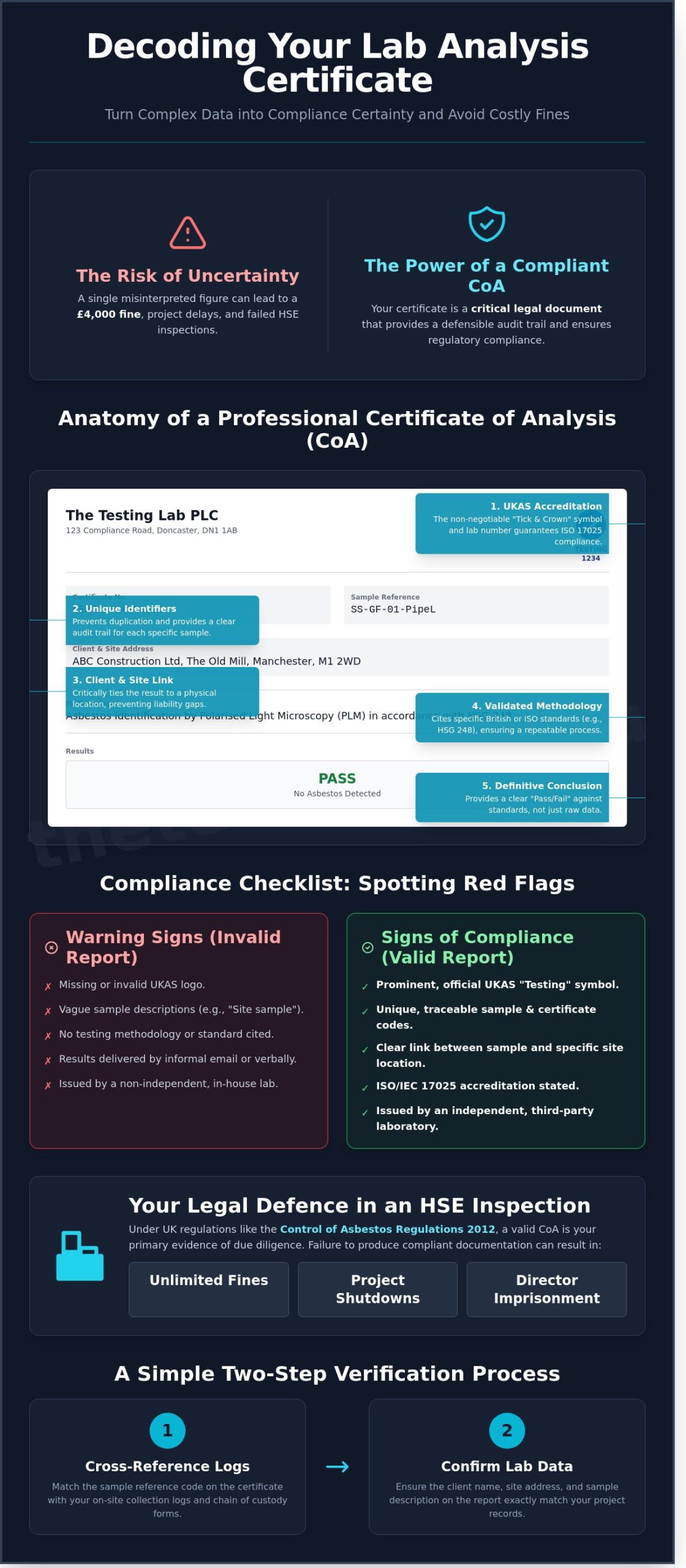
A professional lab analysis certificate functions as a technical passport for your samples. It translates raw laboratory data into a legally defensible document. At the top of the page, you’ll always find the laboratory’s name, physical address, and the UKAS (United Kingdom Accreditation Service) “testing” symbol. This symbol, accompanied by a unique four-digit laboratory number, confirms the facility operates under ISO 17025 standards. If this logo is missing, the results may not be admissible for regulatory compliance in the UK.
Each document carries a unique certificate number and specific sample reference codes. These identifiers prevent duplication and ensure a clear audit trail for every 5ml of water or 10g of soil tested. Below the header, the report identifies the client and the specific project or site address. Accuracy here is vital; 87% of compliance failures in asbestos management stem from certificates that don’t clearly link a sample to a specific room or floor level. The technical core of the document lists the methodology used, such as HSG 248 for asbestos or BS EN ISO 16000 for indoor air quality. Citing these standards ensures the testing follows a validated, repeatable process.
While the UK market relies on ISO standards, the core principles of documentation align with international benchmarks like the Good Manufacturing Practice Guidance, which emphasises that every analytical result must be traceable to a specific batch or sample. Finally, the document must feature an authorisation section. This includes the name and signature of a qualified technical manager or authorised signatory. Without this final verification, the lab analysis certificate is merely an unofficial draft.
Sample Traceability and Chain of Custody
Traceability begins the moment a sample is taken. Your certificate should clearly state the date of receipt and the date of testing. A gap of more than 48 hours in water chemistry testing, for instance, can compromise the integrity of the results due to bacterial growth. The “Chain of Custody” reference on the certificate confirms that the sample was tracked from the site to the lab bench without tampering. If you’re unsure about your current sample’s journey, you can consult our technical experts for a document audit.
Interpreting Technical Results and Units
Results are typically presented in specific units: mg/kg for soil contaminants, µg/l for water, or fibres/cm³ for air samples. You’ll often see the term “ND” (None Detected) or “Below LOD” (Limit of Detection). This doesn’t always mean a substance is entirely absent. It means the concentration is lower than the laboratory’s equipment can reliably measure, which is often 0.01% for bulk material testing. Qualitative results describe what a substance is, such as “Chrysotile detected”, while quantitative results tell you exactly how much is present. Distinguishing between these two is critical for risk assessments and determining the appropriate waste disposal route, which can save up to £150 per tonne in landfill taxes.
Why UKAS Accreditation and ISO 17025 Standards are Non-Negotiable
ISO/IEC 17025 is the definitive international benchmark for testing and calibration laboratories. It isn’t just a badge of honour; it’s a rigorous technical standard that ensures a facility can produce precise and repeatable data. While many businesses claim to follow “best practices,” only those holding this accreditation have proven their technical competence to an external, authoritative body. When you review a lab analysis certificate, the presence of the UKAS “Tick and Crown” symbol confirms that the United Kingdom Accreditation Service has verified the lab’s equipment, staff expertise, and methodology.
The accreditation process is exhausting. Labs don’t just pass once and relax. They undergo annual on-site audits and must participate in regular proficiency testing (PT) schemes. In these PT rounds, the lab receives “blind” samples with unknown concentrations. If their results deviate from the true value beyond strict statistical limits, they risk losing their accreditation. This level of scrutiny is why UKAS-accredited data is the only format accepted by UK regulatory bodies like the Environment Agency or the Health and Safety Executive.
Choosing a non-accredited laboratory carries heavy financial risks. In 2023, several UK land redevelopment projects were halted because soil contamination reports lacked the necessary UKAS oversight. This forced developers to commission entirely new rounds of testing, often costing upwards of £3,500 per site and delaying construction by four to six weeks. Without accreditation, your data is essentially an unverified opinion, which planning authorities will likely reject during the first stage of review.
The Difference Between Accreditation and Certification
It’s a common mistake to confuse ISO 9001 with ISO 17025. ISO 9001 is a management certification that proves a company has organised office processes and good customer service. It says nothing about the accuracy of a chemical analysis. UKAS accreditation under ISO 17025 specifically validates the technical results. To ensure your lab analysis certificate is valid for your needs, you must check the lab’s “Schedule of Accreditation.” This is a public document on the UKAS website that lists every specific test the lab is cleared to perform. If a lab is accredited for “Water Testing” but you’ve sent them “Soil Samples,” their results for that specific job are technically unaccredited.
Global Recognition of UKAS-Accredited Reports
British laboratory standards are some of the highest in the world, and this quality is protected through the ILAC Mutual Recognition Arrangement (MRA). This agreement ensures that a UKAS-accredited report is recognised as equivalent to those issued in over 100 other countries. If you’re managing a project that spans the UK and the Republic of Ireland, or exporting products to the EU, this international alignment is vital. It prevents the need for duplicate testing in different jurisdictions, saving significant capital. This global framework maintains the prestige of British engineering and ensures that technical data remains a reliable asset for international trade and compliance.
- Precision: Accreditation ensures equipment is calibrated to national standards.
- Traceability: Every result can be traced back to the original sample and the specific analyst.
- Legal Weight: Accredited reports hold up in UK courts and planning appeals.
- Risk Mitigation: Annual audits catch potential errors before they reach your desk.
We view our role as more than just a service provider; we’re your strategic partner in risk management. By insisting on ISO 17025, you’re not just buying a piece of paper. You’re investing in the certainty that your project is built on a foundation of accurate, defensible data.
How to Verify and Interpret Your Laboratory Findings
Verification isn’t just a bureaucratic tick-box exercise. It’s the final stage of quality control that ensures your data integrity remains intact from the field to the boardroom. When you receive a lab analysis certificate, you’re looking at a technical document that carries significant legal weight. Treating it with a meticulous engineering mindset is the only way to mitigate risk effectively.
Step 1: Cross-reference the sample ID with your on-site collection log. Discrepancies here are common and dangerous. If your site log identifies a sample as “Ground Floor Boiler Lagging” but the report lists “Generic Fibre 001,” the chain of custody is broken. You can’t prove where that sample originated in a court of law or during an HSE inspection. Match every unique identifier exactly.
Step 2: Check the accreditation status for each individual test. Don’t assume the entire document is covered by a single logo. Look for the ISO/IEC 17025 accreditation symbol next to every specific parameter. If a test is marked as “Non-Accredited,” the lab hasn’t proven its proficiency for that specific method to a national body like UKAS. This ensures your lab analysis certificate meets the legal threshold for compliance.
Step 3: Review any “Comments” or “Deviating Sample” notes. Labs must flag if a sample arrived in an incorrect container, exceeded temperature limits during transit, or had insufficient volume. A “deviating sample” warning means the result’s accuracy is compromised. In the 2023 reporting cycle, approximately 4% of environmental samples were flagged for deviations that could lead to false negatives.
Step 4: Confirm the document is signed by a technical signatory. A valid report requires a signature from an authorised specialist who takes responsibility for the data’s technical validity. Without this, the document is merely a draft and holds no weight in a health and safety audit.
Step 5: Store copies in your compliance folder. Under the Control of Asbestos Regulations 2012, you’re often required to keep these records for 40 years if they relate to employee exposure. Don’t rely on the lab’s portal; download the PDF and keep a physical backup.
Spotting Red Flags in Lab Reports
You’ll know a report is unreliable if it lacks a UKAS logo or features an expired accreditation number. Vague sample descriptions are another warning; “Room 1” is useless if a building has twenty floors. Finally, ensure the report explicitly cites methodology, such as HSG248 for asbestos. If the lab doesn’t name the standard they’ve followed, the results are technically unverifiable and shouldn’t be used for risk assessments.
What to Do if Results Are Positive
Immediate action is mandatory if you see “Asbestos Detected” or Legionella counts exceeding 1,000 cfu/l. You must isolate the area and restrict access to prevent exposure. Use the certificate to brief remediation contractors; it serves as the foundation for their Risk Assessment and Method Statement (RAMS). Once work is complete, don’t just take their word for it. You’ll need an “Air Clearance” certificate to prove the area is safe for re-occupation.
If you need assistance interpreting complex data or want to ensure your testing regime is fully compliant, partner with our expert technical team to secure your facility’s safety.
Obtaining Your Accredited Analysis Certificate with The Testing Lab PLC
The Testing Lab PLC operates from a high-specification, UKAS-accredited facility in Doncaster, where we’ve built a reputation for technical clarity and engineering precision. We don’t just process samples; we provide the rigorous data required for complex compliance and safety management. Our laboratory team handles a diverse portfolio of testing, ranging from Asbestos Bulk Identification to comprehensive soil chemical analysis for brownfield developments. Every lab analysis certificate we issue adheres to the strict ISO 17025 standards, ensuring that your data remains robust under regulatory scrutiny from the Environment Agency or local authorities.
We’ve engineered our internal workflows to maintain a 98% on-time delivery rate for all reports. This operational efficiency allows us to offer 24-hour and 48-hour turnaround times for urgent samples without sacrificing the precision your project demands. We understand that site delays cost money, often exceeding £5,000 per day on mid-sized construction projects. To mitigate this, we provide digital certificate delivery through our secure client portal. This platform gives your site managers and stakeholders instant access to results the moment they’re verified, eliminating the wait for physical post and allowing for immediate decision-making.
Our range of services includes:
- Asbestos bulk sample analysis and fibre counting.
- Soil chemical testing for contamination and waste classification.
- Water quality analysis, including Legionella and potable water testing.
- Structural material inspections and aggregate testing.
Expert Consultancy Beyond the Certificate
Our role extends beyond providing raw data. We act as a strategic partner, helping you interpret how your lab analysis certificate impacts your project timelines and safety obligations. If a report indicates high levels of contamination, our technical team provides direct support to explain the implications. We assist with water management strategies, asbestos management plans, and structural integrity assessments. You gain direct access to our lead analysts for any certificate queries. This transparency ensures that 100% of our clients understand the risk profile of their sites before they commit to costly remediation or removal works.
Nationwide Service from our Doncaster Centre
While we’re rooted in our Doncaster centre, we serve clients across the UK and Ireland with consistent, high-quality reporting. We’ve streamlined the logistics of sample submission to ensure your testing begins the moment it reaches our facility. Whether you’re managing a single residential renovation or a multi-million pound infrastructure project, our reporting remains standardised and clear. You can send samples via our approved courier network or drop them off directly at our laboratory for immediate intake. Our team processes over 1,500 samples weekly, maintaining a level of accuracy that has made us a trusted name in the UK testing industry. Book your accredited laboratory testing today to secure your project’s compliance and move forward with confidence.
Securing Your Supply Chain Through Technical Precision
Mastering the details of a lab analysis certificate is a critical step in de-risking your operations. Verify that every document adheres to ISO/IEC 17025 standards and carries the weight of UKAS accreditation to ensure your data is traceable and legally robust. By focusing on expert technical signatures and specific testing scopes, you’re protecting your brand from the costly consequences of non-compliance. Since 2002, our Doncaster laboratory has provided this engineering-grade certainty to partners across the UK and Ireland. We don’t just deliver data; we provide the technical signatures and ISO-compliant frameworks that move your projects forward. Whether you’re navigating complex regulations or need rapid, precise testing, we’re here to take the weight of quality assurance off your shoulders. Our team has spent over 22 years refining these processes so you don’t have to worry about the fine print. Take the next step toward total technical confidence today.
These principles of due diligence extend far beyond industrial sites. The hospitality and events sectors, for example, depend on property owners maintaining up-to-date safety certifications for things like water quality. Event organizers, including specialist platforms like henfactory.com, rely on venues being fully compliant to ensure the safety and success of their clients’ activities.
Get a Quote for UKAS Accredited Lab Analysis
Your path to absolute compliance starts with a partner who values precision as much as you do.
Frequently Asked Questions
What is the difference between a Lab Analysis Certificate and a Test Report?
A lab analysis certificate provides a definitive summary of final results, whereas a test report offers a granular breakdown of the entire testing process. You’ll find that certificates are designed for compliance checks and quick verification by stakeholders. Test reports include raw data, equipment calibration dates, and specific environmental conditions during the test. Most UK clients prefer the certificate for its clarity and legal standing in standard quality audits.
How can I verify if a lab analysis certificate is genuinely UKAS accredited?
You verify accreditation by visiting the UKAS website and searching their database for the laboratory’s unique 4-digit schedule number. Every valid lab analysis certificate must display the UKAS “tick and crown” logo alongside this specific number. This confirms the facility adheres to ISO/IEC 17025 standards. Without this verification, you can’t guarantee the results meet the rigorous accuracy levels required by UK health and safety laws.
How long is a lab analysis certificate valid for asbestos or legionella?
These documents don’t have a fixed expiry date because they represent the sample’s state at the exact moment of collection. However, HSE guidelines like HSG264 for asbestos recommend re-inspecting materials every 12 months. For legionella, a risk assessment review is typically required every 24 months. If site conditions change or 730 days pass, you’ll likely need a new lab analysis certificate to maintain your compliance status.
Does every sample need its own separate certificate?
You don’t need a separate document for every individual sample; a single certificate can cover multiple items from one site. Laboratories typically group up to 20 samples on one report to streamline your documentation. This approach keeps your project files organised and reduces administrative overhead. Just ensure each sample has a unique ID number that matches the physical labels used during the site’s collection process.
What should I do if my lab certificate mentions a “deviating sample”?
A “deviating sample” notification means your sample arrived at the lab in a condition that might compromise the result’s accuracy. This often happens if the sample was too small, stored at the wrong temperature, or held in an incorrect container. Roughly 12% of samples are flagged for deviations. You’ll need to decide if you want to proceed with the test, knowing the results might be legally challenged later.
Can a non-UKAS accredited lab provide a legally binding certificate?
A non-accredited lab’s certificate is technically legal, but it’s rarely accepted by the HSE or UK insurance providers. If a dispute reaches a tribunal, results from a UKAS-accredited facility carry the “presumption of conformity.” Non-accredited results often lack the rigorous 17025 audit trail. Relying on them increases your liability risk significantly if a health and safety breach occurs on your premises.
How long does it typically take to receive a certificate after sending a sample?
Standard turnaround for asbestos results is usually 48 to 72 hours, while legionella testing takes significantly longer. Since legionella bacteria need time to incubate, you won’t get a final result for at least 10 to 12 days. Many labs offer a 24-hour “fast-track” service for an additional fee, often starting around £50 per sample. Always factor these lead times into your project’s health and safety schedule.
What information is mandatory on a UKAS asbestos analysis certificate?
A UKAS asbestos certificate must include the lab’s 4-digit accreditation number, the sample’s unique reference, and the specific test method used. It’s mandatory to list the analyst’s name and the date the testing occurred. The document should also clearly state the asbestos type found, such as chrysotile or amosite. If any of these 5 key elements are missing, the certificate doesn’t meet HSG248 regulatory requirements.