


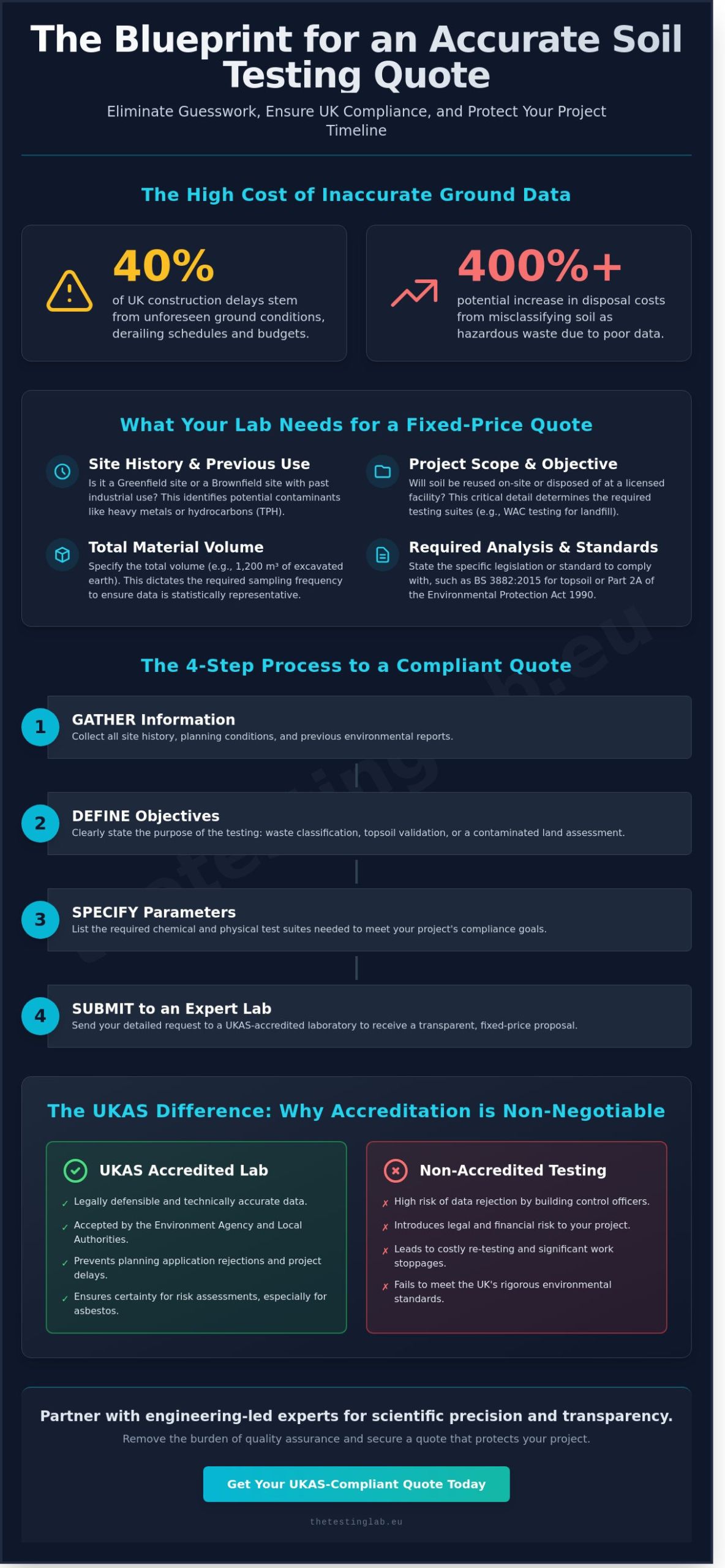
A soil testing quote is much more than a simple line item on a spreadsheet; it’s your primary insurance against the 40% of UK construction delays that stem from unforeseen ground conditions. You probably agree that managing the shift between UKAS-accredited results and non-compliant data feels like a regulatory minefield, especially when unexpected laboratory fees start to erode your project margins. It’s a common frustration for site managers who need precision but often receive vague, incomplete estimates that don’t satisfy local authority requirements.
We’ll show you exactly how to get a quote for soil testing that eliminates guesswork and ensures your project remains fully compliant with UK environmental legislation. By following this professional framework, you’ll learn to secure a transparent, fixed-price proposal that protects your timeline. This guide provides a step-by-step breakdown of the technical data and site parameters required to obtain a reliable, UK wide testing schedule without the risk of hidden costs or site work stoppages.
Key Takeaways
- Understand the rigorous UK legislation and environmental standards that dictate the specific testing protocols required for site safety and legal compliance.
- Discover the precise steps on how to get a quote for soil testing by gathering site history and planning conditions to ensure a fixed, accurate price.
- Learn to distinguish between specialist soil analysis categories to prevent the rejection of materials at UK-wide waste facilities and avoid unnecessary surcharges.
- Identify the essential technical data and sample requirements needed to secure UKAS-compliant laboratory results within your project’s specific timeframe.
- Partner with engineering-led experts to streamline your procurement process, ensuring quality assurance is managed with scientific precision and transparency.
Understanding Soil Testing Requirements UK Wide
Soil testing is a rigorous engineering process involving the chemical and physical analysis of ground samples. In the UK, this ensures site safety and regulatory compliance. Professional analysis prevents the misclassification of soil as hazardous waste, which can increase disposal costs by over 400% in some landfill scenarios. Understanding these requirements is the first step when researching how to get a quote for soil testing for your project. Our UK wide service ensures that whether you’re in London or Edinburgh, your data meets the same high-tier standards required by local authorities.
A strategic approach to testing doesn’t just tick a box; it protects your bottom line. By identifying the exact composition of your site’s ground, you can make informed decisions about waste categorisation and soil reuse. This level of precision is why developers across the country look for specialist partners who understand the nuances of UK legislation. When you’re ready to proceed, knowing how to get a quote for soil testing that covers all these bases is essential for maintaining your project timeline.
Legal Compliance and UK Legislation
The Environmental Protection Act 1990 dictates how waste and contaminated land are managed. If you’re importing or reusing topsoil, adhering to BS 3882:2015 is vital. This British Standard sets the specifications for topsoil quality, ensuring it’s fit for purpose and safe for human health. The Environment Agency enforces these standards across the UK, making precise data a non-negotiable asset for any developer. Failure to comply can lead to costly remediation orders or legal action under Part 2A of the 1990 Act.
The Critical Role of UKAS Accreditation
UKAS accreditation represents the pinnacle of laboratory testing in the United Kingdom. Using a lab without this badge of quality puts your planning applications at risk. Building control officers often reject non-accredited data, leading to project delays. Accredited results ensure your soil test data is legally defensible and technically accurate. It’s the difference between a project that sails through the approval process and one that’s stalled by regulatory scrutiny. For sites where contamination is suspected, including asbestos in soils, UKAS-certified methods provide the necessary certainty for risk assessments.
By partnering with a laboratory that views testing as a scientific discipline rather than a clerical task, you remove the burden of quality assurance from your own shoulders. This technical confidence allows your team to focus on construction while we handle the complexities of the laboratory environment. We provide the clarity needed to navigate the UK’s environmental landscape, ensuring every sample taken from your site is processed with absolute precision.
Essential Information for an Accurate Soil Testing Quote
A laboratory cannot provide a reliable fixed quote without a clear understanding of your project’s specific requirements. Vague requests often lead to “scope creep,” where additional tests are added mid-project, causing budgets to spiral. To understand how to get a quote for soil testing that remains accurate from start to finish, you must provide granular detail about the site and your objectives. This precision allows the lab to allocate the correct technical resources and equipment for your UK wide project.
Site History and Project Scope
Identifying Required Chemical and Physical Parameters
Precision in selecting testing suites prevents you from paying for data you don’t need. You must distinguish between a “General Suite,” which covers basic pH and organic matter, and “Contaminant-Specific” testing for substances like asbestos, phenols, or volatile organic compounds. If your project involves moving material off-site, you will likely require WAC (Waste Acceptance Criteria) testing. This specific analysis is mandatory for UK waste regulators to determine if soil is inert, non-hazardous, or hazardous before it reaches the weighbridge.
Providing the correct number of samples from the outset is a critical step in how to get a quote for soil testing that avoids hidden fees. Under-sampling often triggers a requirement for expensive re-testing when regulators or developers find the initial data insufficient. You should also be transparent about your timeline. If you have a hard deadline for a planning application in 14 days, the lab needs to know this immediately. Expedited “fast-track” services are available, but they require the lab to reorganise their workflow, which impacts the final quote. By consulting with a technical partner early in the process, you ensure your quote reflects the true technical demands of the site.
Deciphering Specialist Soil Analysis Categories
Selecting the correct analysis is the most critical step when you are researching how to get a quote for soil testing. Soil isn’t a uniform material; it’s a complex matrix that varies significantly across different UK Wide regions. Providing a lab with the wrong parameters doesn’t just waste money; it leads to rejected waste at the landfill and potential legal non-compliance. A chemical profile for topsoil validation is entirely different from the data required for hazardous waste classification. Precision in the initial request ensures the laboratory can apply the correct methodology for your specific site conditions, whether you are dealing with natural clay or construction rubble.
The UK Soil Observatory provides essential data on the diversity of soil types across the country, which underscores why a “one size fits all” approach fails in professional engineering. Understanding the specific legal frameworks in the United Kingdom allows you to request the exact suites needed for your project’s success.
Waste Classification: WAC and WM3
There’s often confusion between WM3 and WAC testing, but they serve two distinct legal purposes. You must first use WM3 testing to determine if your soil is classified as hazardous or non-hazardous waste. This assessment is based on the total concentration of contaminants and follows strict Environment Agency technical guidance. It’s a common error to jump straight to WAC testing. In reality, WAC (Waste Acceptance Criteria) testing is only required once the waste has already been classified as hazardous or inert. WAC measures how contaminants leach out of the soil in a landfill environment, not the total hazard level. Requesting these in the wrong order can lead to expensive re-testing and site delays.
Topsoil Validation and Asbestos in Soils
If your project involves landscaping or importing soil to a new development, you’ll need BS 3882:2015 topsoil testing. This standard ensures the soil is physically and chemically fit for purpose, checking everything from nutrient content to phytotoxic contaminants. For UK Wide brownfield developers, asbestos remains the primary concern. Given the industrial history of many sites, asbestos in soils testing is a mandatory safety requirement. Identifying fragments or microscopic fibres early allows for proper risk management. When you understand these categories, you can provide the specific details necessary for how to get a quote for soil testing that is both accurate and legally robust. Expert UKAS accredited consultancy helps interpret these complex results, turning raw laboratory data into actionable site strategies.
The Step-by-Step Process to Requesting a Laboratory Quote
Securing an accurate price for analytical services requires a methodical approach. Understanding how to get a quote for soil testing begins with your site investigation reports or specific planning conditions issued by the local authority. These documents outline the potential contaminants identified during a Phase 1 Desk Study. You should never guess the required suite of tests, as this leads to either insufficient data or unnecessary expenditure. Instead, provide the laboratory with the exact requirements dictated by UK legislation, such as the Environmental Protection Act 1990 or specific Waste Acceptance Criteria if material is leaving the site.
When you contact a laboratory regarding how to get a quote for soil testing, provide a clear list of samples and your required turnaround times. A professional laboratory will review your schedule and highlight any potential issues with sample stability or detection limits. Once you receive the document, scrutinise it for costs that aren’t immediately obvious. Some providers exclude sample collection fees, container delivery charges, or the cost of the final interpretative report. Finalise the process by establishing a robust chain of custody. This document is a legal requirement in the UK wide industry, ensuring that every sample is tracked from the moment it’s taken until the final certificate is issued.
Selecting Sample Quantities and Sampling Methods
The number of samples you need depends on the volume of soil and its intended use. For stockpiled material, a common industry standard is one sample per 50 cubic metres, though this can increase to one per 250 cubic metres for more uniform, virgin soils. It’s vital to use lab-provided containers, usually amber glass jars for organics and plastic tubs for metals, rather than site-sourced containers which may contain cross-contaminants. To maintain chemical integrity, samples must be stored in cool boxes at temperatures between 2°C and 8°C. This precision ensures that volatile compounds don’t degrade before they reach the laboratory bench.
Evaluating the Quotation: Turnaround and Reporting
Timeframes significantly impact project budgets. Standard turnaround usually sits between 5 and 10 working days, while Express services offer results in 24 to 48 hours for a premium fee, often 50% to 100% higher than base rates. Ensure your quote includes a formal UKAS-accredited certificate of analysis. This accreditation, specifically ISO 17025, confirms the laboratory meets international standards for technical competence. You should also verify if the lab provides post-test technical support. Having a specialist available to explain complex results, such as asbestos in soils detections, is often more valuable than the testing itself.
If you need a precise, professional breakdown of your site requirements, our team provides technical clarity at every stage of the process.
Securing Your Soil Testing Quote with The Testing Lab PLC
Understanding how to get a quote for soil testing shouldn’t be a hurdle in your project timeline. The Testing Lab PLC offers a streamlined procurement process designed for UK wide developers and contractors who demand technical rigour. Our expertise isn’t limited to simple topsoil; we provide specialist analysis for asbestos in soils, water quality, and complex construction materials. Every investigation we conduct prioritises precision. Because we operate as a UKAS accredited facility, your project remains fully compliant with UK environmental regulations and Waste Duty of Care standards.
Our UK Wide Laboratory Capabilities
We view our role as a strategic partner rather than just a service provider. This partner-led approach takes the technical burden off your shoulders, letting you focus on site delivery while we manage the quality assurance. We’ve successfully processed thousands of samples for major UK wide projects, ensuring that every result is backed by rigorous internal quality controls and engineering-led methodologies.
The Streamlined Quote Request Process
Efficiency is at the heart of our service. If you’re looking for how to get a quote for soil testing without the typical administrative delays, our digital systems are the answer. You can access our online portal for a fast quote request, or speak directly with our technical consultants. These experts help you define bespoke testing suites that match your specific site requirements, preventing over-testing and unnecessary costs.
UK wide contractors prefer our model because our pricing is transparent and our turnaround times are reliable. When you request a quote, we provide a detailed breakdown of costs, so there aren’t any hidden fees later in the process. We provide the data-driven foundation your project needs to move forward safely. Our team ensures that your specific testing needs, whether for waste classification or environmental compliance, are met with the highest level of professional integrity.
- Direct Technical Access: Speak to the scientists performing your tests.
- Bespoke Testing Suites: Only pay for the parameters your project requires.
- Transparent Pricing: Clear, upfront costs for all UK wide site investigations.
- Compliance Assurance: All testing aligns with current UK legislative frameworks.
Secure Your Project Foundations with Professional Soil Analysis
Navigating UK soil legislation requires more than just a basic list of tests; it demands a strategic partnership with a UKAS accredited laboratory. You’ve learned that providing precise site history and clear grid references prevents unexpected costs during the analytical phase. Accurate data ensures your project meets the rigorous standards set by the Environment Agency and local planning authorities UK wide. Understanding how to get a quote for soil testing shouldn’t be a hurdle to your development timeline or project budget.
We provide independent coverage across the country, specialising in asbestos, water, and soil compliance to keep your site safe. Our team treats every sample with scientific precision, ensuring you receive results that satisfy ISO/IEC 17025 requirements for your environmental reports. We’re here to take the weight of quality assurance off your shoulders so you can focus on delivery. Don’t let regulatory uncertainty or hidden fees stall your progress.
Request a fast, fixed-fee soil testing quote from our UKAS accredited lab
We look forward to supporting your next project with the technical expertise it deserves.
Frequently Asked Questions
How much does a standard soil test cost in the UK?
Standard soil tests in the UK typically range from £60 to £150 per sample for basic chemical suites. These costs fluctuate based on the specific contaminants being screened and the volume of samples required for the project. Additional site visit fees from a geo-environmental engineer can add £500 to £1,500 to the total cost depending on the site’s complexity and location.
Can I take my own soil samples for a laboratory quote?
You can take your own samples for a laboratory quote, but this is generally discouraged for professional or legal applications. Samples collected without following BS 10175 standards often lead to rejected planning applications or inaccurate results. Technical precision is vital, so it’s best to use professional sampling kits or expert technicians to ensure the integrity of your data from the start.
What is the difference between a WAC test and a standard soil analysis?
A standard soil analysis assesses the health or contamination levels of the ground, while a WAC test determines how waste must be handled at a landfill. WAC testing is a legal requirement under the Landfill Directive for any soil leaving a site as waste. You should clarify this distinction when asking how to get a quote for soil testing to ensure you receive the correct suite of analysis for your needs.
How long does it take to get a soil testing quote?
You should expect to receive a soil testing quote within 24 to 48 hours of submitting your site details. Complex projects involving deep boreholes or extensive contamination suites might require 3 to 5 working days for a full technical breakdown. Providing a site plan and any previous desk study reports will accelerate this process and help us provide a more accurate estimate.
Is UKAS accreditation mandatory for soil testing in construction?
UKAS accreditation is mandatory for soil testing results used in planning applications and environmental permits UK Wide. The Environment Agency and local authorities require ISO 17025 certification to ensure the data is accurate and legally defensible. Working with a non-accredited facility risks the total rejection of your technical reports, which can cause significant delays to your construction schedule.
What happens if asbestos is found in my soil samples?
If asbestos is detected, the laboratory must notify you immediately to discuss health and safety protocols under the Control of Asbestos Regulations 2012. You’ll likely need a follow-up quantification test to determine the exact percentage of asbestos present in the soil. This data is critical for deciding if the material is classified as hazardous waste or if it can remain on-site with specific remediation measures.
Do I need a soil test for a small residential extension UK Wide?
You’ll likely need a soil test for a small residential extension UK Wide if your local Building Control officer or structural engineer requires evidence of ground bearing capacity. This is particularly common in areas with shrinkable clay or historical mining activity. A basic geotechnical report ensures your foundations are designed correctly, which prevents costly structural failures and insurance issues in the future.
Can The Testing Lab PLC provide a quote for HMRC LOI fines testing?
The Testing Lab PLC provides comprehensive testing for HMRC Loss on Ignition (LOI) requirements to help you determine correct landfill tax rates. This specific analysis measures the organic content of fine material to ensure it meets the 10 percent threshold for the lower tax rate. Accurate LOI data is essential for maintaining compliance with UK tax legislation and avoiding unnecessary financial penalties at the weighbridge.