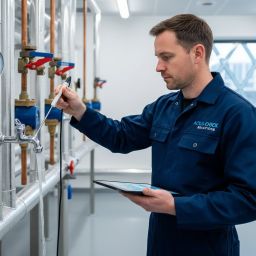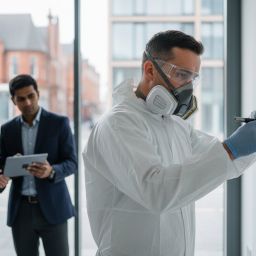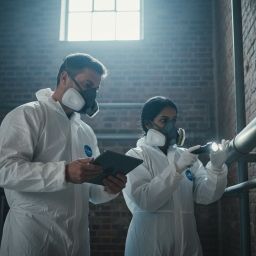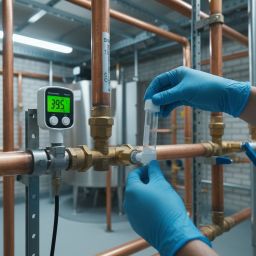


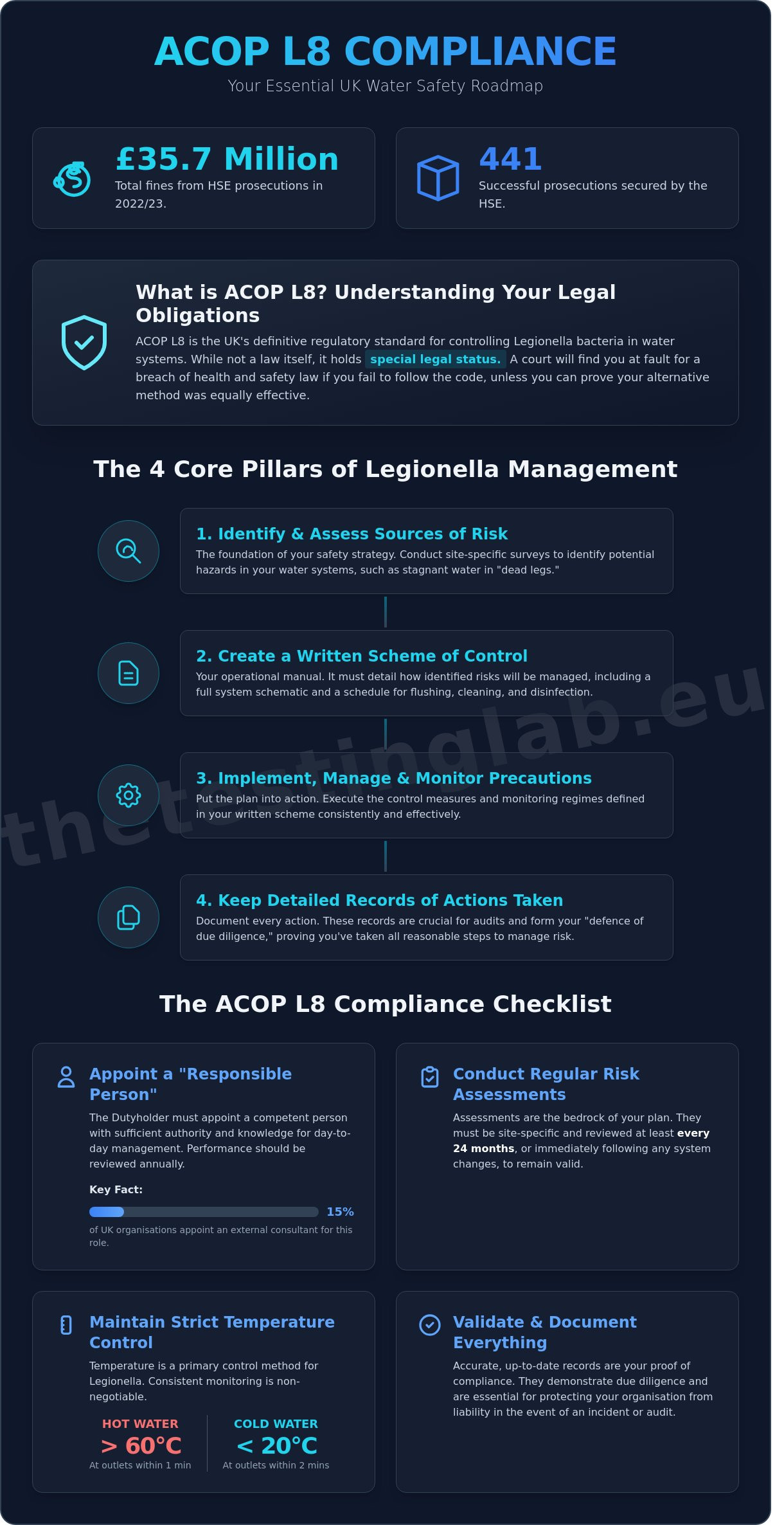
Did you know that the Health and Safety Executive (HSE) secured 441 successful prosecutions in the 2022/23 period, with fines totalling £35.7 million? You’re likely feeling the weight of this responsibility as you manage water systems across your UK wide sites. It’s common to feel overwhelmed by the technical overlap between different guidance documents, but failing to maintain ACOP L8 compliance isn’t an option for any serious dutyholder in 2026.
We believe that water safety should be approached with engineering precision, not guesswork. This guide promises to strip away the confusion and provide a clear, logical roadmap for your compliance journey. You’ll gain a deep understanding of the “Responsible Person” role and a structured framework for your safety records. We’re going to break down the specific actions you need to take to ensure your facilities remain safe, compliant, and ready for any audit.
Key Takeaways
- Understand the unique legal status of the Approved Code of Practice and how to meet your statutory duties as a UK dutyholder.
- Discover the core pillars of a robust Legionella management programme, including how to identify risks and develop a formal written scheme of control.
- Access a comprehensive checklist to streamline your ACOP L8 compliance, covering everything from appointing a Responsible Person to validating site-specific risk assessments.
- Learn how to implement clear lines of accountability and communication to ensure your water safety measures remain effective and fully documented.
- Explore the benefits of a “laboratory-first” approach to water safety and how professional UK-wide assessments can remove the burden of quality assurance.
What is ACOP L8 Compliance? Understanding Your Legal Obligations
ACOP L8 refers to the “Approved Code of Practice: Legionnaires’ disease. The control of legionella bacteria in water systems.” It represents the definitive regulatory standard for water safety across the UK. Achieving ACOP L8 compliance isn’t a voluntary choice for landlords or building managers; it’s a fundamental requirement for anyone managing a premises with a water system. Under UK law, an ACOP holds a unique status. While it isn’t a law itself, it has “special legal status.” If you’re prosecuted for a breach of health and safety law and it’s proved you didn’t follow the code, a court will find you at fault unless you can demonstrate you complied in another, equally effective way.
The “Dutyholder” is the person legally responsible for this safety. This is usually the employer or the person in control of the premises, such as a landlord. They’re tasked with identifying risks and implementing a written scheme of control. To help dutyholders navigate these technical requirements, the HSE provides the HSG274 technical guidance. This document is split into three parts, covering cooling towers, hot and cold water systems, and “other” systems like spa pools. While ACOP L8 outlines the legal “what,” HSG274 provides the engineering “how” to ensure your facility remains safe.
The Legal Framework of Water Safety in the UK
UK water safety is primarily governed by the Health and Safety at Work etc. Act 1974. This legislation requires dutyholders to protect employees and the public from health risks. Additionally, the Control of Substances Hazardous to Health Regulations 2002 (COSHH) specifically classifies Legionella as a hazardous biological agent. The consequences of ignoring these regulations are severe. In recent years, UK courts have issued fines exceeding £1,000,000 for serious health and safety failures. Beyond financial penalties, non-compliance can lead to criminal prosecution and irreparable damage to your professional reputation.
Why ACOP L8 is Essential for UK Businesses
Proactive water management protects tenants and the public from Legionnaires’ disease, a potentially fatal form of pneumonia. Maintaining ACOP L8 compliance is also a critical requirement for insurance validity. Most UK commercial insurers require proof of statutory compliance before they’ll settle a claim related to environmental health. By conducting regular Legionella risk assessments and keeping detailed logs, you build a “defence of due diligence.” This documentation proves you’ve taken every reasonable step to manage risks, effectively taking the burden of liability off your shoulders in the event of an incident.
The Core Pillars of a Legionella Management Programme
Achieving ACOP L8 compliance isn’t a one-off task; it’s a continuous cycle of engineering precision and administrative oversight. The Health and Safety Executive (HSE) outlines four fundamental requirements for every UK-wide property portfolio. First, you must identify and assess sources of risk. Second, you need a written scheme to control those risks. Third, you must implement and manage these precautions. Finally, you have to keep records of every action taken. This structured approach moves the burden of safety from guesswork to a data-driven methodology.
A written scheme serves as your operational manual. It details exactly how you’ll manage the risks identified in your assessment. This document must include a schematic diagram of the entire water system. It also needs a schedule for flushing, cleaning, and chemical treatments. Precision here prevents 90% of potential outbreaks. Without a clear, documented plan, your ACOP L8 compliance status is effectively void.
Appointing a Competent Responsible Person
The Dutyholder, often the landlord or employer, remains legally accountable. However, they must appoint a “Responsible Person” to take day-to-day charge. This individual needs sufficient authority, competence, and knowledge of the specific water system. In complex UK-wide commercial setups, 15% of organisations choose an external consultant to fill this role. If you appoint internally, ensure they have the resources and time to act. The Dutyholder should review the Responsible Person’s performance at least annually to ensure standards don’t slip.
Conducting a Comprehensive Legionella Risk Assessment
A risk assessment is the foundation of your safety strategy. Under the 2013 revision of ACOP L8, assessments should be reviewed at least every 24 months, or immediately if the water system changes. You can’t rely on a generic template. Each property requires a site-specific survey. Focus on “dead legs” where water stagnates; these are prime breeding grounds for bacteria. Maintaining hot water above 60°C and cold water below 20°C is critical. If your portfolio includes older buildings, pay close attention to aerosol-producing outlets like showers or spray taps. For landlords managing multiple sites, professional Legionella risk assessments provide the technical depth needed to satisfy HSE inspectors and protect tenants effectively.
Implementing the Written Scheme of Control
A written scheme of control isn’t a generic template; it’s a site-specific blueprint that dictates how you manage water safety UK wide. This document must detail every control measure, from valve locations to flushing regimes. For landlords, establishing clear lines of accountability is the first step. You must appoint a “Responsible Person” with the authority and knowledge to ensure tasks are completed. Without defined roles, 15% of maintenance tasks often go unrecorded, which creates significant gaps in your ACOP L8 compliance records.
Temperature control serves as your primary defence against bacterial growth. Legionella bacteria remain dormant below 20°C and cannot survive above 60°C. We recommend keeping cold water stored below 20°C and hot water at a minimum of 60°C within the calorifier. Outlets should reach at least 50°C within one minute of running. If your system design prevents these targets from being met, secondary measures become necessary. UV sterilisation or chemical treatments, such as chlorine dioxide dosing, are often integrated into systems where thermal control is inconsistent or where complex pipework creates “dead legs” that harbour stagnant water.
Routine Monitoring and Maintenance Tasks
Consistency is the hallmark of a professional risk management strategy. Your written scheme should mandate the following schedule to maintain ACOP L8 compliance across your portfolio:
- Monthly: Measure temperatures at sentinel taps (the nearest and furthest from the water source). Check that hot water cylinders discharge at 60°C.
- Quarterly: Descale and disinfect all showerheads and spray taps. Limescale provides a nutrient-rich environment for biofilm, increasing bacterial risk by up to 40% in neglected systems.
- Annual: Conduct a visual inspection of cold water storage tanks to check for debris, sediment, or signs of vermin ingress. Calorifiers must also be inspected internally for scale and corrosion.
Microbiological Sampling and UKAS Laboratory Analysis
Sampling isn’t always a monthly requirement, but the 2013 ACOP L8 guidance specifies it’s mandatory when water temperatures fall outside safe limits or when a system is treated with biocides. It’s also vital for high-risk buildings or when a system’s cleanliness is in doubt. Accuracy is non-negotiable here. You must use a UKAS accredited laboratory to ensure the samples are handled under controlled conditions and tested using validated methods.
Lab results are measured in Colony Forming Units (CFU) per litre. If a report shows levels above 100 CFU/l, it’s a signal to review your control measures immediately. Should results exceed 1,000 CFU/l, the system requires urgent disinfection and a follow-up risk assessment. Our laboratory approach treats these results as critical data points, providing landlords with the precision needed to make informed safety decisions rather than relying on guesswork.
The ACOP L8 Compliance Checklist for UK Dutyholders
Achieving total ACOP L8 compliance isn’t a one-time event; it’s a continuous engineering and administrative process. UK-wide dutyholders must adhere to a strict framework to mitigate the risk of Legionnaires’ disease. We’ve broken down the essential requirements into five distinct pillars of responsibility based on the Health and Safety at Work etc Act 1974.
- Administrative: You’ve legally appointed a competent “Responsible Person” and a deputy to oversee the control scheme. This role requires the authority to implement measures and ensure funding is available for remedial works.
- Risk Assessment: Your site-specific assessment is current. Since the 2013 L8 update, assessments don’t have a fixed expiry date but must be reviewed if the water system, building use, or key personnel change.
- Operational: All monthly temperature checks and weekly flushing logs are completed. Hot water must reach 50°C within one minute at outlets, while cold water should stay below 20°C after two minutes of flow.
- Records: You’re maintaining a rigorous audit trail. All monitoring, inspection, and maintenance data must be stored for at least five years to satisfy HSE inspectors.
- Training: Every individual involved in water safety is adequately trained. Competence isn’t assumed; it’s verified through formal certification and regular performance reviews. For those looking for examples of accredited courses in the wider compliance and safety field, you can discover Insight Security Training.
This emphasis on formal training and competence is a cornerstone of professional responsibility in many sectors. For individuals looking to advance their careers through formal qualifications, higher education consultancies provide essential support. For example, sbub.co.uk specializes in helping students navigate the complexities of international university admissions, ensuring they meet the required standards for their chosen field.
Essential Record Keeping for Legal Compliance
Organising your Legionella logbook is vital for successful HSE inspections. While 40% of UK-wide property managers still rely on paper files, digital systems offer superior transparency and instant retrieval. Your logs must include the signature of the person performing the task, the exact date, and precise numerical data points. Recording a simple “Pass” isn’t sufficient; you need the actual temperature or chemical concentration levels to prove your system is under control.
Common Compliance Pitfalls to Avoid
One of the most frequent failures we see is the presence of “dead legs” in the plumbing. These are sections of pipework leading to a closed end where water stagnates and bacteria multiply. Even in buildings constructed after 2021, commissioning flaws can leave these risks hidden. Don’t assume a new build is automatically safe. Another trap is failing to train staff on how to take accurate readings. Using uncalibrated thermometers can lead to false positives, leaving your tenants at risk and your business legally vulnerable.
Achieving Total Compliance with The Testing Lab PLC
Securing full ACOP L8 compliance requires more than a basic understanding of water systems; it demands a rigorous, engineering-led methodology. The Testing Lab PLC delivers professional Legionella risk assessment services UK-wide, ensuring that landlords and Dutyholders meet their legal obligations with absolute certainty. Our “laboratory-first” approach sets us apart from standard consultancies. By prioritising raw data and scientific validation, we eliminate the guesswork often found in generic risk assessments.
We support Dutyholders by providing transparent reporting and expert advice that translates complex biological data into clear management actions. Our team operates with engineering precision, grounded in a commitment to UKAS accreditation and ISO standards. This technical rigour ensures that every recommendation we make is backed by empirical evidence, protecting both your tenants and your legal standing. We don’t just identify risks; we provide the strategic roadmap to mitigate them effectively.
UKAS Accredited Water Testing and Analysis
Our laboratory provides detailed microbiological analysis for Legionella and other waterborne pathogens, adhering to the highest industry standards. We understand that time is a critical factor in public health. That’s why we’ve optimised our processes to offer fast turnaround times, including 24-hour alerts for presumptive positive results. This rapid response allows for immediate remedial action before a minor issue escalates into a major health hazard. Our clear, actionable reports are designed to satisfy HSE requirements, providing a robust audit trail that proves your commitment to safety.
- ISO 17025 accredited laboratory testing for total viable counts (TVC).
- Specific identification of Legionella pneumophila Serogroups 1 and 2-15.
- Detailed analysis of Pseudomonas and other opportunistic pathogens.
- Digital report delivery for instant access to compliance data.
Your Strategic Partner for UK-wide Compliance
Complex commercial and industrial water systems require more than a one-size-fits-all solution. We provide tailored strategies that account for the unique architecture of your property portfolio. Whether you manage a single residential unit or a multi-site industrial complex, our Doncaster headquarters coordinates expert support across the country. We act as a dynamic, knowledge-based workshop where curiosity and methodology work together to solve your compliance challenges. You can request a professional quote for Legionella services to see how our precision-engineered approach fits your specific needs.
By choosing The Testing Lab PLC, you’re not just hiring a contractor; you’re gaining a strategic partner. We take the burden of quality assurance off your shoulders, allowing you to focus on core operations while we maintain your ACOP L8 compliance. Our experts are always available to provide technical clarity, ensuring that your water safety management remains proactive rather than reactive.
Future-Proof Your Water Safety Strategy Today
Navigating the legal complexities of the Health and Safety at Work etc. Act 1974 doesn’t have to be a burden for your organisation. Effective Legionella management hinges on two critical pillars: a robust written scheme of control and high-precision monitoring. By 2026, the HSE expects dutyholders to demonstrate proactive risk mitigation through documented evidence and technical accuracy. Achieving total ACOP L8 compliance protects your workforce and ensures your site remains legally sound throughout the year.
The Testing Lab PLC brings Doncaster-based engineering expertise to every project, operating as a UKAS Accredited Laboratory to provide the scientific rigour your safety protocols require. Our team provides full UK-wide coverage for multi-site compliance, acting as a strategic partner that removes the weight of quality assurance from your shoulders. We’ll handle the technical heavy lifting, ensuring every pipe and cooling tower meets the highest safety standards. Don’t leave your regulatory standing to chance when professional precision is just a click away.
Secure your ACOP L8 compliance with a professional Legionella risk assessment from The Testing Lab PLC and take the first step toward a safer, fully compliant facility today. Your water systems are in the best possible hands.
Frequently Asked Questions
Is ACOP L8 a legal requirement for UK landlords?
Yes, ACOP L8 carries a special legal status under the Health and Safety at Work etc. Act 1974. While the code itself isn’t a law, failure to follow its guidance is admissible in court as evidence of a breach of safety duties. UK wide, landlords must demonstrate they’ve taken reasonable precautions to prevent Legionella growth. Following these guidelines is the recognised method to ensure your property meets mandatory safety standards.
How often should a Legionella risk assessment be carried out under ACOP L8?
You must review your risk assessment at least every 24 months or whenever a significant change occurs in the water system. Changes include new pipework, a change in building use, or if monitoring results suggest previous controls aren’t working. Our laboratory approach suggests that a fixed 2-year cycle ensures precision in safety management. If your property remains vacant for more than 7 days, you should also consider a review to address potential stagnation.
What happens if a UK business is found to be non-compliant with ACOP L8?
Non-compliance with ACOP L8 compliance standards can lead to unlimited fines or up to 2 years of imprisonment for responsible persons. In 2022, the Health and Safety Executive (HSE) issued fines exceeding £50,000 to companies failing to manage Legionella risks effectively. Beyond financial penalties, businesses face severe reputational damage and potential civil claims. We treat compliance as a strategic safeguard that removes the burden of legal risk through rigorous, data-driven documentation.
Can I carry out my own ACOP L8 risk assessment?
You can conduct the assessment yourself if you possess the necessary technical competence and experience. However, the guidelines require the “Responsible Person” to be fully trained to identify hazards and implement control measures. Most UK landlords appoint external specialists to ensure engineering-level precision and avoid oversights. If you lack the specific knowledge to inspect complex pipework or thermal loops, hiring a partner ensures your documentation remains legally robust and scientifically accurate.
What is the difference between ACOP L8 and HSG274?
ACOP L8 provides the high-level legal framework and “Approved Code of Practice,” while HSG274 offers the specific technical guidance for implementation. HSG274 is divided into three parts covering cooling towers, hot and cold water systems, and other risk systems. While the code tells you what your legal duties are, the HSG274 technical sheets explain exactly how to perform tasks like temperature monitoring. Using both documents ensures a comprehensive, data-driven approach to water safety.
What temperature should hot and cold water be kept at for compliance?
Hot water must be stored at 60°C and distributed so it reaches outlets at a minimum of 50°C within 60 seconds. Cold water must remain below 20°C to prevent the Legionella bacteria from multiplying, as they thrive between 20°C and 45°C. These thermal benchmarks are critical metrics in our testing methodology. Maintaining these specific temperatures ensures the biological safety of the system without the immediate need for complex chemical interventions or expensive biocides.
How long must I keep Legionella compliance records for?
You’re required to keep records of all monitoring, inspections, and maintenance for a minimum of 5 years. The risk assessment itself must be kept throughout the period it’s current and for at least 2 years afterwards. Clear, well-structured documentation is the foundation of a successful audit. We recommend digital archiving to ensure these records remain accessible and transparent, providing a clear audit trail for HSE inspectors or local authorities UK wide.
Is Legionella testing mandatory for all water systems?
Laboratory testing for Legionella isn’t mandatory for every simple domestic system, but a risk assessment is a universal requirement. Testing becomes essential if your ACOP L8 compliance assessment identifies high risks or if temperature controls can’t be consistently maintained. For example, systems with cooling towers or those in healthcare settings require quarterly sampling. We view testing as a precision diagnostic tool used to validate that your management system is functioning with 100% efficiency.