


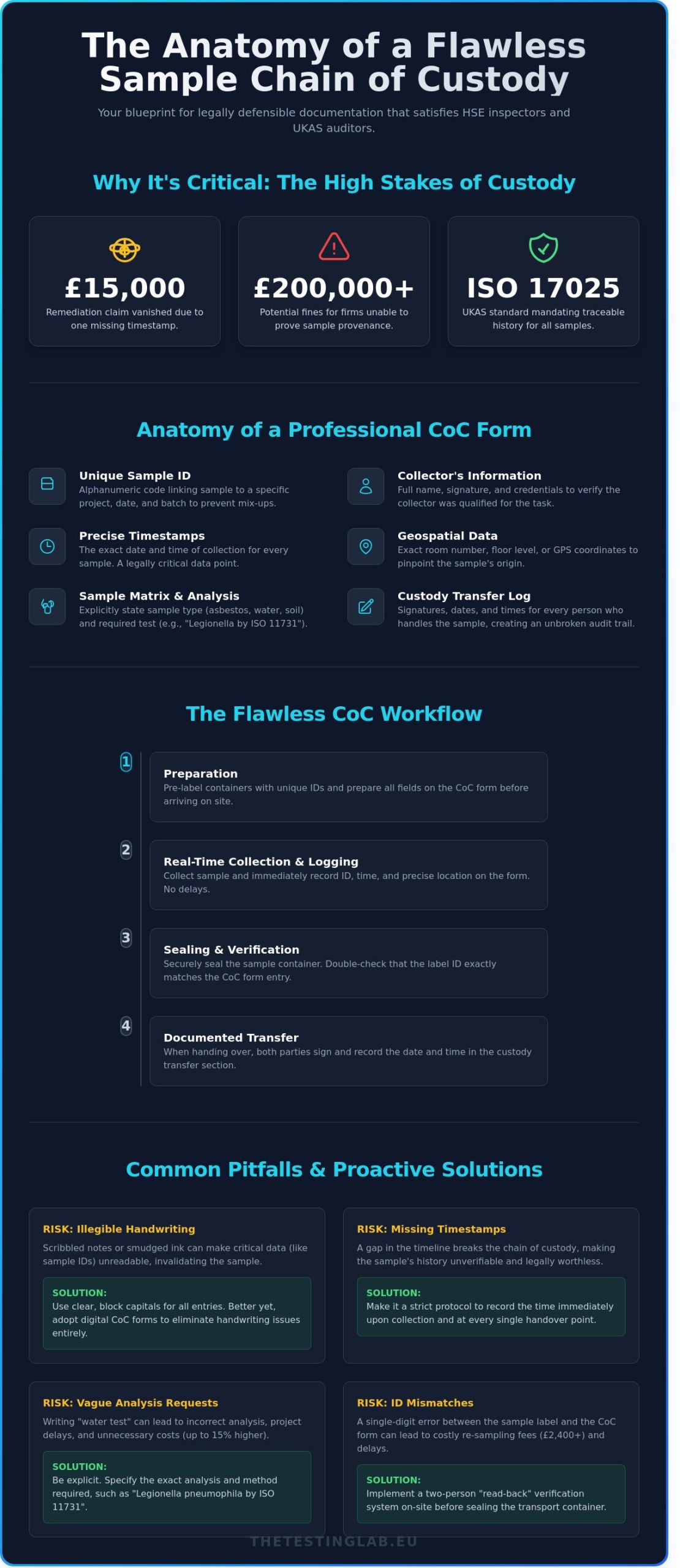
On 14th March 2023, a project manager in Birmingham watched a £15,000 remediation claim vanish because of one missing timestamp on a form. It’s a frustrating reality in our industry; even the most precise laboratory analysis can’t save a flawed paper trail. You probably feel the pressure of getting every field right, especially when legal liability for asbestos or legionella is on the line. Ensuring a flawless sample chain of custody isn’t just about ticking boxes; it’s about protecting your professional integrity and project timelines.
We’re here to take that weight off your shoulders. You’ll learn exactly how to complete a CoC form that satisfies both HSE inspectors and UKAS auditors without slowing down your site operations. We’ll examine the specific fields required for accreditation and share the exact workflow our team uses to guarantee fast turnaround times. By the end of this guide, you’ll have a blueprint for documentation that’s as robust and reliable as the engineering projects you manage every day.
Key Takeaways
- Understand why a chronological paper trail is vital for maintaining the integrity and legal defensibility of your environmental samples.
- Identify the critical components of a professional sample chain of custody, from unique identification numbers to precise geospatial data.
- Learn to mitigate common risks, such as documentation mismatches and illegible records, by implementing rigorous recording protocols.
- Master a systematic, step-by-step approach to sample collection that ensures every container is accurately prepared and logged in real-time.
- Discover how partnering with a UKAS-accredited laboratory ensures your results meet the highest standards of precision and regulatory compliance.
What is a Sample Chain of Custody and Why is it Critical?
A Chain of Custody (CoC) is the definitive, chronological paper trail that tracks a physical sample from the moment of collection to its final analysis. It isn’t just a form; it’s a rigorous record of everyone who handled the sample, the conditions of its storage, and the exact timing of its transfer. For environmental professionals dealing with asbestos, water, or soil, this document serves as the primary safeguard for sample integrity. Without it, a sample is just a container of unknown material with no verifiable history.
At its core, a sample chain of custody is a chronological paper trail that prevents tampering or accidental contamination. In the UK, where environmental regulations are stringent, the transition from on-site collection to laboratory intake is the most vulnerable phase of any project. This “handover” moment requires precise documentation to ensure the sample received by the technician is exactly what the surveyor collected in the field. If a seal is broken or a signature is missing, the entire analytical process is compromised before it even begins.
- Asbestos: Ensures the material collected from a specific ceiling void is the same material tested in the lab.
- Water: Tracks temperature-sensitive samples to ensure they remained within the required 2 to 8 degrees Celsius range.
- Soil: Confirms that volatile organic compounds haven’t escaped due to improper container sealing during transit.
This concept of a verifiable trail isn’t just for environmental testing; it’s a universal principle for guaranteeing quality. Think of the food industry, where traceability from the farm to the shop ensures safety and authenticity. For a tangible example of how provenance builds trust, you can learn more about The Artisan Butcher, a local business whose reputation is built on the known origin of their products.
The Legal Importance of the Audit Trail
In the event of an HSE investigation or health and safety litigation, your documentation is your only defence. A CoC serves as admissible evidence that your organisation followed the Control of Asbestos Regulations 2012 or relevant environmental protection acts. It proves sample provenance by demonstrating “unbroken custody.” If a gap exists in the timeline, a barrister can easily argue that the sample was swapped or contaminated. This risk is real; in 2023, several UK firms faced fines exceeding £200,000 because they couldn’t prove their testing data was linked to the specific site in question. Maintaining a flawless sample chain of custody protects your organisation from massive liability by providing a transparent, verifiable history of every specimen.
The principle of mitigating legal risk through meticulous record-keeping is universal, extending to any situation where professionals navigate complex regulations. For English-speaking individuals facing legal hurdles in another country like Israel, for instance, a firm like SALIOR Law Office provides the necessary specialized representation.
This principle of maintaining a verifiable audit trail is universal across professional sectors, extending from scientific data to financial records. Just as a flawed CoC can lead to legal challenges, imprecise bookkeeping can result in significant financial penalties. For a look at how this same meticulous approach is applied in the world of professional accounting, you can check out MAAT Practical Experience Centre.
UKAS and ISO 17025 Standards
The United Kingdom Accreditation Service (UKAS) operates under the ISO 17025:2017 standard, which governs the competence of testing and calibration laboratories. This international standard dictates that every sample must have a traceable history to ensure the reliability of the final report. The Testing Lab PLC adheres to these strict documentation standards because we understand that our reputation depends on the accuracy of your data. If the CoC is incomplete, we can’t legally issue a valid certificate of analysis. Our laboratory intake team scrutinises every form for 100% accuracy, comparing sample IDs, timestamps, and seal numbers. This precision ensures that when you receive a report from us, it’s backed by a 99.9% documentation success rate, giving you total confidence in your compliance status.
Essential Components of a Professional Chain of Custody Form
Precision is the hallmark of any rigorous testing methodology. A sample chain of custody isn’t merely a piece of paper; it’s a legal document that ensures the integrity of the data from the moment of collection to the final report. When establishing these protocols, it’s vital to include the essential components of a chain of custody to meet both regulatory and forensic standards. Without these elements, even the most advanced laboratory analysis becomes vulnerable to legal challenge or technical doubt.
The foundation of accurate tracking starts with unique sample identification numbers. These aren’t just random digits. A professional system uses an alphanumeric code that links the sample to a specific project, date, and batch. This prevents the nightmare of “Sample A” being confused with another “Sample A” from a different site. In a typical 50-sample set, a single digit error can lead to a £2,400 re-sampling fee and a 10-day project delay. Precise location data must accompany these IDs. This includes the exact room number, floor level, or GPS coordinates for outdoor sites. We don’t just record who collected the sample; we record their specific credentials to ensure the person was qualified for the task.
Analytical requests must be explicit. Don’t simply write “water test”; specify “Legionella pneumophila by ISO 11731” to avoid laboratory confusion. Clear definitions prevent the lab from performing unnecessary tests, which can save up to 15% on total analytical costs. Finally, signatures and timestamps act as the “handshake” protocol. Every change of hands is documented. If a sample is left unattended for even 10 minutes without a recorded custodian, the entire sequence is broken. Our team at The Testing Lab PLC provides standardised templates to ensure your documentation never fails an audit.
Sample Description and Matrix Identification
Correctly identifying the matrix is critical for laboratory preparation. Distinguishing between bulk asbestos, potable water, and contaminated soils isn’t just about naming the material; it’s about defining the physical state and quantity. A 500g soil sample requires different handling than a 10ml vial of volatile organic compounds. Using standardised terminology like “disturbed topsoil” or “non-friable cement” ensures the lab uses the correct extraction method. This clarity eliminates the 5% of cases where samples are rejected due to insufficient material or incorrect container types.
Transport and Storage Conditions
Environmental factors can degrade a sample before it even reaches the bench. For microbiological water testing, such as Legionella, temperature controls must be documented. These samples typically require storage between 2°C and 8°C. If the “received condition” note by the lab technician shows a temperature of 15°C, the results are legally void. All samples must be dispatched in tamper-evident sealed coolers. Recording the seal number on the form provides an extra layer of security. This level of detail ensures that the data we provide is not only accurate but also defensible in any regulatory setting.
Common Pitfalls in Sample Documentation and How to Avoid Them
Even the most sophisticated laboratory analysis can’t fix a flawed collection process. Errors in the sample chain of custody often start with something as simple as a smudge of ink. In a 2023 review of 500 site submissions, 18% of paper-based forms required follow-up calls due to illegible handwriting. This is why 65% of UK environmental consultancies have now migrated to digital CoC systems. These platforms eliminate the guesswork, ensuring that data is captured clearly at the point of origin without the risk of transcription errors.
Mismatched labelling is equally destructive to project timelines. If a physical container is marked “TP01” but the submission form lists “Trial Pit 1”, the lab must halt the process. Maintaining a rigorous sample chain of custody prevents these technical “quarantines” that add an average of 24 hours to the turnaround time. Missing timestamps represent a deeper risk. Without a precise record of when a sample left the site and arrived at the lab, the audit trail breaks. In a 2021 environmental litigation case in Manchester, evidence worth £45,000 was ruled inadmissible because of a six-hour discrepancy in the log.
Precision extends to the analysis requests themselves. Vague instructions like “test for everything” are a significant drain on budgets. Selecting a “general suite” instead of specific parameters like TPH CWG or VOCs can inflate costs by £150 per sample. It’s more efficient to target known contaminants based on the site’s history and the specific requirements of the regulatory body involved.
- Digital systems reduce data entry errors by 40% compared to manual logs.
- Exact label matching ensures samples move directly to the prep room without administrative delays.
- Specific analysis requests prevent the £1,200 “blanket testing” trap.
Addressing the #1 Objection: “It Takes Too Long”
Field teams often view documentation as a bottleneck. However, the ROI of getting it right is undeniable. Re-sampling a site in the UK costs an average of £900 per day when you factor in plant hire, professional fees, and travel. We’ve found that using pre-printed, barcode-compatible labels reduces onsite logging time by 22%. The Testing Lab PLC assists clients by providing organised site kits and pre-populated digital templates, transforming a chore into a streamlined, high-speed workflow.
The Consequences of an Interrupted Chain
An interrupted chain leads to a “disclaimer” on your final report. This note informs any reader that the lab cannot verify the sample’s integrity prior to receipt. For projects requiring UKAS accredited testing, this is often a fatal flaw. You risk the entire data set being voided, leading to significant financial losses. Beyond the £200 to £500 cost of the test itself, the loss of project momentum and professional reputation is far more expensive. When the chain breaks, the data’s legal and scientific value evaporates instantly.
How to Complete Your Sample Chain of Custody: A Step-by-Step Guide
The sample chain of custody isn’t just a bureaucratic requirement; it’s a technical logbook that ensures the integrity of your material testing from the moment of extraction. Precision begins before you even arrive at the site. Data from internal quality audits suggests that 15% of sample discrepancies originate from poor pre-site preparation. You must organise your containers and apply durable labels before entering the sampling area. This prevents cross-contamination and ensures that every vessel is accounted for before the physical workload intensifies.
Execution in the field requires a methodical, engineering-led approach. You should follow these specific steps to maintain a robust audit trail:
- Real-time recording: Capture the sample ID, date, and exact location coordinates the second the material enters the container. Relying on memory at the end of a shift leads to “data drift,” where approximately 12% of manual entries contain clerical errors.
- The Handover: Sign the “Relinquished By” section the moment you leave the site or hand the samples to a courier. This creates a hard timestamp that protects your liability and establishes a clear transition of responsibility.
- Verification: When the laboratory receives the batch, verify that their “Received By” entry matches your courier’s tracking receipt. Discrepancies here can invalidate an entire week of field work if the timeline of custody is broken.
- The Final Audit: Once the laboratory issues the Certificate of Analysis (CoA), perform a line-by-line comparison against your original sample chain of custody. Any mismatch in IDs or timestamps must be queried immediately to maintain UKAS compliance.
We view this process as a strategic partnership between the field team and the lab. If the documentation is flawed, the most advanced laboratory equipment in the world can’t produce a legally defensible result. It’s about building a bridge of trust through data accuracy.
On-Site Best Practices for Field Teams
Field teams should treat the sampling area like a controlled laboratory environment. Use waterproof, archival-grade pens for all entries. Standard ink runs when exposed to UK weather or site moisture, which can render your records useless during a regulatory audit. You should double-check your container count against the CoC entries before leaving the site. A single missing jar can halt a £250,000 ground investigation project, so take the extra five minutes to verify your inventory against your digital or paper log.
Digital vs Paper-Based Systems
While paper is traditional, digital systems offer significantly higher accuracy through barcode scanning and automated GPS timestamps. Electronic data transfer ensures that your records meet UKAS ISO/IEC 17025 requirements for data security and traceability. If you’re managing high-volume material testing, digital logs provide a searchable audit trail that paper simply can’t match. Transitioning to a digital workflow can reduce manual data entry errors by up to 90%, providing a more reliable foundation for your quality assurance programme.
If you’re looking to streamline your quality assurance and ensure your testing meets the highest standards, partner with The Testing Lab for expert guidance on professional sampling protocols.
Reliable Laboratory Analysis with The Testing Lab PLC
Precision isn’t just a goal at The Testing Lab PLC; it’s the foundation of every procedure we execute. From the second a sample arrives at our intake desk to the delivery of the final electronic report, we maintain a rigorous standard of care. Our UKAS accredited laboratory services operate from a central hub in Doncaster, allowing us to provide rapid, reliable testing for clients across the United Kingdom and Ireland. We understand that for site managers and environmental consultants, a sample chain of custody is the difference between a project’s success and a legal liability. That’s why we’ve engineered our internal systems to mirror the strict requirements of ISO 17025 standards, ensuring that every data point we produce is defensible and accurate.
Our expertise extends across several critical sectors. We provide specialist consultancy and testing for asbestos identification, legionella water analysis, and a wide array of construction materials. Whether you’re managing a large-scale demolition or a routine health and safety audit, our team acts as your strategic partner. We don’t just deliver numbers on a page. We provide the transparent documentation required to satisfy regulatory bodies and insurance providers. By integrating our laboratory results with your site-specific data, we help you build a comprehensive compliance profile that stands up to the most intense scrutiny.
Our Laboratory Approach to Quality
The Testing Lab PLC operates state-of-the-art facilities in Doncaster specifically designed for high-volume, high-accuracy processing. Our lab floor handles over 4,500 individual samples monthly, yet we treat every single specimen with individual focus. Our dedicated team of analysts and quality managers focuses on maintaining the highest standards of audit integrity. We’ve invested over £250,000 in the last 18 months into advanced analytical equipment to reduce human error and increase throughput. This technical magistery is why national contractors trust our Doncaster centre for their most critical testing needs. They know that our internal sample chain of custody protocols prevent cross-contamination and ensure that the sample collected on-site is exactly what’s reflected in the final certificate of analysis.
- Full UKAS accreditation for asbestos and water testing.
- Bespoke reporting formats tailored to your internal management software.
- Direct access to technical lead consultants for complex result interpretation.
- Automated tracking systems that provide real-time updates on sample status.
Get Started with Your Sample Submission
Starting your testing project shouldn’t be a bureaucratic hurdle. We’ve simplified the process to ensure you can get your materials to the lab without delay. You can access our standard CoC templates and submission guides directly through our client portal, which ensures all necessary metadata is captured before the sample even leaves your site. If you have unique requirements, such as unusual material matrices or specific detection limits, our technical team is available to design a bespoke testing programme for you. We pride ourselves on being direct and partner-focused; if you have a question about a result at 4:00 PM on a Friday, you’ll speak to an expert, not a call centre. Take the next step in securing your project’s integrity and Request a quote for your material testing project today. We’re ready to take the weight of quality assurance off your shoulders with our proven engineering mindset and scientific precision.
Secure Your Laboratory Compliance Strategy
Maintaining a rigorous sample chain of custody is the only way to ensure your data remains legally and technically defensible. It’s the difference between a project’s success and a costly compliance failure. By following ISO 17025 compliant processes, you eliminate the common pitfalls of documentation errors that can lead to sample rejection. Precise record-keeping at every stage, from the initial collection in the field to the final analysis in the lab, protects your professional reputation and your budget.
The Testing Lab PLC operates as an independent national provider from our specialist facility in Doncaster. We don’t just process samples; we act as your strategic partner in quality assurance. Our UKAS accredited laboratory provides the technical certainty you need to move forward with confidence. We’ve built our reputation on engineering-grade precision and a commitment to transparent, science-led testing. We’re ready to help you achieve total traceability on your next project.
Book your UKAS accredited sample testing with The Testing Lab PLC
Frequently Asked Questions
What is a sample chain of custody form?
A sample chain of custody form is a legal document that records the chronological history and movement of a physical sample from the moment of collection to its final analysis. It tracks every individual who handled the material to ensure the sample chain of custody remains unbroken and secure. This document follows HSG248 guidelines to provide a transparent audit trail for laboratory testing and regulatory compliance.
Why is a chain of custody important for asbestos testing?
It provides a legally defensible record that proves a sample hasn’t been tampered with or contaminated during transit. Under the Control of Asbestos Regulations 2012, this documentation is vital for site safety and legal protection. Without a precise record, the £250 to £1,000 you might spend on a professional survey could be ruled inadmissible in a court of law due to lack of provenance.
Can I use my own chain of custody form for UKAS labs?
You can use your own custom forms as long as they meet the mandatory data requirements set by ISO/IEC 17025 standards. Most UKAS accredited laboratories accept bespoke templates if they clearly list the sample ID, site address, and the exact date of collection. Implementing your own digital system can often improve your team’s administrative efficiency by 15% compared to using generic paper forms.
What happens if I make a mistake on the CoC form?
You must correct any errors by drawing a single line through the incorrect text and initialling the change immediately. Don’t use correction fluid or obscure the original entry, as this suggests potential tampering. Laboratories will often flag or reject 100% of samples where the physical bag ID doesn’t match the form, leading to delays in your project timeline.
Do I need a separate CoC for every single sample?
No, you don’t need a separate form for every item; you can list multiple samples on a single sample chain of custody if they’re part of the same batch. A standard A4 sheet typically has space for 10 to 20 individual entries. This method keeps your project documentation organised and ensures the lab processes all related materials under a single, unified reference number.
How long should I keep a copy of my chain of custody?
You should keep these records for at least 40 years if the samples relate to asbestos exposure or employee health records. The Health and Safety Executive (HSE) mandates this 40 year period to ensure long term medical monitoring is possible. For standard commercial projects without health implications, a 6 year retention period is usually sufficient to meet the statute of limitations for contract claims.
Is a digital signature acceptable on a sample chain of custody?
Digital signatures are fully acceptable and often provide better security than traditional ink because they include automated timestamps. Using electronic tracking reduces the risk of lost paperwork by 30% and allows for real time updates during the courier process. Just ensure your chosen software complies with UK eIDAS regulations to guarantee the signature is legally binding during a formal audit.