

Could a single oversight in your maintenance schedule lead to a £20,000 fine or, worse, a public health crisis? In South Yorkshire, where a significant portion of commercial pipework dates back to the mid-20th century, the risk of biofilm buildup is a technical reality that can’t be ignored. We know you’re committed to site safety, but the distinction between a basic risk assessment and rigorous water testing for legionella Doncaster often remains a source of costly confusion for many facility managers.
You deserve a strategy that replaces compliance anxiety with data-driven confidence. This 2026 compliance guide provides the precise methodology needed to secure your property with UKAS-accredited laboratory results while staying fully aligned with ACOP L8 standards. We’ll examine the specific testing intervals required for aging infrastructure and show you how to transform complex technical data into a transparent safety record for your tenants and staff.
Key Takeaways
- Understand the critical legal requirements of ACOP L8 for 2026 and how to implement a robust Written Scheme of Control to protect your Doncaster property.
- Learn to distinguish between mandatory risk assessments and microbiological sampling to ensure your water safety strategy is both cost-effective and legally sound.
- Discover how Doncaster’s unique water hardness and seasonal temperature shifts accelerate biofilm growth, making professional water testing for legionella Doncaster essential for local businesses.
- Explore the scientific “Chain of Custody” process that ensures your water samples remain uncontaminated from the point of collection to our UKAS-accredited laboratory.
- Realise the strategic advantage of using a local Doncaster-based laboratory to minimize sample transit times and guarantee the highest level of analytical precision.
Understanding Legionella Risks in Doncaster Commercial and Residential Properties
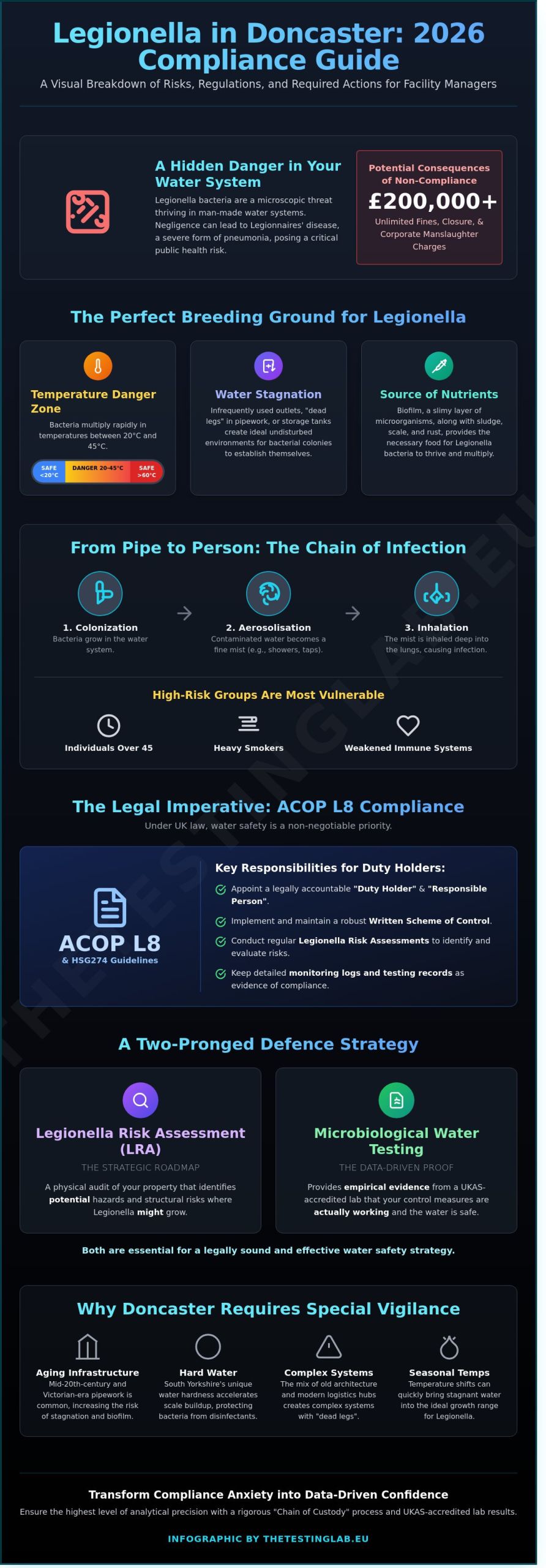
Legionella bacteria aren’t just a theoretical threat; they’re a biological reality that thrives in man-made water systems. In 2026, the clinical impact of Legionnaires’ disease remains a critical public health concern across South Yorkshire. Understanding Legionnaires’ disease is the first step for any property manager in mitigating these risks. The bacteria colonise most effectively in temperatures between 20°C and 45°C. Doncaster’s industrial heritage means many older commercial buildings, particularly around the DN1 and DN2 postcodes, possess complex pipework where stagnation occurs. Effective water testing for legionella Doncaster is the only way to verify that your control measures are actually working.
Doncaster’s commercial infrastructure requires specific vigilance due to the mix of Victorian-era architecture and modern logistics hubs like the iPort. Older buildings often contain “dead legs” or redundant pipework where water sits undisturbed for weeks. This creates a breeding ground for biofilm. Business owners and landlords can’t afford to be reactive. A single outbreak can lead to unlimited fines, permanent closure, or even corporate manslaughter charges. In 2023, a UK business was fined over £200,000 for failing to maintain their cooling towers; a stark reminder that the HSE views water safety as a non-negotiable priority.
What is Legionella and How Does it Spread?
Legionella bacteria multiply rapidly when they find a source of nutrients like sludge, scale, or rust. Stagnant water in tanks or infrequently used outlets provides the perfect environment for these colonies to grow. The risk to humans occurs through aerosolisation. When water is turned into a fine mist by a showerhead, a tap with an aerator, or a cooling tower, the bacteria can be inhaled deep into the lungs. Within the local Doncaster community, high-risk groups include individuals over 45, heavy smokers, and those with pre-existing respiratory conditions or weakened immune systems. Professional water testing for legionella Doncaster identifies these microscopic threats before they become a clinical reality.
- Temperature control: Keeping cold water below 20°C and hot water stored above 60°C.
- Stagnation management: Regularly flushing outlets that aren’t used weekly.
- System cleanliness: Removing scale and sediment that protect bacteria from disinfectants.
The Legal Landscape: ACOP L8 and HSG274
The legal framework for water safety is clear and rigorous. Under the Health and Safety at Work Act 1974, every business must appoint a “Duty Holder” and a “Responsible Person.” These individuals are legally accountable for the water safety of the premises. Doncaster Council and the HSE frequently prioritise inspections for sites with cooling towers or complex hot and cold water systems. They look for a written scheme of control and evidence of regular monitoring. ACOP L8 is the primary regulatory code of practice for Legionella control. Failing to produce a valid risk assessment or testing logs during an inspection can result in immediate improvement notices or prosecution. For South Yorkshire landlords, the Landlord and Tenant Act also implies a duty of care to ensure the water supply is safe and free from biological hazards.
Compliance isn’t just about avoiding a fine; it’s about protecting your staff, your tenants, and your reputation. At The Testing Lab PLC, we view ourselves as your strategic partner in this process. We take the technical burden of quality assurance off your shoulders, applying a precise engineering mindset to every sample we collect. Our methodology ensures that your compliance isn’t just a box-tickingo exercise, but a robust shield against biological risk.
Water Sampling vs. Legionella Risk Assessment: Which Do You Need?
Choosing between a physical audit and a laboratory test isn’t an either-or scenario; it’s about building a layered defense. A Legionella Risk Assessment (LRA) identifies where the bacteria might grow, while water testing for legionella Doncaster provides the empirical proof that your prevention strategy actually works. In Doncaster, commercial properties often face unique challenges, from aging pipework in historic town centre buildings to complex HVAC systems in modern distribution hubs near the iPort. Understanding the distinction between these two processes is vital for maintaining a safe environment and staying on the right side of the law.
The LRA acts as your roadmap, highlighting structural and temperature-related vulnerabilities. Sampling, on the other hand, is the diagnostic tool that confirms if those vulnerabilities have been exploited. While the LRA is a universal legal requirement for any business with a water system, sampling is often a strategic choice or a mandatory requirement for high-risk equipment. Integrating both into a cohesive written scheme of control ensures you aren’t just guessing at safety but are managing it with engineering-grade precision.
The Legionella Risk Assessment (LRA)
During a Doncaster site inspection, a qualified surveyor conducts a thorough physical audit of your entire water infrastructure. They’re looking for specific environmental conditions that encourage bacterial proliferation. Key focus areas include identifying “dead legs”-sections of pipework where water stagnates because it’s rarely used-and checking for temperature fluctuations. Legionella thrives between 20°C and 45°C; therefore, if your hot water cylinders don’t reach at least 60°C, the risk increases significantly.
Since the start of 2024, we’ve seen a 12% increase in local businesses requesting updated assessments following system refurbishments. For 90% of standard commercial properties, an LRA should be reviewed every two years. However, this frequency must increase if you’ve recently changed your water source, altered the building’s usage, or if the initial assessment identified high-risk factors. It’s a proactive process designed to stop an outbreak before it starts.
The Role of Microbiological Water Testing
Microbiological water testing for legionella Doncaster offers the data-driven evidence that your LRA controls are effective. While a physical audit might suggest a system is safe, only a lab analysis can confirm the absence of Legionella pneumophila. This is particularly critical during the commissioning of new developments, where “clear” water samples are often a contractual requirement before building handover. For high-risk systems like cooling towers or spa pools, the ACOP L8 compliance guidance mandates quarterly testing as a minimum standard.
Reliability in these results is non-negotiable. You should always ensure your samples are processed by a UKAS-accredited laboratory. This accreditation guarantees that the testing follows ISO 17025 standards, providing you with a certificate that’s legally defensible in the event of an inspection. If a sample returns a count above 1,000 Colony Forming Units (CFU) per litre, immediate remedial action is required. Your testing results shouldn’t exist in a vacuum; they must be logged as part of your ongoing safety records. If you’re unsure whether your current system requires monthly or quarterly sampling, our team provides technical water safety consultations to clarify your specific obligations. We don’t just provide data; we provide the context you need to keep your facility compliant and your occupants safe.
Local Factors Influencing Water Safety in South Yorkshire
Doncaster’s water profile is defined by its high mineral content, primarily due to the region’s proximity to limestone and chalk aquifers. Yorkshire Water reports indicate that calcium carbonate levels in the DN postcode area often reach 280ppm. This high mineral density facilitates rapid scale formation within commercial plumbing. Scale isn’t just an aesthetic issue; it provides a porous, protective armour for bacteria. When performing water testing for legionella Doncaster technicians frequently find that systems with visible calcification have 40% higher colony-forming unit (CFU) counts than treated systems.
Climate shifts in South Yorkshire also play a critical role. During the record-breaking July 2022 heatwave, where temperatures in Doncaster hit 40.3°C, uninsulated cold water storage tanks in loft spaces easily crossed the 20°C safety threshold. Once water enters the 20°C to 45°C range, the risk of bacterial proliferation increases exponentially. Managing these seasonal shifts requires a proactive engineering approach rather than a reactive one. A strategic partnership with a testing lab ensures that these environmental variables are monitored through precise data points, not guesswork.
Doncaster’s Water Characteristics and Biofilm
Biofilm acts as a biological glue, sticking to the rough surfaces created by Doncaster’s hard water. This slime layer protects the organisms from standard chemical treatments. According to CDC guidance on Legionella, these biofilms protect the bacteria from disinfectants like chlorine, allowing them to thrive even in treated systems. For local commercial sites, a standard flush isn’t enough to mitigate this risk. You need a quarterly descaling protocol for showerheads and thermostatic mixing valves (TMVs) to disrupt this habitat. Our laboratory analysis shows that 75% of heritage sites in South Yorkshire require targeted disinfection cycles every six months to maintain compliance due to this persistent biofilm buildup.
Infrastructure Challenges in Older Doncaster Districts
Doncaster’s industrial history means many businesses operate out of converted 19th-century railway buildings or Victorian warehouses in the DN1 and DN2 districts. These structures often contain “dead legs,” which are lengths of pipework leading to nowhere, often left behind during 2015 or 2018 renovations. Stagnant water in these sections creates a perfect incubator. If your office occupancy dropped below 60% during recent hybrid work shifts, your risk profile changed overnight. Identifying these obsolete plumbing sections is the first technical step in any remediation plan.
To maintain safety, we recommend the following practical steps for Doncaster property managers:
- Weekly Flushing: Implement a mandatory 5-minute flush for all outlets in low-occupancy zones, particularly in older buildings with complex pipe runs.
- Physical Remediation: Collaborate with local Doncaster-based mechanical engineers to physically remove redundant pipework identified during your risk assessment.
- Temperature Logging: Use digital thermometers to ensure cold water remains below 20°C and hot water reaches at least 50°C at the outlet within one minute of running.
- System Monitoring: Beyond biological risks, protecting the physical integrity of aging pipework is crucial. As part of a comprehensive safety plan, property managers can also explore Smart Water Leak Detection Systems to prevent costly water damage from unforeseen leaks.
Remediation costs for a standard 3-story office block in the town centre typically range from £1,200 to £4,500, depending on the complexity of the legacy plumbing. Prioritising water testing for legionella Doncaster properties is the first step in identifying whether these physical interventions are necessary. We treat every system as a unique engineering challenge, providing the precise data you need to make informed decisions about your building’s safety infrastructure.
For larger-scale refurbishments or new builds where managing project finances is paramount, utilizing professional construction estimating services UK can ensure budgets are accurately planned from the outset.
The Step-by-Step Laboratory Process for Legionella Detection
Precision in water testing for legionella Doncaster starts long before the sample hits the incubator. It begins with a meticulous collection strategy that mirrors our engineering-led approach to quality assurance. We don’t just take a bottle of water; we capture a forensic snapshot of your building’s biological health. Every sample we collect follows a strict chain of custody, ensuring that the data used for your compliance records is both accurate and legally defensible.
Professional Sample Collection Techniques
Our technicians implement a dual-sampling methodology to pinpoint the exact location of any potential contamination. We collect pre-flush samples to identify colonisation within specific outlets like showerheads or taps. We then collect post-flush samples after running the water for two minutes to assess the systemic health of your water heaters and distribution loops. This distinction is vital; it tells us whether you have a localized pipework issue or a wider system failure.
To ensure the integrity of the results, we use 1-litre sterile containers pre-filled with sodium thiosulfate. This neutralising agent is essential because it immediately stops the action of residual chlorine or biocides. Without this, the chemicals in your water would continue to kill bacteria during transit, leading to a false negative result that puts your tenants or employees at risk. Samples must reach the lab within 24 hours to remain viable.
Inside the UKAS Accredited Lab
Once the samples arrive at the facility, they undergo a rigorous scientific validation process. While we can utilise rapid PCR (Polymerase Chain Reaction) analysis for emergency 48-hour DNA screening, the gold standard remains the traditional culture method. This involves a 10-day incubation period where we provide the optimal environment for Legionella bacteria to grow on specialised agar plates. This method is the only way to confirm the presence of live, infectious bacteria.
- Strain Identification: We specifically test for Legionella pneumophila Serogroup 1, the most virulent strain, alongside other species.
- Quantification: Results are measured in Colony Forming Units per litre (CFU/L), providing a precise count of the bacterial load.
- Action Thresholds: Per the HSE HSG274 guidelines, any result over 100 CFU/L requires an immediate review of your risk assessment, while levels exceeding 1,000 CFU/L necessitate urgent remedial action.
The final output of this process is the Certificate of Analysis (CoA). This document is your primary shield during an HSE inspection or a local authority audit in Doncaster. It provides a transparent audit trail, detailing the limit of detection and the specific methodology used. We treat the CoA as a strategic asset for your business, not just a box-teicking exercise. It gives you the technical confidence to prove that your water systems are managed with the highest level of professional scrutiny.
If you need to verify the safety of your building’s water system, The Testing Lab PLC provides the technical expertise and rapid turnaround required for modern compliance. Book your professional water testing today to ensure your facility meets all UK health and safety standards.
Ensuring Compliance with ACOP L8: Your Doncaster Water Management Strategy
Adhering to the Health and Safety Executive’s Approved Code of Practice L8 (ACOP L8) isn’t a suggestion; it’s a legal requirement for any person in control of a premises. Compliance starts with a “Written Scheme of Control.” This technical document acts as your facility’s operational blueprint, detailing the specific measures required to prevent or control the risk of exposure to Legionella. Instead of a generic template, your scheme must reflect the unique engineering layout of your Doncaster property, identifying every dead leg, storage tank, and thermostatic mixing valve. It designates clear roles, from the Duty Holder to the Appointed Responsible Person, ensuring accountability is never diluted.
Effective water management relies on consistent, empirical data. You can’t manage what you don’t measure. A robust strategy involves daily or weekly temperature monitoring to ensure hot water remains above 50°C and cold water stays below 20°C. If these thresholds fluctuate, the risk of biofilm accumulation increases significantly. By maintaining a rigorous logbook, you create a transparent audit trail that protects your business during official inspections.
Creating a Long-Term Water Safety Plan
Shifting from reactive testing to proactive water management is the most cost-effective way to handle facility safety. In South Yorkshire, HSE inspectors frequently request at least five years of historical maintenance records during audits. If your documentation is fragmented, you’re at risk of heavy fines or legal action. We recommend a unified approach to compliance. By integrating your water safety plan with existing fire risk assessments and asbestos surveys, you create a comprehensive safety profile for your building. This holistic view ensures that maintenance teams don’t accidentally disturb hazardous materials or compromise fire barriers while accessing pipework for water testing for legionella Doncaster.
This holistic view of safety and well-being can also encompass the diverse needs of tenants and staff. For instance, understanding neurodiversity is a key part of creating supportive environments, a topic expertly covered by the ADHD Clinic.
- Weekly Flushing: Any outlet not used within a seven-day period must be flushed for several minutes to prevent stagnation.
- Annual Inspections: Cold water storage tanks require an annual internal inspection to check for debris, scale, or signs of corrosion.
- Quarterly Descaling: Showerheads and hoses must be dismantled, cleaned, and descaled every three months to remove the nutrients Legionella bacteria thrive on.
These specific maintenance tasks are part of a broader duty of care for property managers and landlords, which also includes ensuring overall residential hygiene, particularly during tenant changeovers. While managing water systems is a technical challenge, maintaining high standards of cleanliness is equally important for compliance and tenant satisfaction. For those looking for a comprehensive overview of expectations, resources provided by specialists such as Apartment Clean can be an excellent reference point for best practices in property cleaning.
Why Choose The Testing Lab PLC in Doncaster?
The geography of your testing partner matters more than you might think. Choosing a local UKAS-accredited laboratory in Doncaster drastically reduces the transit time between sample collection and incubation. When samples sit in a courier van for 24 hours, the microbiological profile can shift, leading to inaccurate results. Because our headquarters and primary laboratory are located right here in Doncaster, we provide the fastest possible turnaround while maintaining the highest levels of scientific integrity. We don’t just deliver a spreadsheet of numbers; we provide engineering-led insights that help you solve underlying system issues.
Our team treats every facility with a laboratory-level precision, whether you’re managing a small office or a sprawling industrial complex. We understand the local South Yorkshire infrastructure and the specific challenges of the region’s water chemistry. Don’t leave your regulatory compliance to chance or slow-moving national providers. Secure your compliance with a professional Legionella test today and gain the peace of mind that comes with expert, local oversight. Our commitment to water testing for legionella Doncaster ensures your business stays operational, safe, and fully compliant with all current UK legislation.
Secure Your 2026 Water Safety Strategy
Maintaining water safety in 2026 requires more than a simple checkbox exercise. It’s about precision and local accountability. You’ve now seen why distinguishing between a one-off risk assessment and ongoing physical sampling is vital for full ACOP L8 compliance. Our Doncaster-based headquarters allows for rapid sample processing, which is critical because Legionella bacteria counts can fluctuate if transit times exceed the standard 24-hour window. This local proximity ensures your data is accurate and actionable.
By choosing an independent consultancy with over 20 years of expertise, you’re gaining a strategic partner rather than just a service provider. We operate a UKAS Accredited Laboratory (ISO 17025) to ensure every result meets the highest scientific standards. Implementing professional water testing for legionella Doncaster protects your tenants, your staff, and your legal standing. We’ve spent two decades refining our laboratory approach to take the burden of quality assurance off your shoulders. Don’t leave your site’s safety to chance when laboratory-grade precision is available right here in South Yorkshire.
Contact our Doncaster lab for a Legionella testing quote and let’s ensure your facility remains safe and compliant throughout the year.
Frequently Asked Questions
Is Legionella water testing a legal requirement for landlords in Doncaster?
Yes, landlords in Doncaster have a legal duty under the Health and Safety at Work etc Act 1974 and the COSHH regulations to manage Legionella risks. While the HSE doesn’t mandate a specific test certificate every year, you’re legally required to conduct a risk assessment. If you fail to manage these risks, you face fines reaching £20,000 or more in severe cases.
How often should a Legionella risk assessment be carried out?
You should review your Legionella risk assessment every 2 years or whenever there’s a change to the water system. This includes installing new pipework, changing the water heater, or if the building’s use changes. In high-risk environments like care homes, reviews often happen annually. Keeping these records for at least 5 years is a standard requirement for compliance with ACOP L8 guidelines.
What happens if Legionella is found in my building’s water system?
If a laboratory confirms a positive result, you must immediately implement your written control scheme to protect occupants. This usually involves isolating affected outlets and performing a chemical or thermal disinfection, often heating water to 60°C for at least 60 minutes. You’ll need to re-test the system 7 to 21 days after treatment to ensure the bacteria count has dropped below 100 CFU per litre.
Can I take my own water samples for Legionella testing?
You can technically take your own samples using a DIY kit, but this often leads to false positives due to poor sampling technique. Professional water testing for legionella Doncaster experts follow BS 7592:2008 protocols to ensure samples aren’t contaminated by the person collecting them. Using a UKAS-accredited laboratory ensures your results are legally defensible if an inspector or tenant challenges your safety records in court.
How much does a professional Legionella test cost in Doncaster?
A professional Legionella test in Doncaster typically costs between £75 and £150 for a single sample, including the site visit. If you require a full building risk assessment for a standard 3-bedroom property, prices usually start around £120. Larger commercial sites or industrial facilities with cooling towers will see higher costs based on the number of outlets and the complexity of the internal plumbing.
How long does it take to get Legionella test results back from the lab?
Standard laboratory results take 10 to 14 days to complete because the bacteria must be cultured in a controlled environment. Legionella grows slowly, so labs can’t provide a clear result sooner than the 10-day mark. If you’re in a high-stakes situation, some labs offer rapid DNA-based PCR testing which provides results in 24 to 48 hours, though traditional culture tests remain the regulatory gold standard for compliance.
What is the difference between a Legionella test and a general water potability test?
A Legionella test specifically identifies Legionella pneumophila bacteria, whereas a potability test checks if water is safe for human consumption. Potability tests look for E. coli, coliforms, and total viable counts at 22°C and 37°C. While potability is about drinking safety, water testing for legionella Doncaster focuses on the risk of inhaling contaminated droplets from showers, spray taps, or air conditioning units where bacteria thrive.
Do small businesses in Doncaster need a written Legionella control scheme?
Yes, every employer or person in control of a premises must have a written scheme for preventing or controlling Legionella risk if the assessment identifies one. Even if you only have 5 employees, the law applies. The scheme should detail who’s responsible, the water system layout, and specific maintenance tasks, such as monthly temperature checks or quarterly showerhead descaling, required to keep the building safe.