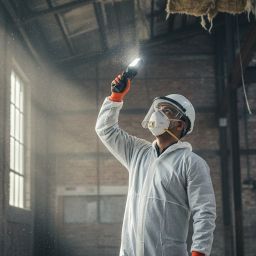


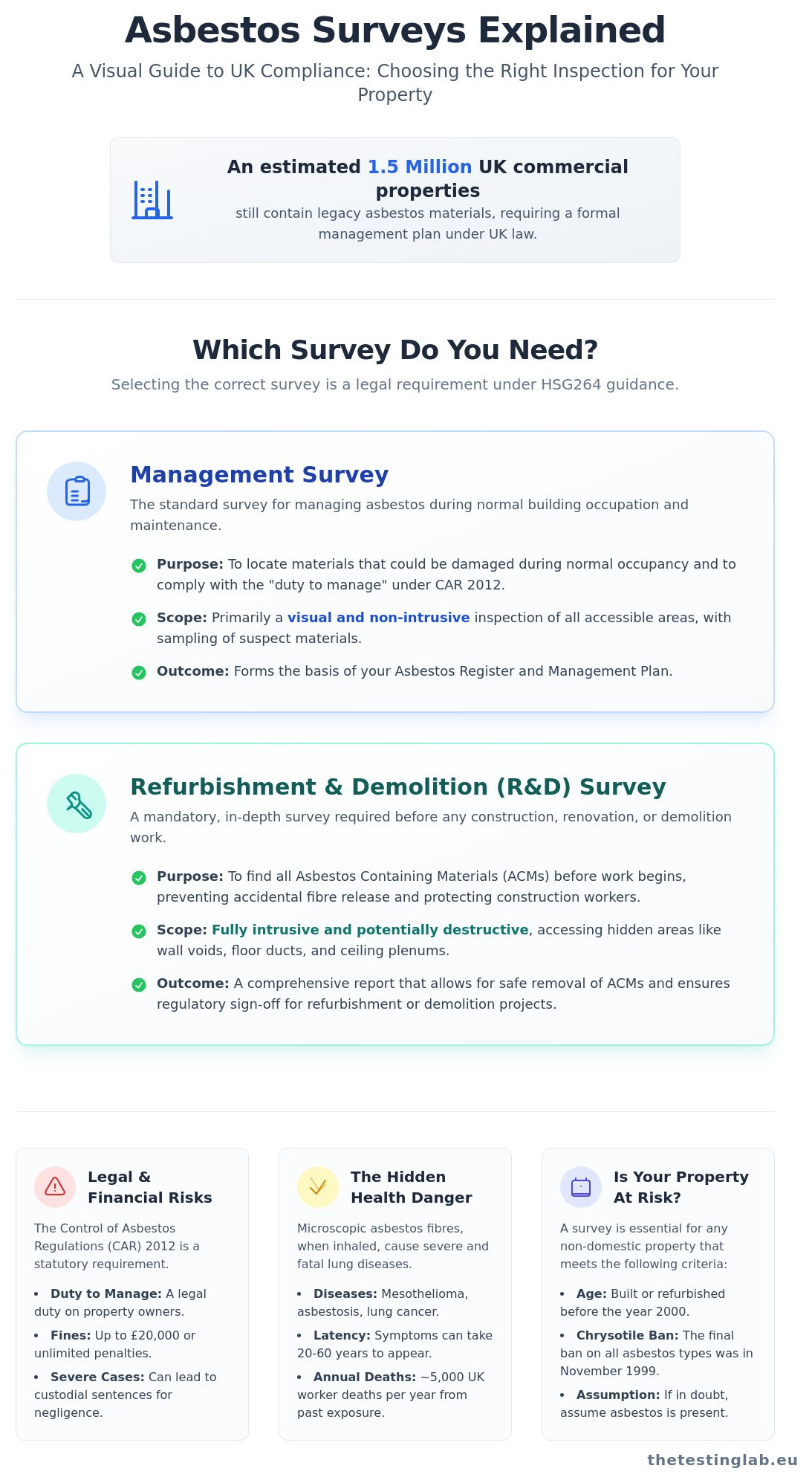
Did you know that an estimated 1.5 million commercial properties across the UK still contain legacy asbestos materials according to recent health and safety audits? You’re right to worry about the £20,000 maximum summary fine or the unlimited penalties that the HSE can impose for non-compliance with CAR 2012. It’s natural to feel overwhelmed by the technical jargon or the fear that a professional asbestos survey might bring your operations to a standstill. We believe that precision in testing shouldn’t come at the cost of your business’s momentum.
This guide ensures you’ll master the complexities of UK-wide legislation and understand exactly how a rigorous inspection protects your staff and your bottom line. We’ll clarify the technical differences between Management and Refurbishment surveys so you can act with engineering-grade confidence. You’ll finish this article with a clear, actionable asbestos management plan for 2026 that satisfies every legal requirement while keeping your occupants safe and your business running smoothly.
Key Takeaways
- Understand the legal frameworks governing UK-wide compliance and why a professional asbestos survey is the essential first step in protecting your people and property.
- Learn to distinguish between Management and Refurbishment surveys under HSG264 to ensure you commission the correct inspection for your building’s specific requirements.
- Discover the technical precision behind UKAS-accredited sampling and how a laboratory-led methodology ensures total site coverage and accurate material identification.
- Master the interpretation of Material and Priority Assessment scores to transform complex survey data into a robust, actionable asbestos management plan.
- See how an engineering-led approach to consultancy provides the transparent reporting and precision needed to manage hazardous materials with total confidence.
What is an Asbestos Survey and Why is it Legally Required in the UK?
An Asbestos survey is a comprehensive, systematic inspection of a property designed to locate and manage hazardous materials. It isn’t a casual walkthrough; it’s a technical audit of a structure’s safety profile. The primary objective is to identify the location, type, and condition of Asbestos Containing Materials (ACMs). This data allows property owners to create a robust management plan that prevents accidental fibre release. In the UK, any building constructed or renovated before the total ban in November 1999 is high-risk. While the use of crocidolite and amosite was banned earlier, chrysotile remained in use until the very end of the millennium, meaning thousands of UK-wide commercial and industrial sites still contain these legacy materials.
The legal framework governing this process is the Control of Asbestos Regulations (CAR) 2012. Regulation 4 specifically outlines the “duty to manage” asbestos in non-domestic premises. This isn’t a voluntary safety measure; it’s a statutory requirement. Failure to comply leads to severe penalties from the Health and Safety Executive (HSE). In 2023, the HSE continued to issue unlimited fines and, in cases of gross negligence, custodial sentences for those who failed to protect occupants. Without a professional Asbestos survey, you can’t prove compliance, making your business liable for prosecution and immediate site closure if hazardous fibres are detected during routine work.
The Role of the Duty Holder under UK Law
The Duty Holder is the individual or entity responsible for the maintenance and repair of non-domestic premises. Under UK-wide law, this person must maintain an up-to-date asbestos register. This register acts as a live safety document, informing every contractor and employee about the presence of ACMs before any work begins. Professional surveys provide the empirical data needed for this register. It’s the foundation of a safe system of work, ensuring that maintenance teams don’t accidentally disturb hidden fibres during minor repairs or large-scale renovations.
Health Risks: Why Professional Identification Matters
Asbestos fibres are microscopic, often measuring less than 3 microns in width. When inhaled, they lodge deep in the lung tissue, leading to fatal conditions like mesothelioma and asbestosis. These diseases have a long latency period, often taking 20 to 60 years to manifest symptoms. Friable materials, which crumble under light pressure, pose the most immediate threat as they easily become airborne. Because many ACMs look identical to modern insulation or cement, visual inspection is never sufficient. Definitive identification requires laboratory-grade precision to confirm fibre types and concentrations, which is why we treat every inspection with scientific rigour.
Choosing the Right Asbestos Survey: Management vs Refurbishment
Selecting the correct asbestos survey depends entirely on your intent for the property and its current lifecycle stage. The Health and Safety Executive (HSE) defines two primary levels of inspection within the HSG264 framework to ensure UK wide safety and compliance. While a Management Survey supports your ongoing legal duty to manage, an R&D survey is a strict prerequisite for any physical alterations. Navigating these requirements requires a technical mindset. It’s often beneficial to engage in professional asbestos consultancy to define the exact scope before site works begin, preventing costly project delays or accidental exposure.
The Management Survey: Standard Compliance
The Management Survey is the standard tool for day-to-day building operations. Its primary goal is to locate Asbestos Containing Materials (ACMs) that could be disturbed or damaged during normal occupancy, including routine maintenance. Our surveyors focus on a visual inspection of all accessible areas, taking samples of suspect materials for lab analysis. This process establishes a baseline for your Asbestos Management Plan, which is a legal requirement under CAR 2012. If you’re managing a commercial portfolio in 2026, this survey ensures your tenants and employees remain protected from incidental contact with fibres.
Refurbishment and Demolition (R&D) Surveys
Before any structural works, extensions, or full demolitions commence, an R&D survey is legally mandatory. Unlike the standard inspection, this is a fully intrusive process. Surveyors must access wall voids, floor ducts, and lift shafts, often using destructive techniques to uncover materials hidden behind the building fabric. Statistics from the HSE suggest that roughly 5,000 workers die annually from past asbestos exposure; many of these cases stem from disturbing hidden ACMs during construction. An R&D survey eliminates this uncertainty. It’s a critical safety gate that must be cleared before any contractor sets foot on site.
This includes seemingly minor cosmetic upgrades. For instance, before a specialist firm like Universal Blinds UK installs new shutters, an intrusive survey is essential to ensure their fitters do not drill into concealed asbestos insulation board (AIB) within window frames or walls.
The same principle applies when converting a property into a public venue; before entertainment specialists like RCT Entertainment & Events install lighting rigs or sound systems, the underlying structure must be certified as safe for such modifications.
Likewise, establishing a popular nightlife spot in a historic city centre, a common setting for entertainment venues, requires this same diligence. You can learn more about The Comedy Attic, a premier club in Edinburgh, as an example of a public-facing business where such safety standards are paramount.
Choosing between these isn’t always binary. Large-scale UK wide programmes often require a hybrid approach or phased inspections to manage costs. If you’re unsure which path fits your 2026 project timeline, you can request a technical consultation to align your asbestos survey strategy with your health and safety obligations. We treat every inspection with laboratory-grade precision, ensuring no hidden risk compromises your project’s integrity.
The Technical Process: From On-Site Sampling to UKAS Lab Analysis
A professional asbestos survey relies on methodical precision rather than guesswork. When surveyors arrive on-site, they follow the stringent protocols outlined in the HSG264 guidance. They don’t just look for obvious signs; they conduct a systematic, room-by-room inspection to identify Suspect Asbestos Containing Materials (SACMs). This engineering-led approach ensures that every square metre of a property is accounted for before any renovation or demolition work begins.
The methodology hinges on representative sampling. Surveyors identify homogenous areas where materials appear identical in manufacture and age. Instead of damaging every surface, they take strategic samples that represent the entire batch. This process involves:
- Wetting the material with a suppressant to prevent fibre release.
- Extracting a small core or fragment using specialised hand tools.
- Double-bagging the sample in 500-gauge polythene bags.
- Sealing the sample point with professional-grade filler or tape.
- Assigning a unique barcode to maintain a rigorous chain of custody from the site to the laboratory.
This level of detail is vital for UK-wide compliance. It ensures that the data used for the final risk assessment is accurate, traceable, and legally robust.
Laboratory Techniques: Polarised Light Microscopy (PLM)
Once samples reach the lab, scientists use Polarised Light Microscopy (PLM) to confirm the presence of asbestos. Technicians examine the fibres under magnification levels ranging from 80x to 500x. They look for specific optical properties to distinguish between Chrysotile (white), Amosite (brown), and Crocidolite (blue). UKAS accreditation to ISO 17025 standards is the gold standard for these tests. It provides the technological confidence that even low-percentage asbestos content in complex textured coatings or floor tiles won’t be missed.
Asbestos in Soils and Construction Waste
Brownfield redevelopment across the UK faces the unique challenge of ground contamination. Identifying asbestos fragments within soil matrices requires a different level of expertise compared to building materials. Under the Control of Asbestos Regulations 2012, rigorous asbestos in soils testing is a mandatory prerequisite for land redevelopment. Precise soil analysis prevents the 15% average project delay caused by unexpected contamination discovery mid-construction. By quantifying the asbestos content early, developers can manage waste disposal costs effectively and ensure the safety of groundworkers and future site occupants.
Interpreting Your Asbestos Report and Implementing a Management Plan
Receiving your completed asbestos survey is a critical milestone, but the data it contains requires professional interpretation to ensure UK-wide compliance. A standard report deconstructs findings into two primary metrics: the Material Assessment and the Priority Assessment. The Material Assessment score (ranging from 2 to 12) evaluates the product type, its condition, and the specific asbestos variety. The Priority Assessment score is equally vital; it measures the likelihood of human exposure based on room occupancy and the frequency of maintenance activities. Combining these scores gives you a definitive risk rating, guiding your next strategic moves.
The Asbestos Register: Your Live Compliance Document
Your register isn’t a static file; it’s a dynamic tool that must be updated whenever the status of a building changes. To meet HSE requirements, it must detail the precise location, material type, condition, and quantity of all ACMs. Accuracy is non-negotiable. By 2025, approximately 84% of UK commercial property managers transitioned from paper-based logs to cloud-based digital management systems. This shift ensures that maintenance staff and external contractors can access real-time data on their mobile devices before they even touch a wall. You’re legally required to share this register with anyone liable to disturb the fabric of the building.
Next Steps: Remediation or Management?
Finding asbestos doesn’t always necessitate immediate removal. If the material is in good condition and unlikely to be disturbed, “management in situ” is often the safest and most cost-effective path. We frequently recommend encapsulation for materials like Asbestos Insulating Board (AIB). This process involves applying a specialist penetrative sealant to trap fibres, providing a durable barrier without the risks associated with full extraction. However, if the Material Assessment score indicates high friability or if renovation is planned, removal becomes mandatory. Any removal project must conclude with a 4-stage clearance process, including air monitoring to a detection limit of <0.01 f/ml, ensuring the area is safe for re-occupation.
Managing these risks requires technical precision and a clear roadmap for long-term safety. If you need expert guidance on interpreting your findings, our team provides comprehensive asbestos consultancy services to help you maintain a safe, compliant environment.
- Material Assessment: Focuses on the physical state and type of the ACM.
- Priority Assessment: Evaluates the human element and risk of disturbance.
- Re-inspections: Mandatory annual checks to monitor for degradation.
- Accessibility: The register must be available to all site workers 24/7.
Securing UK-Wide Compliance with The Testing Lab PLC
The Testing Lab PLC functions as a strategic partner for duty holders across the United Kingdom. Based in our Doncaster headquarters, we deliver UK-wide coverage with the speed of a local provider and the technical depth of a national laboratory. Every asbestos survey we conduct follows an engineering-led methodology, prioritising precision over speed. We don’t just deliver a PDF; we provide a comprehensive safety roadmap backed by transparent reporting. Our consultants understand that site managers need data that’s both accurate and actionable to avoid project delays.
Our commitment to quality is reflected in our laboratory’s history. Since 2002, we’ve focused on technical excellence, ensuring that our clients meet their legal obligations without the stress of managing multiple uncoordinated contractors. By centralising our operations, we maintain a consistent standard of reporting that remains identical whether your project is in London, Manchester, or Glasgow.
Why UKAS Accreditation is Non-Negotiable
UKAS accreditation isn’t just a badge; it’s a guarantee of technical competence. It means our laboratory is regularly audited to ensure our testing methods are consistent and accurate. This rigour ensures your data stands up to scrutiny in legal proceedings or during HSE inspections. Since our inception in 2002, we’ve maintained these high standards to protect our clients from the severe financial and legal consequences of non-compliance. Without this level of accreditation, your results could be deemed inadmissible in a court of law, leaving your business vulnerable.
Integrated Health and Safety Solutions
Efficiency in site management comes from consolidation. By using The Testing Lab PLC as a single partner for asbestos, water, and material testing, you reduce the administrative burden of managing multiple vendors. Our multi-disciplinary laboratory allows us to combine site investigations, such as pairing an asbestos survey with a Legionella risk assessment. This holistic view ensures no compliance gap is left unaddressed, saving you time and reducing the overall cost of site safety audits.
- Streamlined site investigations through a single expert point of contact.
- Expert advice on complex UK legislation including CAR 2012.
- Consistent UK-wide reach with rapid turnaround times from our Doncaster hub.
Our team is ready to provide expert advice on the complexities of UK safety legislation. For a tailored approach to your property’s compliance, contact us today for a bespoke quote for asbestos services.
Future-Proof Your Compliance Strategy for 2026
Navigating the complexities of the Control of Asbestos Regulations 2012 requires more than a tick-box approach; it demands precision and technical foresight. Whether you’re maintaining a commercial facility or planning a major 2026 renovation, choosing the correct Asbestos survey is the only way to mitigate legal risks and health hazards. Since 2002, The Testing Lab PLC has bridged the gap between complex UK legislation and practical site management. Our UKAS accredited laboratory ensures every sample undergoes rigorous scientific analysis, while our Doncaster HQ coordinates expert teams for UK-wide coverage. You aren’t just buying a report. You’re securing a strategic partnership that protects your workforce and your liability. We’ve spent 22 years refining our laboratory-led methodology to take the burden of compliance off your shoulders. It’s time to move from uncertainty to total regulatory confidence through scientific accuracy. Our team’s ready to provide the clarity your project needs to stay safe and legal.
Request a Professional Asbestos Survey Quote Today
Frequently Asked Questions
How long does an asbestos survey take to complete?
A standard domestic asbestos survey for a three-bedroom property typically takes between 2 and 4 hours to complete on-site. Larger commercial premises often require 1 to 3 days depending on the complexity of the structure and the number of samples required. Once the physical inspection ends, UKAS-accredited laboratory results are usually delivered within 48 to 72 hours to ensure scientific precision.
Is an asbestos survey a legal requirement for selling a house in the UK?
No, it’s not a strict legal requirement for domestic sellers under the Control of Asbestos Regulations 2012, but it’s a practical necessity. Most UK mortgage lenders require an asbestos survey before approving a loan on properties built before 2000. Data shows that 75% of UK solicitors recommend a survey to prevent future liability and ensure the safety of the new occupants.
What is the difference between a survey and a sample test?
A survey is a comprehensive site inspection designed to locate all potential Asbestos Containing Materials (ACMs) within a building. A sample test is the specific laboratory analysis of a single piece of material to confirm the presence of fibres. Think of the survey as the strategic diagnostic roadmap, while the sample test provides the scientific proof through microscopic examination.
Can I stay in the building while an asbestos survey is being carried out?
You can remain in the building during a Management Survey because the methodology is non-intrusive and doesn’t disturb the fabric of the building. However, for a Refurbishment and Demolition (R&D) survey, the premises must be vacant. These intrusive inspections involve breaking into walls and ceilings; therefore, strict access control is required to manage the risk of fibre release.
How much does a professional asbestos survey cost UK-wide?
A standard domestic asbestos survey typically costs between £200 and £350 for a three-bedroom semi-detached home. Commercial rates start at approximately £500 and scale upwards based on the square footage and the building’s age. These prices include the site visit, the surveyor’s expertise, and the subsequent UKAS-accredited laboratory analysis of any samples taken during the process.
How often should an asbestos management survey be updated?
You should review your asbestos management plan every 12 months to remain compliant with UK health and safety legislation. Regulations require a reinspection of known ACMs at least once a year to check for physical degradation or accidental damage. If you plan any structural changes or the building’s use changes significantly, you’ll need to update your survey records immediately.
Does a building built in 1999 need an asbestos survey?
Yes, any building completed before 31 December 1999 requires a survey to ensure total safety. While the UK government banned chrysotile (white asbestos) in November 1999, existing stockpiles of building materials were frequently used until the very end of the year. We’ve identified ACMs in several UK-wide projects where construction finished in the final weeks of 1999.
What happens if asbestos is found during the survey?
The surveyor assigns a risk score to each material based on its condition and the likelihood of fibre release. If the material is in good condition, it’s recorded in the asbestos register and monitored annually. If it’s damaged or high-risk, you must hire a licensed contractor to encapsulate or remove the material following the Control of Asbestos Regulations 2012 protocols.