
Roughly 6 million residential properties across the UK still contain legacy materials installed before the 1999 total ban, which means your pre-millennium house likely contains asbestos in the home. You might feel a genuine sense of anxiety when a RICS survey flags potential risks or when you’re planning a 2026 renovation project. It’s completely understandable to worry about your family’s respiratory health or the potential financial impact on your property’s market valuation. Conflicting advice on DIY forums often only adds to this confusion, leaving many homeowners feeling stuck between high costs and safety risks.
We believe that scientific clarity is the most effective tool for safety. This guide offers a definitive, UK-compliant strategy for identifying and managing these materials according to the Control of Asbestos Regulations 2012. You’ll learn how to spot high-risk textured coatings or floor tiles, create a structured safety plan, and engage UKAS-accredited laboratories for precision testing that provides absolute peace of mind. We’re moving from uncertainty to a methodical, engineering-led approach to residential safety that puts you back in control of your environment.
Key Takeaways
- Identify high-risk materials and hidden locations in typical UK semi-detached and terraced houses to effectively protect your household.
- Understand the critical concept of friability to accurately assess when asbestos in the home requires professional intervention or simple monitoring.
- Ensure full legal compliance UK-wide by understanding your specific responsibilities under the Control of Asbestos Regulations 2012 (CAR 2012).
- Learn why UKAS-accredited laboratory testing is the non-negotiable standard for verifying material safety using precise Polarised Light Microscopy.
- Transition from uncertainty to expert-led management by following a structured, engineering-based methodology for long-term residential safety.
Understanding Asbestos in UK Residential Properties
Asbestos isn’t a synthetic chemical or a modern industrial invention. It’s a group of six naturally occurring silicate minerals composed of microscopic fibres. Builders and manufacturers prized these minerals for their extraordinary tensile strength, chemical resistance, and thermal insulation properties. To grasp the technical complexity of What is Asbestos?, you have to look at its physical durability. These fibres are virtually indestructible, which made them ideal for construction but hazardous to human health when disturbed and inhaled.
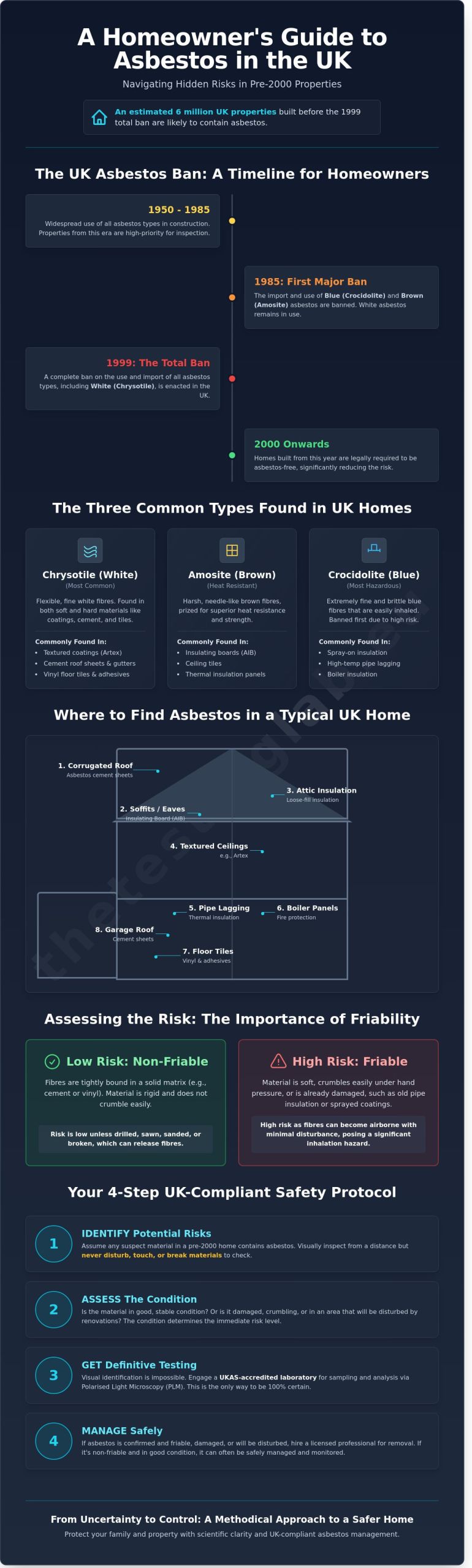
Between 1950 and 1999, the UK construction industry integrated asbestos into thousands of building components. It’s a common misconception that asbestos in the home is only found in industrial-style prefabs or social housing. In reality, any property built or refurbished before the turn of the millennium likely contains some form of asbestos-containing material (ACM). We categorise the risk based on three primary types found in British domestic architecture: Chrysotile, Amosite, and Crocidolite.
- Chrysotile (White Asbestos): The most frequently used variety. You’ll often find it in soft products like textured ceiling coatings or hard products like cement roof sheets and floor tiles.
- Amosite (Brown Asbestos): Known for superior heat resistance. It was the standard choice for insulating boards, ceiling tiles, and structural fire protection.
- Crocidolite (Blue Asbestos): This type consists of extremely thin, brittle fibres. It was primarily used in high-temperature applications, such as pipe lagging and spray-on insulation, before being phased out earlier than white asbestos.
The UK Asbestos Ban: Key Dates for Homeowners
UK legislation evolved as the health risks became undeniable. In 1985, the government implemented the first major restriction, banning the import and use of both blue and brown asbestos. While this significantly reduced the use of high-risk insulation boards, white asbestos remained legal and widely used in products like corrugated roofing and decorative finishes. The definitive turning point occurred in November 1999, when the UK enacted a total ban on all forms of asbestos. If your home was built from 2000 onwards, it’s legally required to be asbestos-free. These dates provide a vital framework for your survey and maintenance priorities; any property predating 1985 is a high-priority candidate for a professional inspection.
Why Asbestos was the “Wonder Material” of the 20th Century
Post-war Britain faced a massive housing shortage, requiring materials that were cheap, durable, and fireproof. Asbestos was the perfect engineering solution. It was mixed into over 3,000 different products, ranging from heavy-duty structural components to everyday household items. Trade names like Marinite and Eternit dominated the market, appearing in everything from kitchen boiler cupboards to garage roof panels. It provided a level of fire protection that few other materials could match at the time. This transition from industrial use to widespread domestic application means that asbestos in the home is often hidden behind layers of paint, wallpaper, or modern flooring, requiring a methodical, laboratory-grade approach to identify correctly.
Common Locations and Materials Containing Asbestos
Identifying asbestos in the home presents a significant technical challenge because the fibres are microscopic; you simply cannot confirm its presence by sight alone. Between 1950 and the final ban in 1999, the UK construction industry integrated asbestos into over 3,000 different building products. In a typical semi-detached or terraced house, these materials often hide in plain sight. Many homeowners mistake modern fibre cement for older asbestos cement, or assume a smooth ceiling is safe when it may have been skimmed over a textured coating. This risk profile is consistent for residential properties UK wide, regardless of regional architectural styles. Expert sampling remains the only definitive way to verify safety and manage risk.
Internal Asbestos Materials: From Ceilings to Floors
Artex and similar textured coatings represent the most frequent domestic encounter with asbestos. These finishes were a staple for UK decorators until the mid-1980s. While some manufacturers phased out asbestos earlier, it wasn’t fully banned in these coatings until 1992. These textured finishes often contain between 1% and 5% chrysotile. You can view detailed diagrams of Common locations of asbestos in UK homes provided by the Health and Safety Executive to see how these materials are distributed through different rooms.
Beneath your feet, 9-inch or 12-inch vinyl floor tiles from the 1960s and 70s frequently contain asbestos. The dark, brittle bitumen adhesive, or mastic, used to bond them to the concrete screed is also a high-risk material. For fire protection, builders used Asbestos Insulating Board (AIB). This is a higher-risk material than cement. You’ll typically find AIB lining airing cupboards, acting as ceiling tiles in kitchens, or installed as panels behind boilers and inside fuse boxes.
External and Structural Asbestos Hazards
The exterior of a UK property often contains durable asbestos cement products. Corrugated roofing on sheds, garages, and lean-to extensions is a prime example. These sheets typically consist of 10% to 15% white asbestos compressed with cement. Rainwater goods, including downpipes and gutters, were also manufactured using this cement blend until the late 1980s. Inside the loft space, it’s common to find old cold water storage tanks; these are often grey, hard-wearing asbestos-reinforced boxes that remain in place even after modern plumbing upgrades.
Safely managing these materials is a crucial first step for any attic renovation. If you’re exploring how to transform this area, you can discover The Loft Worm for a detailed step-by-step guide.
- Soffits and Fascias: Located under the roofline, these frequently utilised AIB for its weather resistance and fireproofing.
- External Cladding: Some properties feature cement shingles or panels on the upper storeys.
- Flue Pipes: Older gas heating systems often used asbestos cement flues that vent through the roof or wall.
If you’re planning a garden extension or major landscaping, don’t overlook the ground. Groundworks can uncover buried fragments or historical contamination from previous demolitions. It’s vital to understand the risks of asbestos in soils before you begin any significant excavation work.
Hidden Risks in Voids and Cavities
Professional surveyors often find asbestos in the home tucked away in structural voids that are invisible during a standard walk-through. Ceiling cavities and floor voids were frequently used to run pipework insulated with asbestos lagging. This material is incredibly dangerous, often containing up to 85% asbestos content. It’s highly friable, meaning it crumbles under the slightest pressure. Partition walls in older flats might also contain hidden AIB cores for acoustic insulation. Because these areas are inaccessible, a pre-refurbishment survey is essential before any DIY or trade work begins. If you’re unsure about a specific material in your property, consulting a specialist laboratory for testing can provide the technical clarity you need.
Assessing the Risk: When Does Asbestos Become Dangerous?
Identifying asbestos in the home doesn’t necessitate an immediate evacuation. The primary danger isn’t the presence of the mineral itself, but the potential for its microscopic fibres to become airborne. When these fibres are inhaled, they lodge deep within the lung tissue, leading to fatal conditions such as mesothelioma, asbestosis, and lung cancer. Data from the Health and Safety Executive (HSE) shows that asbestos remains the single greatest cause of work-related deaths in the UK, accounting for approximately 5,000 fatalities annually. Most of these cases stem from historic exposure, but the risk remains high for modern homeowners during renovations. You can find detailed technical breakdowns on these hazards in the Official UK Asbestos Safety Guidance.
The safety of your living environment depends on the stability of the material. If a product containing asbestos is in good condition, sealed, and located where it won’t be knocked or scraped, it’s often safer to leave it alone. We apply a rigorous engineering logic to risk assessment: disturbance equals danger. Once you drill, saw, or sand these materials, you bypass the safety of the original installation. This is why professional testing is a non-negotiable step before any structural changes occur in properties built before the total UK ban in November 1999.
Friable vs. Non-Friable Asbestos in the Home
We categorise risk based on “friability,” which is a material’s tendency to crumble under pressure. Friable materials are the most hazardous because they can be reduced to powder by hand pressure alone. Examples include loose-fill insulation or Asbestos Insulating Board (AIB), which was frequently used for fireproofing in UK homes throughout the 1960s and 1970s. These materials have a high percentage of asbestos and release fibres with very little provocation. Non-friable materials, such as vinyl floor tiles or cement roofing sheets, are different; the fibres are “bonded” within a solid matrix of plastic or concrete. Asbestos fibres only escape into the air when the physical integrity of the material’s matrix is compromised by force or decay.
Common Exposure Scenarios for UK Homeowners
Most accidental exposures in domestic settings follow a predictable pattern of “DIY disasters.” We often see cases where homeowners have scraped away textured “Artex” coatings from ceilings to modernise a room without realising the coating contains chrysotile. This action creates a high concentration of dust in a confined space. Another common scenario involves electrical rewiring. An electrician might drill through an unidentified AIB panel to run new cables, unknowingly contaminating the entire floor.
Environmental factors also play a role in risk escalation. In poorly maintained lofts or damp garages, water damage can cause cement-bonded asbestos to degrade over time. When the bonding agent weakens, the material’s friability increases, making it much more likely to shed fibres during a routine clear-out. Precise identification through laboratory analysis is the only way to move from guesswork to a data-driven safety plan. We treat every sample with the same scientific rigour you’d expect in a high-tech manufacturing facility, ensuring that your home remains a controlled, safe environment for your family.
Legal Requirements and Safe Management for Homeowners
The Health and Safety Executive (HSE) provides the framework for all asbestos handling through the Control of Asbestos Regulations 2012 (CAR 2012). These regulations are the gold standard for safety across the UK. While private homeowners aren’t legally forced to manage asbestos in their own living spaces under CAR 2012, the moment a contractor enters the property, the legal landscape shifts. Under the Health and Safety at Work etc Act 1974, you have a responsibility to ensure a safe working environment. This means identifying the location and condition of asbestos in the home before any hammers swing.
The HSE doesn’t just suggest safety; they mandate it. Their data shows that asbestos remains the single greatest cause of work-related deaths in the UK, claiming roughly 5,000 lives annually. Because of this, professional surveys aren’t just a hurdle; they’re a vital risk-mitigation tool for any property transaction or major structural change. Ensuring you have a verified record of any ACMs (Asbestos Containing Materials) protects both your health and your legal standing.
Landlord Obligations and the Duty to Manage
If you’re a landlord, your legal profile is different. Regulation 4 of CAR 2012, known as the “duty to manage,” applies specifically to the common parts of residential buildings. This includes foyers, lift shafts, boiler rooms, and roof voids in blocks of flats or Houses in Multiple Occupation (HMOs). You’re legally required to identify asbestos and create a written management plan to prevent exposure. Many professional landlords now treat an asbestos register as a standard part of their compliance portfolio for every individual unit. This proactive approach prevents costly delays during emergency repairs. For complex portfolios, engaging an asbestos consultancy ensures your management plan meets every HSE requirement and keeps your tenants safe.
DIY Sampling vs. Professional Surveys
It’s tempting to buy a cheap DIY kit online, but the risks rarely justify the small savings. Taking your own samples often leads to cross-contamination. Without professional-grade PPE and HEPA-filtered vacuums, snapping a small piece of an Artex ceiling can release thousands of microscopic fibres into your carpets. Professional surveyors use laboratory-standard protocols to ensure zero-fibre release during the sampling process. This precision is what prevents a minor check from becoming a major decontamination project.
You’ll typically choose between two survey types. A Management Survey is standard for buying a house; it locates asbestos that might be damaged during normal occupancy. If you’re planning a renovation, you need a Refurbishment and Demolition (R&D) Survey. This is an intrusive, destructive inspection that finds hidden materials inside walls or under floorboards. An R&D survey is a mandatory requirement for contractors under the Construction (Design and Management) Regulations 2015. Having a professional survey report ready for your Home Information Pack makes the selling process smoother and protects you from future liability claims.
Managing asbestos in the home requires a scientific, methodical approach to ensure long-term safety and legal compliance. Don’t leave your property’s safety to chance. You can book a professional asbestos inspection to secure your home today.
Professional Asbestos Testing and Consultancy Solutions
Securing a definitive diagnosis of asbestos in the home requires more than a visual check. Precision is the only metric that matters when your family’s health is at stake. In the UK, the United Kingdom Accreditation Service (UKAS) provides the essential framework for this accuracy. Choosing a lab with ISO 17025 accreditation isn’t just a recommendation; it’s a requirement for legal and safety compliance under the Control of Asbestos Regulations 2012. This accreditation ensures that the facility undergoes rigorous annual audits, verifying that every test result is reproducible, traceable, and scientifically sound.
The laboratory process relies on Polarised Light Microscopy (PLM). This technique allows analysts to examine the optical properties of individual fibres at magnifications up to 400x. By using specialised refractive index liquids, technicians identify the specific mineral group, whether it’s Chrysotile (white), Amosite (brown), or Crocidolite (blue). This level of detail is vital because different fibre types carry different risk profiles and regulatory requirements. A microscopic analysis is the only way to confirm if a material contains less than 0.1% asbestos by weight, which is the threshold for many UK safety standards.
Once the analysis is complete, you’ll receive an asbestos analysis certificate. Interpreting this document is straightforward but critical. A “No Asbestos Detected” (NAD) result means the sample is clear. If the result is positive, the certificate will specify the fibre type and the material matrix. This data dictates your strategy. You don’t always need to remove the material. If the asbestos is in good condition and unlikely to be disturbed, encapsulation is often the safer, more cost-effective route. This involves sealing the material with a high-performance polymer coating to prevent fibre release. However, if you’re planning renovations, you must hire an HSE-licensed contractor to perform a full removal under controlled conditions.
The Testing Lab PLC: UKAS Accredited Excellence
Our Doncaster-based laboratory operates with a focus on rapid, high-precision bulk sample identification for clients UK wide. We provide a 24-hour turnaround for urgent samples, ensuring you aren’t left in a state of uncertainty. Beyond the lab, we conduct professional site inspections and air clearance testing to verify that your living spaces are safe after remedial work. If you’ve found a textured ceiling or old floor tiles that look suspicious, contact our specialists for technical advice before you disturb the material.
Getting a Quote for Your Home Asbestos Test
Transparency in pricing helps you manage the costs of maintaining a safe property. We calculate our fees based on the volume of samples and the specific survey type required, such as a Management Survey or a more intrusive Refurbishment Survey. Because we’re an independent laboratory, we don’t perform removal work. This eliminates any conflict of interest; our only goal is to provide an honest, scientific assessment of asbestos in the home. Request a quote for asbestos testing today to receive a bespoke breakdown of costs and secure your property’s future.
Securing Your Property for 2026 and Beyond
Managing asbestos in the home requires a methodical approach rather than a reactive one. Properties constructed before the 1999 ban often contain hidden risks within floor tiles, pipe lagging, or textured ceilings. It’s vital to remember that these materials only pose a significant health threat when they’re damaged or disturbed during renovations. By adhering to the standards set by the Control of Asbestos Regulations 2012, you’re taking the necessary steps to maintain a safe environment across your property. We provide the technical clarity you need to handle these materials with confidence.
Our team brings over 20 years of technical expertise to every inspection, operating from our local Doncaster centre with full national coverage. We treat every domestic survey with the same scientific rigour as a large-scale industrial project. This ensures your results are accurate and your management plan is robust. Taking these proactive steps today prevents costly delays and health concerns tomorrow. You’re not just managing a building; you’re protecting a home. Secure your home today with UKAS-accredited asbestos testing from The Testing Lab PLC.
Frequently Asked Questions
Is asbestos in the home dangerous if it is not damaged?
Asbestos in the home doesn’t pose an immediate health risk if it’s in good condition and left undisturbed. The danger occurs only when materials are damaged or degraded, releasing microscopic fibres into the air. According to the Health and Safety Executive (HSE), materials containing asbestos installed before the 1999 UK-wide ban are safe to leave in situ. You must monitor these materials for any signs of physical wear or water damage.
How can I tell if my ceiling has asbestos without a test?
You can’t definitively identify asbestos in the home by sight alone; laboratory analysis is the only way to confirm its presence. However, if your property was built or renovated before 2000 and features textured coatings like Artex, there’s a high probability it contains chrysotile. Look for a “stippled” or “heavy swirl” pattern. If the coating was applied between 1960 and 1985, the likelihood of asbestos content is nearly 80%.
Can I remove asbestos from my own home in the UK?
You’re legally allowed to remove non-licensed asbestos materials from your own property, but it’s rarely advisable due to the health risks involved. The Control of Asbestos Regulations 2012 mandates that higher-risk materials, such as asbestos insulation board (AIB) or pipe lagging, must only be handled by HSE-licensed contractors. For lower-risk items like floor tiles, you must still follow strict disposal protocols at a designated local authority hazardous waste site.
How much does a professional asbestos survey cost for a 3-bed house?
A standard management survey for a typical 3-bedroom semi-detached house in the UK usually costs between £200 and £350. If you’re planning renovations, a more intrusive Refurbishment and Demolition (R&D) survey is required, which typically ranges from £400 to £600. These prices include the site visit and the laboratory analysis of 3 to 5 samples. This ensures total precision in the final report and follows the HSG264 technical guidance.
What should I do if I accidentally drilled into asbestos?
Stop working immediately and evacuate the room to prevent further fibre dispersal. You should close all windows and doors, then seal the area with polythene and tape to contain the dust. Don’t use a domestic vacuum cleaner, as this will spread fibres through the exhaust. Instead, contact a UKAS-accredited professional to perform air monitoring and a thorough decontamination of the space to ensure it’s safe for re-entry.
Does home insurance cover asbestos removal or testing?
Most standard UK home insurance policies don’t cover the cost of asbestos testing or removal because it’s classified as a gradual maintenance issue rather than sudden accidental damage. You might find coverage if the asbestos was disturbed by a “covered peril,” such as a fire or a major flood. Check your policy’s “accidental damage” clause carefully, but 95% of UK homeowners will need to fund these specialist services independently.
How long does it take to get asbestos test results back?
You’ll typically receive your asbestos test results within 24 to 48 hours after the laboratory receives the samples. Many UKAS-accredited labs offer a same-day “fast-track” service for urgent situations, though this often carries a 50% price premium. Once the analysis is complete, you’ll receive a digital certificate detailing the specific fibre type found, such as chrysotile, amosite, or crocidolite. This allows for an evidence-based management plan for your property.