
Did you know that according to recent Home Office data, electrical faults and distribution accounted for 15% of all non-residential fires in the UK last year? It’s a sobering thought that a single overlooked socket can jeopardise your entire operation. You likely already know that keeping your premises safe is a top priority, yet the sheer complexity of UK fire safety legislation often feels like a moving target. It’s stressful to worry about hidden risks or the threat of heavy fines and invalidated insurance policies while you’re trying to manage a business.
We’re here to apply a precise, engineering mindset to your safety protocols. This guide identifies the most common fire hazards found across UK-wide sites and provides clear, actionable steps to mitigate them in line with the latest 2026 regulatory standards. We’ll break down the essential hazard checklist you need and explain your legal obligations so you can maintain a safe, compliant environment with total confidence.
Key Takeaways
- Understand your legal obligations under UK fire safety legislation by mastering the “Fire Triangle” to prevent ignition before it occurs.
- Identify and mitigate the most common fire hazards in your premises, from faulty electrical systems to the improper storage of combustible waste.
- Discover how to manage high-risk activities such as hot works on construction sites and complex chemical handling in laboratory environments UK-wide.
- Learn the systematic 5-step approach to conducting a professional fire risk assessment that prioritises the safety of both personnel and property.
- Recognise why technical precision in professional assessments provides superior legal protection and compliance compared to standard DIY checklists.
Understanding Common Fire Hazards: Definitions and UK Legal Obligations
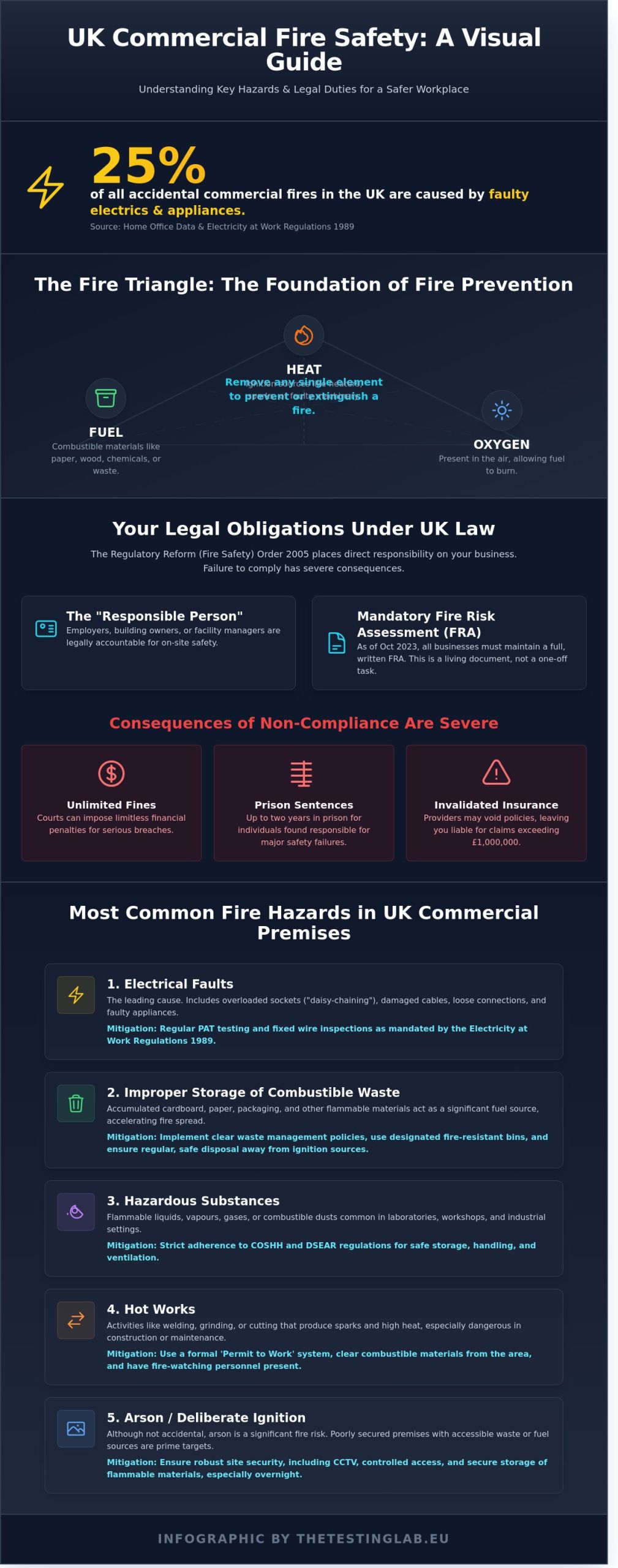
A fire hazard represents any material, substance, or human behaviour that increases the probability of an ignition event or accelerates the spread of flames. In a commercial environment, identifying common fire hazards is the first technical step in a robust safety strategy. Every hazard functions through the interaction of the Fire Triangle: heat, fuel, and oxygen. Heat sources include faulty machinery or portable heaters; fuel comprises items like cardboard packaging or upholstery; and oxygen is ever-present in the atmosphere. If you remove any single element, the fire cannot exist. In the UK, managing these elements isn’t just best practice; it’s a rigid legal requirement that demands a laboratory-like precision in identification and control.
The Regulatory Reform (Fire Safety) Order 2005 serves as the primary legislative framework across the UK. It mandates that every non-domestic premises undergoes a Fire Risk Assessment (FRA). This isn’t a one-time tick-box exercise. It’s a living document that identifies risks and outlines mitigation strategies. Statistics from the Home Office show that in the year ending March 2023, there were over 11,000 fires in non-dwelling buildings in England alone. This data highlights why the FRA is the bedrock of site safety. Effective assessments prevent the catastrophic loss of assets and, more importantly, protect human life by ensuring that potential ignition points are neutralised before a crisis occurs.
The Legal Duty of the “Responsible Person”
UK law places the burden of safety on the “Responsible Person”. This individual is usually the employer, building owner, or facilities manager. If you’re in control of a premises, you’re legally bound to ensure the safety of everyone on-site through “suitable and sufficient” risk assessments. Since the introduction of Section 156 of the Building Safety Act in October 2023, all businesses, regardless of size, must record their full fire risk assessment in writing. Failing this duty carries severe penalties. Courts can impose unlimited fines or prison sentences of up to two years for serious breaches. Beyond criminal prosecution, insurance providers often void policies if a firm hasn’t identified common fire hazards or maintained their assessment records, leaving the business financially vulnerable to claims exceeding £1,000,000.
Key Legislation Beyond the Fire Safety Order
While the 2005 Order is the umbrella regulation, specific technical risks fall under additional UK laws. The Electricity at Work Regulations 1989 require that all electrical systems are maintained to prevent danger. This is critical because faulty electrics cause roughly 25% of all commercial fires in the UK. Managing hazardous substances requires adherence to COSHH (Control of Substances Hazardous to Health), which overlaps with fire safety when dealing with flammable vapours or liquids. These regulations ensure that even the most complex industrial processes remain within safe operational parameters. Precision in these areas reduces the burden on the business and ensures long-term operational continuity.
For businesses in sectors like oil, gas, or petrochemicals, compliance often involves specifying high-integrity components for process safety; if you’re looking for specialist suppliers in this area, you can check out OG VALVES LTD..
- Electricity at Work Regulations 1989: Mandates regular PAT testing and fixed wire inspections to mitigate electrical ignition risks.
- COSHH: Focuses on the safe storage and handling of chemicals that could act as fuel sources.
- DSEAR: The Dangerous Substances and Explosive Atmospheres Regulations 2002 (DSEAR) require UK employers to control the risks from substances that can cause fires or explosions in the workplace.
The Most Frequent Causes of Fires in Commercial and Residential Settings
Identifying common fire hazards is the first step toward a robust safety strategy. Home Office statistics reveal that electrical distribution and appliances remain the primary culprit. These faults account for approximately 25% of all accidental fires in UK commercial premises. Addressing these risks requires a methodical, engineering-led approach rather than a cursory glance. It’s not just about compliance; it’s about protecting the continuity of your operations through precise risk mitigation.
Electrical Hazards: More Than Just Overloaded Sockets
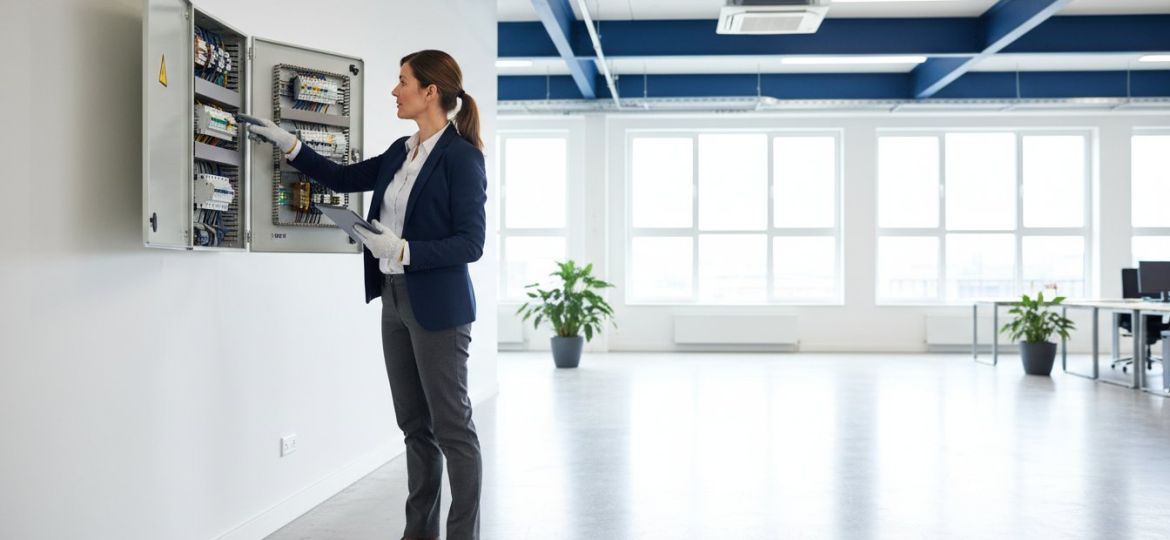
Many facility managers underestimate the danger of “daisy-chaining” extension leads. This practice creates high resistance and heat build-up that standard circuit breakers might not immediately detect. Damaged cables and loose connections represent silent threats that only professional inspection uncovers. To remain compliant and safe, businesses must conduct Portable Appliance Testing (PAT) regularly and schedule an Electrical Installation Condition Report (EICR) every five years to assess the fixed wiring.
In server rooms, dust accumulation acts as a hidden insulator. It prevents heat dissipation in high-density hardware, leading to component failure or ignition. Regular maintenance and environmental monitoring are essential for these high-value areas. If you’re looking to enhance your facility’s safety protocols, our team can help you integrate these checks into a broader quality assurance framework.
Flammable Substances and Improper Storage
Stockpiles of paper, cardboard, and packaging materials provide the perfect fuel for rapid fire spread. When these items clutter escape routes or sit near ignition sources, a small spark becomes a site-wide emergency. You should store solvents, cleaning agents, and fuels in dedicated fire-rated cabinets that meet UK safety standards. This prevents accidental ignition and contains the fire if a spill occurs.
Proper ventilation is a non-negotiable requirement for storage areas containing volatile substances. Using the UK Fire Risk Assessment guide helps identify whether your current storage solutions meet the necessary legal thresholds. Neglecting these details often leads to “dirt and clutter” acting as kindling, which accelerates fire growth exponentially within the first 120 seconds of ignition.
Heating and Cooking Risks
Portable heaters are notorious for causing incidents when placed too close to combustible office furniture or curtains. They require a minimum clearance of one metre at all times. In commercial kitchens, the risk shifts to the extract systems. Grease accumulation within ductwork provides a continuous path for fire to travel through a building’s structure, often bypassing fire doors and compartments.
Under the Regulatory Reform (Fire Safety) Order 2005, regular ductwork cleaning is a legal necessity for commercial kitchens to prevent grease-led flashover and ensure the safety of the premises. Beyond the kitchen, human negligence remains a factor. Smoking in unauthorised areas and leaving cooking equipment unattended contribute to the 15,000+ non-residential fires recorded annually across the UK. Education and clear signage are your best defences against these avoidable common fire hazards.
Arson: The External Risk
Deliberate ignition accounts for a significant portion of property damage, yet many organisations overlook external security. Waste areas and skips positioned against building walls are prime targets for opportunists. Securing these areas and ensuring bins are locked or stored away from the main structure mitigates the risk of an external fire penetrating the building envelope. Simple measures, such as improved lighting and CCTV, drastically reduce the likelihood of a deliberate attack on your property.
Industry-Specific Fire Risks: Construction, Laboratories, and High-Occupancy Buildings
Identifying common fire hazards requires a granular look at industry-specific operations. While basic risks like overloaded sockets exist everywhere, certain sectors face unique threats that demand specialised mitigation strategies. In the UK, fire safety is governed by the Regulatory Reform (Fire Safety) Order 2005, but the practical application of these rules varies significantly between a high-rise residential block and a chemical testing facility.
Fire Hazards on Construction Sites
Construction sites are inherently dangerous due to their evolving nature. Timber frame developments represent a specific risk; they’re highly vulnerable before fire-rated plasterboard is installed. Data from UK insurers suggests that hot works, including welding, grinding, and torch-applied roofing, cause approximately 15% of all fires on site. Managing these risks isn’t optional. It’s a legal requirement to operate a strict Hot Works Permit system. These permits ensure that a fire watch remains in place for at least 60 minutes after work finishes. Temporary electrical supplies also pose a threat, as cables are often exposed to physical damage from plant machinery. The Fire Protection Association provides detailed guidance on these permit systems, which are mandatory for insurance compliance across most UK sites. For developers working on existing structures, professional structural surveys are essential to identify how new loads might impact the fire integrity of the original building fabric.
Laboratory and Specialist Testing Risks
Laboratories present a complex intersection of chemical hazards and high-voltage electrical testing equipment. The presence of high-purity gases like hydrogen or methane, stored in pressurised cylinders, creates an explosive potential that standard fire risk assessments might overlook. Precision is vital here. Facilities must adhere to UKAS accreditation standards to ensure that safety protocols are robust and repeatable. It’s not just about the chemicals on the bench; it’s about how they’re disposed of. Reactive waste can cause fires within the plumbing itself if not managed correctly. Implementing rigorous effluent discharge monitoring helps prevent hazardous chemical build-up in drainage systems, reducing the risk of subterranean ignition. Effective ventilation systems are also critical, as they prevent the accumulation of flammable vapours that could be ignited by a single spark from a centrifuge or oven.
High-Occupancy Buildings and Structural Integrity
In high-occupancy environments like hotels or student accommodation, the focus shifts to compartmentation. The building is designed to contain a fire within a single “cell” for a specific period, usually 30 to 120 minutes. However, common fire hazards often hide behind the walls. Retrofitted internet cabling or pipework often breaches fire-stopping seals, allowing smoke and flames to bypass structural barriers. Under the Building Safety Act 2022, “Accountable Persons” for high-rise buildings must maintain a “Golden Thread” of information regarding these safety measures. Older building fabrics are particularly prone to these issues. Hidden cavities in Victorian-era conversions can act as chimneys, pulling fire through the structure at an alarming rate. Regular inspections of fire doors and dampers are the only way to ensure the building’s original fire strategy still functions as intended. Small failures in these systems don’t just cause damage; they cost lives by compromising escape routes.
How to Conduct a Fire Risk Assessment to Identify Hidden Hazards
Under the Regulatory Reform (Fire Safety) Order 2005, every UK business must complete a Fire Risk Assessment (FRA). It’s not a “one and done” task; it’s a living document that protects your assets and your people. The process follows five logical stages designed to uncover common fire hazards that often stay hidden behind walls or in storage cupboards. Section 156 of the Building Safety Act 2022 now mandates that all businesses must record their full assessment in writing, regardless of staff numbers.
- Step 1: Identify fire hazards. Look for the fire triangle components. Fuel includes waste paper, textiles, and upholstery; ignition sources range from faulty kitchen appliances to overloaded extension leads; and oxygen is supplied by natural ventilation or medical gas cylinders.
- Step 2: Identify people at risk. You’ve got to consider everyone on the premises. This includes full-time staff, night-shift cleaners, and visitors. Pay specific attention to vulnerable individuals who might need Personal Emergency Evacuation Plans (PEEPs).
- Step 3: Evaluate, remove, or reduce. Once you’ve found a risk, act on it immediately. Replace flammable materials with fire-retardant alternatives. Move ignition sources away from fuel. If a risk can’t be removed, install engineering controls like automatic sprinklers or fire shutters.
- Step 4: Record, plan, and train. Document your findings and your evacuation strategy. This record should include a detailed floor plan showing the location of all fire-fighting equipment. Ensure 100% of staff receive basic fire safety training so they know exactly what to do when the alarm sounds.
- Step 5: Review and update. Check your FRA annually or whenever you change the office layout. Even moving a single partition wall can create new common fire hazards by obstructing smoke detectors or changing airflow patterns.
Evaluative Frameworks for Hazard Mitigation
We apply the “Hierarchy of Control” to fire safety just as we do in engineering quality assurance. Elimination is the primary goal. If you can’t eliminate a risk, you mitigate it through substitution or engineering. Substandard safety measures are often the biggest threat to life. A fire door with a broken self-closing mechanism isn’t just a maintenance issue; it’s a critical failure point. In high-stress scenarios, clear signage and unobstructed escape routes reduce evacuation times by up to 30%, which is the difference between safety and disaster.
The Role of Technology in Hazard Detection
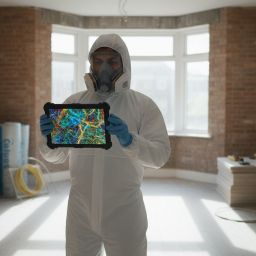
Precision testing changes how we see risk. Thermographic imaging allows us to identify electrical hotspots before they ignite. It’s a non-invasive way to check distribution boards for loose connections or overloaded circuits. Advanced smoke detection systems now use multi-sensor technology to distinguish between steam and a real fire, significantly reducing false alarms. When assessing older buildings, we also look at structural integrity. Ensuring your building uses modern asbestos consultancy services helps verify that fire-rated materials haven’t been compromised by historical contaminants or poor renovations.
Ensure your premises meet every UK legal requirement with a professional, laboratory-grade review. Contact The Testing Lab PLC to secure your facility and protect your workforce today.
Ensuring Compliance and Safety with The Testing Lab PLC
Identifying common fire hazards is only the first step toward safeguarding your business. While a basic DIY checklist might highlight a blocked fire exit or an out-of-date extinguisher, it rarely uncovers the systemic failures that lead to prosecution under the Regulatory Reform (Fire Safety) Order 2005. At The Testing Lab PLC, we replace guesswork with engineering precision. Our professional assessments provide the legal “due diligence” defence that a standard document simply cannot offer. If a fire occurs, insurers and authorities will scrutinise the competency of the person who carried out the assessment; our team ensures that scrutiny never leads to liability.
We operate with a strategic, partner-focused mindset. Our team views your commercial building as a complex system where fire safety intersects with electrical integrity and occupancy patterns. We don’t just point out risks; we provide the technical roadmap to mitigate them. Whether you manage a single retail unit in Doncaster or a nationwide industrial portfolio, our UK-wide coverage ensures consistent standards across every site you operate. We’ve seen that 70% of businesses that experience a major fire never reopen; our goal is to ensure you aren’t part of that statistic by applying rigorous, laboratory-grade testing to your physical environment.
UKAS Accredited Expertise You Can Trust
Reliability in compliance isn’t subjective. It’s measured through UKAS accreditation, which serves as the gold standard for technical competence in the UK. This third-party validation proves our inspectors adhere to the highest international standards of impartiality and accuracy. Based in Doncaster but serving the entire UK, our experts integrate fire safety with broader environmental monitoring. We often combine fire risk assessments with Legionella testing or asbestos surveys, creating a unified compliance profile. This holistic approach reduces administrative friction and minimises site downtime, allowing you to manage multiple safety requirements through a single, trusted partner.
Taking the Next Step Toward Fire Safety
Securing your premises shouldn’t be a bureaucratic hurdle. Our process is designed for speed and clarity, starting with a simple quote request. Once we understand the scale of your facility, we schedule a comprehensive site survey that fits your operational hours. You won’t receive a vague list of suggestions. Instead, we deliver a prioritised, evidence-based report that satisfies both local fire authorities and commercial insurers. This document serves as your definitive guide to eliminating common fire hazards and maintaining a safe environment for your staff and visitors. We use clear, logical structures in our reporting so that your facilities team can act on findings immediately without needing a degree in fire science.
Precision is our passion. We believe that every data point we collect contributes to a safer working world. Our commitment to quality means we stay updated on the latest 2024 legislative shifts, ensuring your business remains ahead of the regulatory curve. If you’re ready to move beyond basic checklists and embrace a professional, laboratory-grade approach to safety, our team is standing by to assist.
Get a professional Fire Risk Assessment quote today and ensure your business meets every UK legislative requirement with total confidence.
Future-Proof Your Fire Safety Strategy
Maintaining compliance with the Regulatory Reform (Fire Safety) Order 2005 isn’t just a legal checkbox; it’s a critical operational safeguard. Home Office statistics reveal that electrical distribution and faulty appliances account for 25% of all accidental fires in UK businesses. By proactively identifying common fire hazards such as overloaded circuits or improperly stored combustible materials in high-occupancy buildings, you protect both your workforce and your physical assets. It’s about moving from reactive fixes to a state of permanent readiness.
The Testing Lab PLC operates as a UKAS Accredited Laboratory, providing precision-led safety solutions UK-wide. Our engineering team brings deep technical expertise in asbestos, water, and fire safety compliance to every inspection. We don’t just find faults; we provide the strategic roadmap needed to mitigate risk across your entire property portfolio. Whether you manage a high-tech laboratory or a busy construction site, our nationwide coverage ensures your documentation meets the rigorous standards required for 2026. Take the burden of quality assurance off your shoulders and let our specialists handle the technical complexity.
Secure your business with a professional Fire Risk Assessment
Your safety deserves a scientific approach that leaves nothing to chance.
Frequently Asked Questions
What is the most common cause of fire in the workplace?
Faulty electrical equipment and the misuse of appliances represent the most common cause of fire in UK workplaces. Statistics from the Home Office for 2022/23 indicate that electrical distribution and appliances account for 33% of all fires in non-dwelling buildings. These incidents often stem from poor maintenance or “daisy-chaining” extension leads. Regular PAT testing and circuit inspections help mitigate these risks before they escalate into critical failures.
How often should a fire risk assessment be carried out in the UK?
You must review your fire risk assessment regularly to ensure it remains valid under the Regulatory Reform (Fire Safety) Order 2005. While the law doesn’t specify a fixed timeframe, industry best practice dictates an annual review or an immediate update if you change your building layout. If you employ 5 or more people, you’re legally required to record the significant findings in writing to remain compliant.
Are extension leads a fire hazard if they aren’t overloaded?
Extension leads remain a fire hazard even without overloading if they’re coiled during use or physically damaged. A coiled lead generates heat through induction; this can melt insulation at temperatures exceeding 100°C. We often see 4-way blocks tucked under desks where they accumulate dust and lack ventilation. This buildup prevents heat dissipation and creates a high-risk environment for ignition in modern office spaces.
What are the three components of the fire triangle?
The fire triangle consists of three essential components: heat, fuel, and an oxidising agent, usually oxygen. Removing any single element causes the fire to extinguish immediately. For example, a CO2 extinguisher works by displacing oxygen, while a water extinguisher removes the heat element. Understanding this chemical balance is fundamental to identifying common fire hazards and implementing effective suppression systems across your UK facility.
Who is responsible for fire safety in a commercial building?
The “Responsible Person” carries the legal burden for fire safety under Article 3 of the Fire Safety Order 2005. This is typically the employer, building owner, or facilities manager. In multi-tenant buildings, multiple parties often share this responsibility. You’re accountable for ensuring all fire safety equipment is maintained and that staff receive adequate training to handle emergency evacuations safely and efficiently.
Can dust actually cause a fire in an industrial setting?
Accumulations of organic or metallic dust pose a severe fire and explosion risk in industrial environments. When fine particles disperse in the air at specific concentrations, they can ignite with explosive force. The Health and Safety Executive (HSE) reports that even a layer of dust 0.8mm thick, roughly the thickness of a paperclip, is enough to cause a devastating secondary explosion if disturbed by a primary fire.
What are the “hidden” fire hazards in modern offices?
Lithium-ion batteries in laptops, e-scooters, and personal vaping devices represent significant hidden fire hazards in modern offices. These batteries can enter “thermal runaway” if damaged, reaching temperatures over 600°C in seconds, which is why sourcing them from a reputable UK vendor like Vape Center is crucial for safety. Another hidden risk is the server room, where high power density and cooling failures create a perfect storm for electrical fires. We recommend installing dedicated smoke detection systems in these high-value, high-risk technical zones.
Is a fire risk assessment a legal requirement for small businesses?
A fire risk assessment is a mandatory legal requirement for every UK business, regardless of size. Under the Fire Safety Order 2005, you must conduct an assessment to identify common fire hazards and protect occupants. While businesses with fewer than 5 employees don’t strictly need to document the findings, we strongly advise keeping a written record. This documentation provides vital evidence of due diligence during local fire authority inspections.