


Could your current compliance strategy withstand a rigorous HSE inspection tomorrow? Many duty holders across the UK find themselves at risk because they rely on outdated data, unaware that an Asbestos Re-inspection is a mandatory requirement under the Control of Asbestos Regulations 2012. With the HSE conducting over 400 proactive inspections of public buildings in the last 12 months, the margin for error has disappeared. You likely feel the pressure of ensuring every square metre of your property is accounted for, but the technical nuances of monitoring material conditions often create unnecessary stress for even the most diligent managers.
We’re here to act as your strategic partner, providing the precision and expertise needed to master your legal “Duty to Manage”. This guide delivers a clear framework for your 2026 compliance cycles and ensures your Asbestos Management Plan (AMP) meets the latest UKAS accredited safety standards. We’ll break down the mandatory 12-month monitoring schedule and explain how to validate legacy surveys so you can maintain a safe environment UK wide with total confidence.
Key Takeaways
- Understand your legal obligations under Regulation 4 of the Control of Asbestos Regulations (CAR) 2012 to ensure full compliance UK wide.
- Identify the specific responsibilities of the “Duty Holder” to clarify the roles of landlords, tenants, and employers in managing site risks.
- Learn how a professional Asbestos Re-inspection monitors the condition of previously identified materials to maintain a robust and accurate safety register.
- Discover the critical differences between initial management surveys and recurring inspection cycles to ensure your safety documentation remains up to date.
- Recognise why UKAS accreditation is vital for ensuring your safety records meet rigorous legal standards and satisfy professional insurance requirements.
What is an Asbestos Re-inspection and Why is it Mandatory?
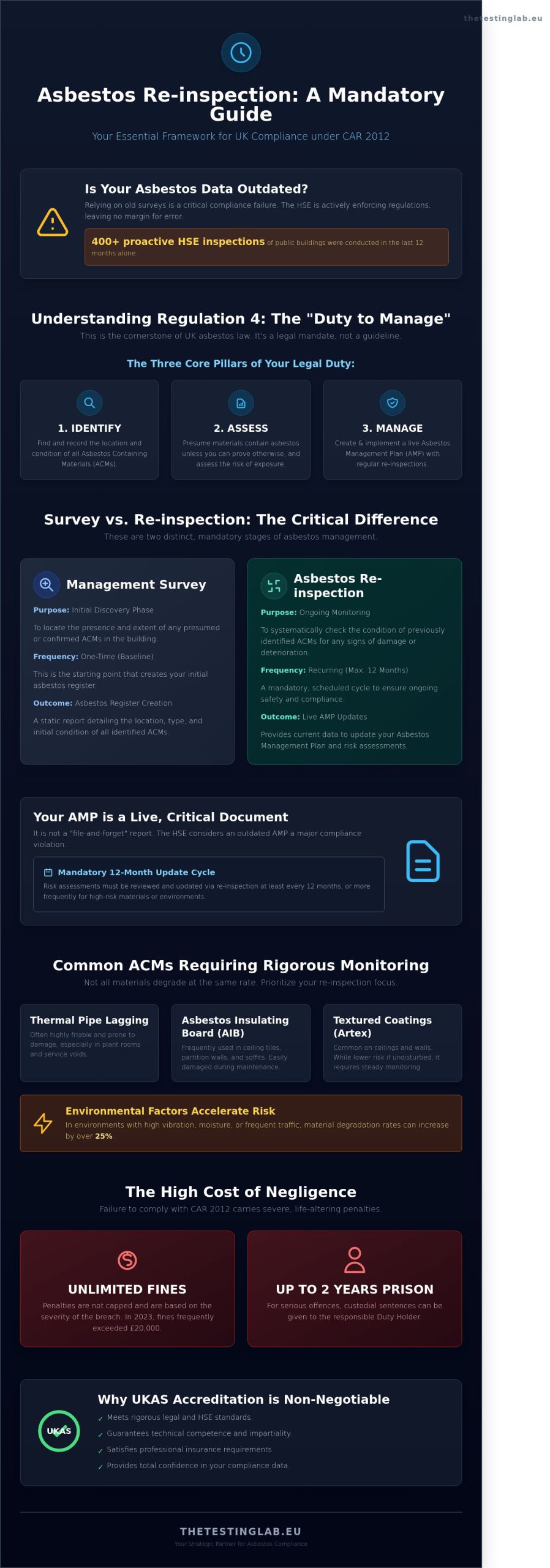
An Asbestos Re-inspection is a scheduled, systematic review of previously recorded Asbestos Containing Materials (ACMs). Duty holders across the UK have a legal obligation under the Control of Asbestos Regulations 2012 (CAR 2012) to manage these risks. It’s a precision-led process that goes beyond a simple walk-through. While a Management Survey serves as the initial discovery phase, the re-inspection cycle is the ongoing maintenance phase that ensures the safety of your building’s occupants.
Relying on casual visual monitoring by untrained staff is a significant risk. Professional documentation and expert oversight are required to detect subtle changes in material friability or surface damage. These micro-changes often precede hazardous fibre release. By adhering to strict Asbestos abatement procedures, organisations can ensure that ACMs remain in a safe, non-friable condition. Our asbestos consultancy team provides the engineering-grade precision needed to identify these risks before they escalate into legal or health crises.
The Role of the Asbestos Management Plan (AMP)
Your Asbestos Management Plan (AMP) isn’t a static document; it’s a live data set that must reflect the current state of your UK-wide premises. Every Asbestos Re-inspection feeds directly into this plan, allowing for the adjustment of risk scores based on material deterioration or site changes. The Health and Safety Executive (HSE) considers an outdated AMP a major red flag during inspections. If your risk assessments haven’t been updated within the last 12 months, your compliance framework is effectively void. We treat the AMP as a strategic roadmap, ensuring every data point is accurate and actionable.
Identifying Asbestos Containing Materials (ACMs)
Not all ACMs degrade at the same rate. Identifying the specific type and location of materials is crucial for setting inspection frequencies. Common materials that require rigorous monitoring include:
- Thermal Pipe Lagging: Highly friable and prone to damage in plant rooms.
- Asbestos Insulating Board (AIB): Frequently found in ceiling tiles and partition walls.
- Textured Coatings: Often containing Chrysotile (white asbestos), which requires steady monitoring despite lower perceived risk.
Understanding Regulation 4: Your Legal Obligations UK Wide
The Control of Asbestos Regulations (CAR) 2012 remains the definitive legal framework for managing asbestos risks in the United Kingdom. Specifically, Regulation 4 establishes the “duty to manage” asbestos in non-domestic premises. This legal mandate applies UK wide, encompassing everything from factories and offices to the common parts of residential blocks. The responsibility falls on the “Duty Holder,” a role typically filled by the person or entity that has clear responsibility for the maintenance or repair of the premises. In many commercial leases, this burden shifts from the landlord to the tenant, making it vital to review your contract to confirm who is legally accountable.
Failing to maintain a precise, up-to-date asbestos register carries severe penalties. Under the Health and Safety at Work etc. Act 1974, non-compliance can lead to unlimited fines or up to two years in prison. In 2023 alone, several UK firms faced fines exceeding £20,000 for failing to monitor the condition of known asbestos-containing materials (ACMs). Because Asbestos Re-inspection is a statutory requirement, simply having an initial survey isn’t enough to satisfy HSE inspectors or local authorities.
The Duty to Manage Asbestos
The Duty to Manage is built upon three core pillars. First, you must identify the location and condition of ACMs. Second, you must assess the risk of exposure. Third, you must create and implement a plan to manage those risks. A critical aspect of UK legislation is the “presumption” rule. If you can’t prove a material is asbestos-free, you must treat it as a high-risk ACM. This means presumed materials require the same rigorous monitoring and documentation as confirmed asbestos. To ensure your management plan remains compliant, our Asbestos Consultancy Services provide the technical oversight needed to navigate these complex requirements.
HSE Guidance and Compliance Cycles
The HSE duty to manage asbestos guidance suggests that 12 months is the standard maximum interval for a re-inspection. However, this isn’t a “one size fits all” rule. If an ACM is located in a high-traffic area or is in a vulnerable condition, you must shorten the inspection cycle to six months or even three months. Your decision on frequency should be evidence-based, documented within your risk assessment, and signed off by a competent person. “Under CAR 2012, the Duty Holder must ensure that the condition of ACMs is inspected at regular intervals to prevent accidental exposure.”
Regular Asbestos Re-inspection ensures that any degradation, such as water damage or accidental impact, is caught before fibres become airborne. If you’re unsure about your current compliance status, you can request a professional review of your asbestos management plan to ensure it meets 2026 standards. This proactive approach transforms a legal obligation into a robust safety culture that protects both your staff and your business reputation UK wide.
Management Survey vs. Re-inspection: Key Differences
Understanding the distinction between an initial Management Survey and a recurring Asbestos Re-inspection is vital for duty holders across the UK. A Management Survey is a foundational investigation. It’s designed to locate Asbestos Containing Materials (ACMs) that could be disturbed during normal occupancy. This process often involves intrusive sampling. In contrast, an Asbestos Re-inspection is a periodic, visual assessment of previously identified ACMs to monitor their condition over time. While a Management Survey for a standard 200sqm office might cost £500 or more, a re-inspection typically requires a smaller investment. These recurring checks often start around £250, provided the original data is robust and accessible.
You cannot use a re-inspection to plan construction or maintenance work. If your project involves breaking into the building fabric, UK legislation mandates a Refurbishment and Demolition (R&D) survey under HSG264. Relying on a re-inspection for such tasks is a common compliance failure that risks accidental fibre release. Proactive monitoring through an Asbestos Re-inspection represents a significant cost-benefit. Emergency remediation after a fibre release can easily exceed £10,000 for a single incident; a scheduled inspection costs a fraction of that amount and keeps your liability low.
When is a New Survey Required?
Material changes to a building, such as structural alterations or a shift in how the space is used, immediately invalidate old survey data. Many UK businesses still rely on “pre-2000” surveys that lack the rigour of modern standards. These legacy documents often miss hidden ACMs or use outdated risk scoring. If your records don’t meet current HSE expectations, you must commission a modern UKAS Accredited Asbestos Testing Pillar audit to ensure total compliance. Data from 2010 or earlier should be treated with extreme caution as it may not reflect current material degradation.
The Re-inspection Workflow
The process begins with a meticulous review of the existing asbestos register. Our surveyors conduct a site walkover to inspect every known ACM documented in previous reports. If an area was marked “inaccessible” in the original survey, we attempt to gain access or recommend a specific targeted investigation. We use high-resolution photographic evidence to document material stability. This creates a clear audit trail that proves the condition hasn’t deteriorated since the last check. The final report updates your management plan, ensuring your UK-wide portfolio remains safe and legally compliant for the 2026 period.
The Process: What Happens During a Professional Re-inspection?
A professional Asbestos Re-inspection is a systematic audit designed to verify that the Control of Asbestos Regulations 2012 (CAR 2012) requirements are met across your premises. This isn’t a cursory walk-through; it’s a technical verification of the data held within your existing Asbestos Management Plan. The process begins with thorough preparation, where you provide the surveyor with previous registers, floor plans, and records of any remedial works completed since the last visit. This historical data acts as the baseline for the current assessment.
Once on-site, the surveyor conducts a visual assessment of every known Asbestos Containing Material (ACM) location identified in previous surveys. They evaluate the physical condition of the material, checking for signs of impact damage, water ingress, or surface delamination. If a material’s state has changed, the surveyor must document this precisely to update your risk profile. The goal is to ensure that the “as-is” state matches the “as-recorded” state, maintaining a continuous chain of safety for all UK wide sites.
- Preparation: Collating existing site data and previous survey results.
- On-site Inspection: Physical verification of every ACM entry in the register.
- Data Update: Recording changes in condition or accessibility.
- Final Reporting: Issuing an updated register with clear, actionable recommendations for the next 12 months.
Material and Priority Scoring Explained
Surveyors quantify risk using two distinct metrics defined by the HSE: the Material Score and the Priority Score. The Material Score (up to 12 points) assesses the item itself, focusing on the product type, its condition, surface treatment, and fibre type. The Priority Score (up to 12 points) addresses the human element. It considers the likelihood of disturbance based on room occupancy, the frequency of maintenance activities, and the proximity of the ACM to high-traffic zones. A combined score provides a total risk rating that dictates your management strategy. High-traffic areas, such as corridors in schools or hospitals, naturally demand more frequent monitoring or more robust encapsulation solutions due to the elevated Priority Score.
Sampling During Re-inspection
While an Asbestos Re-inspection is primarily visual, new samples are required if a material has degraded significantly or if its composition is now in doubt. If a previously sealed panel is now broken, exposing the raw matrix, the surveyor may take a sample to confirm the fibre release potential and ensure the original identification remains accurate. This level of precision prevents “risk creep” where materials are managed based on outdated assumptions. In cases where site work has disturbed the ground, you might also require specialized Asbestos in Soils Testing to ensure external safety standards are maintained alongside internal compliance.
Ensure your site remains compliant and your occupants stay safe with a professional assessment. Request a technical quote for your next re-inspection today.
Why UKAS Accreditation Matters for Your Re-inspections
Choosing a UKAS accredited consultancy isn’t just a best-practice decision; it’s a fundamental requirement for legal and technical defensibility. The United Kingdom Accreditation Service (UKAS) ensures that the teams performing your Asbestos Re-inspection possess the precise technical competence required by ISO/IEC 17020 standards. When a Duty Holder relies on The Testing Lab PLC, they’re securing a level of scrutiny that stands up to Health and Safety Executive (HSE) inspections and complex insurance claims. A report from an unaccredited source may be deemed inadmissible in legal proceedings following an incident, leaving your organisation vulnerable.
Unaccredited inspections often fail to identify subtle material degradation, which can lead to accidental fibre release. By using our integrated laboratory facilities, we eliminate the delays associated with third-party sample shipping. Our team provides immediate analysis, ensuring that if a material’s condition has worsened since the last survey, you’ll have the data to update your management plan within 24 hours. This speed is vital for maintaining compliance UK wide without disrupting your daily operations. It’s about moving from reactive fixes to proactive, data-driven management.
Strategic Compliance with The Testing Lab PLC
Managing asbestos across multiple locations requires a unified data structure. We specialise in organising complex, multi-site re-inspection programmes for large UK organisations, ensuring every asset is tracked through a centralised reporting system. Our Doncaster-based headquarters acts as a strategic hub, allowing our mobile units to reach any site in the country with rapid response times. This centralisation ensures that whether you have five sites or five hundred, the quality of reporting remains identical. To begin securing your portfolio and ensuring your Duty to Manage is fully met, you can Request a Quote for Asbestos Services today.
Beyond Asbestos: Holistic Building Safety
Compliance is rarely a standalone effort. Many of our partners find that an isolated approach to risk management creates administrative friction and higher costs. We’ve refined a holistic model that integrates your Asbestos Re-inspection with other critical requirements like fire risk assessments and water safety. Using a single strategic partner for all environmental testing reduces the number of site visits and ensures your safety data is consistent across all pillars. You can learn more about our integrated approach by visiting our Legionella Risk Assessment Pillar. This methodology doesn’t just save time; it provides a clearer picture of your building’s overall health and can reduce your total compliance spend by approximately 15% through logistical efficiencies and reduced contractor management overheads.
Secure Your Statutory Compliance UK Wide
Meeting the requirements of Regulation 4 is a continuous commitment that demands precision and technical rigour. A professional Asbestos Re-inspection serves as the backbone of your safety strategy; it ensures that managed materials haven’t deteriorated or been disturbed since your last survey. By choosing a UKAS accredited partner, you’re not just ticking a box. You’re leveraging two decades of engineering-led expertise to protect your staff and contractors from avoidable risks.
The Testing Lab PLC operates from our Doncaster HQ to provide comprehensive coverage UK wide, bringing over 20 years of technical experience to every site visit. We bridge the gap between complex legal obligations and practical site management, removing the burden of quality assurance from your shoulders. Our team ensures your data is accurate, your risks are documented, and your business remains fully compliant with 2026 standards. It’s about more than just a report; it’s about the peace of mind that comes from laboratory-grade accuracy.
Book your UKAS Accredited Asbestos Re-inspection with The Testing Lab PLC
We’re ready to help you navigate these critical safety requirements with confidence and clarity.
Frequently Asked Questions
How often is an asbestos re-inspection required by law in the UK?
An asbestos re-inspection is typically required every 12 months under the Control of Asbestos Regulations 2012 (CAR 2012). High-risk materials or areas with significant foot traffic often demand 6-month intervals to maintain a valid Asbestos Management Plan. The specific frequency depends on the risk score assigned during the initial survey, ensuring that any degradation is caught before it poses a health risk.
Can I carry out an asbestos re-inspection myself if I am the Duty Holder?
You can legally perform a re-inspection if you’re deemed competent according to Health and Safety Executive (HSE) standards. This requires specific training to identify material degradation and understand the risks of fibre release. Most UK wide duty holders prefer to hire UKAS-accredited professionals to ensure 100% compliance and avoid the personal legal liability that comes with an inaccurate assessment.
What is the difference between an asbestos survey and an asbestos re-inspection?
An asbestos survey is the initial investigation used to locate and identify asbestos-containing materials (ACMs) within a building. In contrast, an asbestos re-inspection is a periodic monitoring visit that checks the condition of known ACMs listed in your existing register. Think of the survey as the diagnostic tool and the re-inspection as the ongoing maintenance check to ensure the building remains safe for all occupants.
What happens if a re-inspection identifies damaged asbestos?
If damaged material is found, you must update the Asbestos Management Plan immediately and restrict access to the affected area to prevent exposure. Depending on the severity, you’ll need to arrange for sealing, encapsulation, or removal by a licensed contractor. Data from 2023 suggests that prompt remedial action is the most cost-effective way to manage liability and protect the health of building users across the UK.
Do I need a re-inspection for a domestic property in the UK?
Re-inspections aren’t legally required for private individual houses, but they’re mandatory for the common parts of residential buildings like flats or apartments. Under Regulation 4 of CAR 2012, landlords and management companies must manage asbestos in hallways, boiler rooms, and lift shafts UK wide. This proactive monitoring is essential for preventing the 5,000 annual deaths currently attributed to past asbestos exposure in the UK.
How much does a professional asbestos re-inspection cost UK wide?
A professional asbestos re-inspection typically costs between £250 and £600 for a standard commercial unit or small office block. Larger industrial sites or complex multi-storey buildings often see fees exceeding £1,200 depending on the number of items recorded in the register. These prices reflect the surveyor’s technical expertise and the administrative time required to update your digital compliance records and risk assessments.
Is a re-inspection necessary if the building was built after 2000?
Buildings constructed after the year 2000 don’t require an asbestos re-inspection because the use of asbestos was fully banned in the UK in November 1999. If your property’s construction was completed in 2001 or later, it’s officially considered asbestos-free under current safety frameworks. You should keep your building’s completion certificates on file to prove this exemption to any health and safety inspectors who visit the site.
What documents should I have ready for the asbestos surveyor?
You must provide the surveyor with the current Asbestos Register, the existing Management Plan, and all previous survey reports. Site maps and records of any remedial work or removals carried out since the last visit are also vital for an accurate assessment. Having these documents ready ensures the inspection is precise and follows the strict regulatory requirements for UK wide property management and safety compliance.