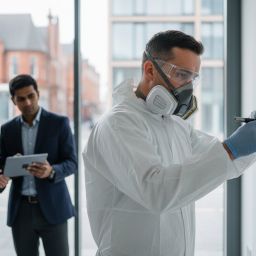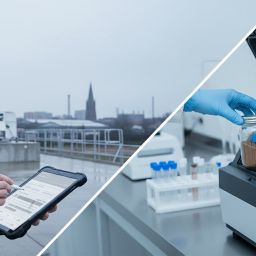


Could a single unverified test result be the catalyst for a £50,000 fine from the Health and Safety Executive? For many firms, the hidden cost of budget testing only becomes clear during a legal audit or a failed safety inspection. You already know that managing complex requirements for asbestos, water, and soil is a high-stakes balancing act where there’s no room for error. Partnering with a UKAS Accredited Laboratory ensures that your data isn’t just a number on a page; it’s a legally robust shield that demonstrates absolute due diligence. We’ll show you exactly how to secure total peace of mind through technical precision and risk management across your UK wide operations.
This definitive 2026 guide explains the critical importance of ISO/IEC 17025 standards for your project planning. You’ll discover how to streamline multiple testing streams while ensuring every result stands up to the most rigorous regulatory scrutiny. We’re moving beyond simple definitions to provide a strategic roadmap for compliance that protects your reputation and your bottom line.
Key Takeaways
- Understand the critical distinction between simple certification and technical accreditation to ensure your testing meets the highest UK legal standards.
- Learn how ISO/IEC 17025 serves as the gold standard for technical competence, guaranteeing that your laboratory results are both valid and defensible.
- Discover the essential steps to verify a UKAS Accredited Laboratory and why checking the specific “Schedule of Accreditation” is vital for UK-wide risk management.
- Evaluate the long-term ROI of accredited testing versus the significant financial and safety risks associated with non-accredited results in critical sectors.
- Gain insights into how a UK-wide strategic partner like The Testing Lab PLC can streamline your compliance processes through engineering-led precision and expertise.
What is a UKAS Accredited Laboratory and Why is it Essential for UK Businesses?
A UKAS Accredited Laboratory represents the pinnacle of technical integrity within the British testing landscape. While many facilities claim to be “certified,” accreditation is a far more rigorous benchmark that proves technical competence rather than just procedural adherence. It’s the difference between an organisation saying they follow a process and an independent authority proving they have the specific expertise, equipment, and environment to deliver accurate results. For UK businesses operating in 2026, this distinction is critical for risk management. Choosing an accredited partner ensures that data isn’t just a number on a page, but a legally defensible asset that protects your reputation.
Accreditation provides the “gold standard” because it verifies the validity of the testing method itself. It’s about precision. Public health and safety depend on these results every day. Whether the task involves testing for Legionella or analysing soil contaminants, the margin for error is zero. Independent verification removes the “homework marking itself” scenario, providing stakeholders with absolute confidence in the findings. This rigorous oversight ensures that every piece of equipment is calibrated to national standards and every technician is qualified for their specific role.
The Role of the United Kingdom Accreditation Service
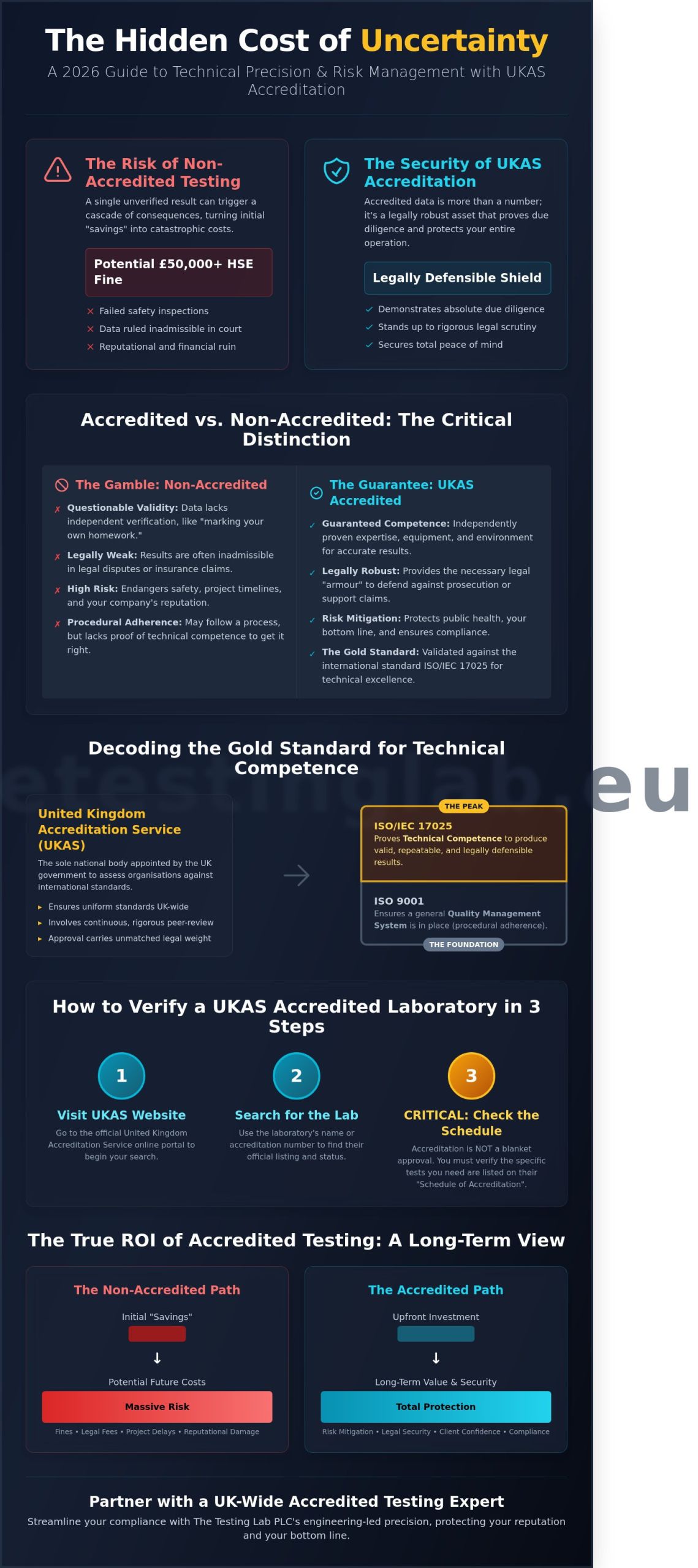
The United Kingdom Accreditation Service (UKAS) operates as the sole national body appointed by the government to assess organisations against international standards. It functions under a Memorandum of Understanding with the Department for Business and Trade. This isn’t a static badge of honour. It involves a continuous, rigorous peer-review process where technical assessors scrutinise everything from equipment maintenance logs to the statistical uncertainty of measurements. Because UKAS is the only body recognised for this purpose UK-wide, its stamp of approval carries weight that no private certification can match.
This oversight ensures a level playing field across the UK. By maintaining a uniform standard, UKAS allows businesses to trust that a test result from a lab in Scotland is directly comparable to one from a lab in London. It’s a system built on transparency and technical excellence, designed to facilitate trade and ensure the highest levels of safety across all industrial sectors.
Legal Recognition and UK Legislation
Compliance isn’t optional for UK firms. The Health and Safety at Work etc. Act 1974 places a clear duty on employers to ensure the safety of their operations and the public. During the assessment of hazardous materials or structural integrity, the Health and Safety Executive (HSE) specifically looks for UKAS accreditation as evidence of competence. This level of scrutiny is particularly vital in high-stakes environments like asbestos in soils testing, where precision directly impacts human health and land redevelopment costs.
Data from a non-accredited source is frequently ruled inadmissible in UK legal proceedings or insurance claims following an incident. If a business relies on unverified data, they’re taking a massive financial and legal risk. Without the UKAS symbol, a test report lacks the weight needed to defend a company against prosecution or to support an insurance payout. In essence, a UKAS Accredited Laboratory provides the necessary legal “armour” that modern UK businesses require to operate safely and successfully.
Understanding ISO/IEC 17025: The Standard for Technical Competence
ISO/IEC 17025 is the backbone of any UKAS Accredited Laboratory. While ISO 9001 serves as a solid foundation for general business quality, it doesn’t verify the technical expertise required to deliver precise chemical or physical analysis. This international standard is specifically designed for testing and calibration laboratories. It proves that a facility isn’t just following a process, but is technically capable of producing valid, repeatable results. In the UK, this standard is overseen by the sole National Accreditation Body for the United Kingdom, ensuring that laboratory data is accepted both domestically and internationally.
Technical competence isn’t a “set and forget” achievement. It demands a culture of constant verification. Labs must participate in ongoing proficiency testing (PT) schemes, which act as an external check on their accuracy. These schemes involve testing “blind” samples and comparing the results against other facilities across the UK. If a lab’s data drifts outside of acceptable statistical limits, they’re required to halt testing and investigate the cause immediately. This level of scrutiny is what separates a professional testing partner from a standard commercial lab.
Technical Requirements for UK Laboratories
Technical mastery starts with the people behind the equipment. Every analyst must undergo rigorous competency assessments to prove they can perform specific methods to the required standard. It’s not enough to have a degree; they need documented evidence of their practical skill. The laboratory environment itself is also strictly controlled. Factors like temperature, humidity, and electromagnetic interference are monitored because even slight fluctuations can skew results in sensitive procedures.
Metrological traceability is another non-negotiable pillar. Every measurement must be linked back to national or international standards through an unbroken chain of calibrations. Whether it’s a high-precision balance or a complex mass spectrometer, the equipment’s accuracy is verified against known references. This ensures that a result produced in Manchester is identical to one produced in London using the same criteria.
The quality of the testing instruments themselves is fundamental to achieving this traceability. To see examples of the professional-grade measurement tools used in these processes, you can read more.
This same principle applies globally in industrial sectors, where specialists in equipment calibration ensure that everything from logistics to manufacturing relies on verified, accurate measurements. For example, in the Australian market, you can discover Independent Scale Service to see how these standards are maintained in the industrial weighing sector.
Management and Quality Control Systems
A robust management system acts as the safety net for every sample processed. In a UK-wide context, document control ensures that technicians always use the most current version of a testing method, preventing errors caused by outdated protocols. Every step of the sample’s journey, from arrival to the final report, is logged. This creates a transparent audit trail that protects the integrity of the data.
When non-conforming work is identified, the system triggers a formal root cause analysis. It’s not about assigning blame; it’s about fixing the process to ensure the error can’t happen again. This systematic approach is vital for complex tasks like WAC testing, where precision determines how waste is legally classified. By maintaining these high standards, a UKAS Accredited Laboratory provides the certainty businesses need to manage risk effectively.
Accredited vs Non-Accredited Testing: Risks and ROI
Selecting a UKAS Accredited Laboratory isn’t just about ticking a compliance box; it’s a strategic risk management decision. While non-accredited facilities might offer lower upfront quotes, the hidden liabilities often exceed the initial savings by 300% or more. In high-stakes environments like UK construction or manufacturing, the price of a “false negative” in asbestos or legionella testing can be catastrophic. It’s the difference between a safe site and a £50,000 HSE fine or a total project shutdown. Choosing the technical rigour of a UKAS Accredited Laboratory ensures that data is legally defensible and scientifically robust.
The Financial Risks of Unaccredited Data
Unaccredited data is a liability that can halt a project’s momentum overnight. If a local authority or the Environment Agency rejects a testing report because the lab lacks the necessary scope, the financial fallout is immediate. On a mid-sized UK infrastructure project, delays can cost upwards of £10,000 per week in plant hire and standby labour. Beyond direct costs, there’s the issue of insurance. Many UK-wide insurers now specify that Professional Indemnity (PI) cover is contingent on using labs accredited by the United Kingdom Accreditation Service (UKAS). If you rely on unaccredited results and a contamination claim arises, your cover might be void. Paying for re-testing when initial results are found to be unreliable is a waste of capital that most modern businesses can’t afford.
Operational Benefits of Using a UKAS Partner
Partnering with an accredited laboratory provides more than just a certificate; it offers a direct line to expert consultancy. This support is vital when interpreting complex results for asbestos consultancy or legionella risk assessments. The operational advantages include:
- Chain of Custody: Rigorous tracking of physical samples from the site to the final report, ensuring data integrity that holds up in court.
- International Trade: Accreditation facilitates cross-border compliance between the UK and Ireland. Through the ILAC MRA agreement, UKAS-accredited data is recognised globally, removing technical barriers to trade.
- Stakeholder Confidence: Providing clients with accredited data proves a commitment to quality. It builds a reputation for reliability that helps win high-value contracts.
By integrating accredited testing into your workflow, you’re not just buying a result. You’re investing in a partnership that protects your brand, your budget, and your legal standing across the UK.
Beyond ensuring technical and legal compliance, maintaining a professional and unified digital reputation is essential for business growth. To help align your digital identity with your operational standards, OS.labs works with firms to organize a brand’s online presence into a coherent system.
How to Verify and Select a UKAS Accredited Laboratory
Selecting the right partner for your testing requirements isn’t about finding the cheapest quote; it’s about technical competence. You can verify any UKAS Accredited Laboratory by using the official UKAS directory. Start by searching for the lab’s name or their unique four-digit accreditation number. Once you’ve found the listing, you must download the Schedule of Accreditation. This PDF is the only legal proof of what the lab is actually allowed to do under their accreditation. Don’t take a verbal “we’re UKAS accredited” at face value. Always check the document date to ensure their status is current.
Checking the Scope of Accreditation
A common misconception is that a lab’s accreditation covers every activity they perform. In reality, accreditation is granted for specific “scopes.” You need to match your project requirements against the methods listed in their schedule. For instance, a lab might be accredited for chemical analysis of water but not for the initial sampling process. If your project requires compliance with UK legislation like the Health and Safety at Work etc. Act 1974, ensuring the specific test method is accredited is vital. Distinguishing between sampling accreditation and laboratory analysis accreditation prevents legal gaps in your chain of custody.
Industry-Specific Testing Requirements
Different sectors demand specific technical rigour. For property management, Legionella risk assessments must be conducted by organisations that demonstrate technical competence in line with ACoP L8. Similarly, asbestos consultancy and surveys require accreditation to ISO/IEC 17020 or 17025 to ensure the safety of building occupants. In the construction and waste sectors, verifying standards for asbestos in soils testing is a priority to avoid massive fines under environmental regulations.
Before you ship samples, ask these three questions to vet your provider:
- Is the specific analyte and matrix (e.g., lead in topsoil) listed on your current Schedule of Accreditation?
- What are your typical turnaround times, and do you offer expedited reporting for urgent UK wide projects?
- Can you provide a single point of contact for technical queries across all our UK sites?
Choosing a partner that operates as a UKAS Accredited Laboratory with a UK wide presence ensures you receive consistent reporting formats and standardised methodologies regardless of where your project is located. This level of uniformity is essential for multi-site operations where data comparison is necessary for risk management. For precise, reliable results that meet all regulatory standards, you can request a quote from our specialist team today.
Partnering with The Testing Lab PLC: Your UK-Wide Accredited Testing Expert
The Testing Lab PLC operates as a premier independent, UKAS accredited laboratory, providing the critical data needed for high-stakes environmental and occupational hygiene projects. Based in Doncaster, our centre of excellence delivers technical precision that moves beyond simple data reporting. We act as a strategic partner, ensuring your project meets the strict requirements of UK environmental legislation without the burden of managing complex quality assurance yourself. Our team approaches every test with a focus on quality and technological confidence, serving clients UK-wide with a commitment to scientific rigour.
Comprehensive Testing Facilities in Doncaster
Our South Yorkshire facility handles high-volume sample processing with a specific focus on asbestos, water, and soil analysis. We’ve built our reputation on an engineering-led approach; this means we don’t just process samples, we understand the mechanical and chemical contexts of your site. In projects requiring advanced spatial data or mechanical modeling, Protomolecule offers 3D scanning services that complement our technical investigations. Our independence is a core asset. Since we’re not tied to any remediation or consultancy firms, our results remain 100% unbiased. This transparency is vital when you’re facing regulatory audits or complex site investigations. We currently process thousands of samples monthly, maintaining the capacity for rapid turnaround times for urgent requirements.
The laboratory is designed for efficiency and accuracy. We use modern automation where it enhances precision, but we rely on our senior chemists and analysts for the nuanced interpretation of data. This blend of technology and human expertise ensures that every certificate of analysis we issue stands up to the highest level of scrutiny from the Environment Agency and other regulatory bodies. By centralising our operations in Doncaster, we maintain a consistent standard of excellence that smaller, fragmented labs can’t match.
Specialised Services and Technical Support
Managing UK landfill regulations requires precise data to avoid significant fines and project delays. We provide comprehensive WAC (Waste Acceptance Criteria) testing to determine the correct disposal route for excavated materials. For construction projects involving landscaping or site restoration, we offer BS 3882:2015 topsoil testing to verify soil quality and nutrient levels, ensuring compliance with British Standards. Our technical team supports project managers by translating complex findings into actionable compliance steps.
Whether you’re managing a brownfield redevelopment or a large-scale infrastructure project, our UK-wide logistics network ensures your samples reach our UKAS accredited laboratory quickly and safely. We’ve streamlined the process from sample collection to final reporting to remove friction from your workflow. If you require professional oversight for your safety protocols, you can request a tailored quote for asbestos and legionella services to secure expert support. Our goal is to provide a seamless, transparent experience that gives you total confidence in your project’s compliance status.
Future-Proof Your Operations with Technical Precision
Choosing a UKAS Accredited Laboratory isn’t just a regulatory checkbox; it’s a strategic move to mitigate legal risks outlined in the Health and Safety at Work etc. Act 1974. By 2026, the gap between accredited precision and non-accredited guesswork will only widen, making ISO/IEC 17025 compliance the minimum standard for defensible data. Our independent, engineering-led approach ensures every test result is backed by scientific rigour and technical magistery.
From our central hub in Doncaster, The Testing Lab PLC provides UK wide service coverage, delivering the clarity you need to manage complex assets. We don’t just provide data; we act as your strategic partner to take the weight of quality assurance off your shoulders. Our team focuses on transparency and methodical excellence to ensure your projects remain compliant and efficient.
Ready to elevate your testing standards? Contact our UKAS accredited experts for a bespoke testing quote and let’s start building a safer, more compliant future together.
Frequently Asked Questions
Is it a legal requirement to use a UKAS accredited laboratory in the UK?
It isn’t a blanket legal requirement for every industry, but specific UK regulations mandate it for high-risk sectors. For instance, the Control of Asbestos Regulations 2012 requires UKAS accreditation for all asbestos testing and surveys. Choosing a UKAS accredited laboratory ensures you meet the strict compliance standards set by the Health and Safety Executive (HSE) for UK-wide operations, reducing your legal liability during regulatory inspections.
How can I check if a laboratory’s UKAS accreditation is still valid?
You can verify a laboratory’s status by searching the official UKAS website using their unique four-digit accreditation number. Every accredited facility must maintain a public Schedule of Accreditation that lists the specific tests they’re authorised to perform. Check this schedule regularly because accreditation applies to individual testing methods, not the entire facility’s output. It’s the only way to ensure their certification hasn’t been suspended or withdrawn.
What is the difference between ISO 9001 and ISO/IEC 17025 for laboratories?
ISO 9001 focuses on general quality management systems, while ISO/IEC 17025 specifically addresses the technical competence of testing and calibration laboratories. This distinction is important in many fields; for example, a skin treatment clinic’s credibility might come from being nurse-led, like Ada Aesthetics, rather than from a general business award. While ISO 9001 proves a business is well-managed, a process often guided by specialists like Align Quality, it doesn’t guarantee the technical accuracy of test results. ISO/IEC 17025 requires rigorous peer evaluation of equipment, staff expertise, and methodology. This distinction is vital for ensuring your data stands up to scientific and legal scrutiny.
Beyond industrial compliance, these technical standards are equally critical in medical and legal diagnostics. For those seeking professional oversight in areas like legal DNA testing or mobile phlebotomy, you can visit Dyvine Medical & Wellness to explore their specialized clinical services. Similarly, in property safety, you can explore Laboratory Composite Methamphetamine Test to see how these rigorous technical standards are applied to identify chemical residues and ensure a safe environment.
The evolution of technical analysis is also impacting the creative industries, where musicians and producers can check out MixMaster Pro to utilize AI-driven evaluation for ensuring their audio tracks meet professional standards.
The emphasis on high-standard results is also prevalent in the skincare industry; for instance, those interested in advanced dermatological kits can explore Skin Peel 4000 to see how professional-grade treatments are made available for home use.
Can a non-accredited laboratory produce accurate results?
Non-accredited laboratories can produce accurate results, but they lack the independent, third-party verification that guarantees consistency. Without the oversight of a UKAS accredited laboratory, there’s no external proof that equipment is calibrated to national standards or that staff follows validated procedures. This creates a significant risk for your business, as unverified data often fails to meet the evidentiary requirements of UK regulators and insurance providers.
What should I look for on a laboratory analysis certificate to ensure it is accredited?
Look for the UKAS “Royal Tick” logo and the specific four-digit accreditation number on the analysis certificate. The document should clearly state which individual tests are “UKAS accredited” and which are not, as labs often perform a mix of both. Ensure the laboratory’s name matches the UKAS database exactly. A valid certificate provides a clear audit trail, linking your specific sample directly to a validated and monitored testing method.
Does UKAS accreditation cover on-site sampling as well as lab testing?
UKAS accreditation can cover on-site sampling, but only if it’s explicitly listed on the laboratory’s Schedule of Accreditation. Sampling is the most common source of error in environmental testing. If the sampling process isn’t accredited, the accuracy of the subsequent lab analysis becomes irrelevant. Always confirm that field technicians follow ISO/IEC 17025 standards for collection and transport to maintain the integrity of your UK-wide projects.
Why is accreditation particularly important for asbestos and legionella testing?
Accreditation is critical for asbestos and legionella because these substances pose severe risks to public health and carry heavy legal penalties. Under the Control of Asbestos Regulations 2012, all UK asbestos analysis must happen in a UKAS accredited laboratory. For legionella, HSE’s HSG274 Part 2 guidance strongly recommends using accredited facilities. Using unverified labs for these hazards increases the risk of false negatives, which could lead to dangerous exposure.
How often are UKAS accredited laboratories inspected or audited?
UKAS laboratories undergo a mandatory annual surveillance visit to ensure they maintain high standards. Every four years, they must pass a more intensive full reassessment of their entire management system and technical capabilities. These audits involve technical assessors observing staff performing tests and checking years of calibration records. This rigorous cycle ensures that the laboratory remains compliant with the latest UK-wide scientific advancements and regulatory changes.