

Over 5,000 people in the UK still die from asbestos-related diseases every year, a stark reminder from the Health and Safety Executive (HSE) of the risks lurking in buildings constructed before 2000. When the lab results arrive, the pressure is immense. We know the feeling; an asbestos analysis report can feel like a puzzle, filled with technical terms, confusing acronyms like NAD, and the looming fear of non-compliance and unexpected costs.
This guide is your key to decoding that puzzle. We promise to walk you through every section, translating the scientific jargon into plain English so you understand your legal obligations, safety implications, and potential financial impact. By the end of this article, you’ll have a clear, actionable roadmap for managing any detected materials, ensuring you can move forward with confidence and full HSE compliance for 2026 and beyond.
Key Takeaways
- Learn what common lab results like ‘NAD’ (No Asbestos Detected) actually mean for your legal obligations under the Control of Asbestos Regulations 2012.
- Quickly identify the risk level associated with different asbestos types (like Chrysotile or Crocidolite) and material conditions mentioned in your report.
- Discover the immediate, HSE-mandated steps you must take after your asbestos analysis report confirms the presence of asbestos to ensure compliance.
- Understand why UKAS accreditation is the non-negotiable standard for ensuring your test results are legally defensible and accurate.
What Is an Asbestos Analysis Report and Why Is It Legally Required?
An asbestos analysis report is a formal, scientific document that provides definitive identification of asbestos fibres within building materials. It is not merely a summary; it’s your primary evidence of compliance with Regulation 4 (The Duty to Manage) of the Control of Asbestos Regulations 2012. This legislation mandates that UK property duty holders identify and manage the risks from asbestos, a group of six naturally occurring fibrous minerals detailed in this overview of What is Asbestos?. Consequently, a casual “don’t worry, it’s all clear” from a builder is legally insufficient and dangerously negligent. Only a formal report from an accredited laboratory provides the necessary proof. This document becomes a permanent and vital component of your property’s Health and Safety file, directly informing your ongoing Asbestos Management Plan and dictating safe procedures for any future maintenance or refurbishment work.
The Legal Weight of ISO 17025 Accreditation
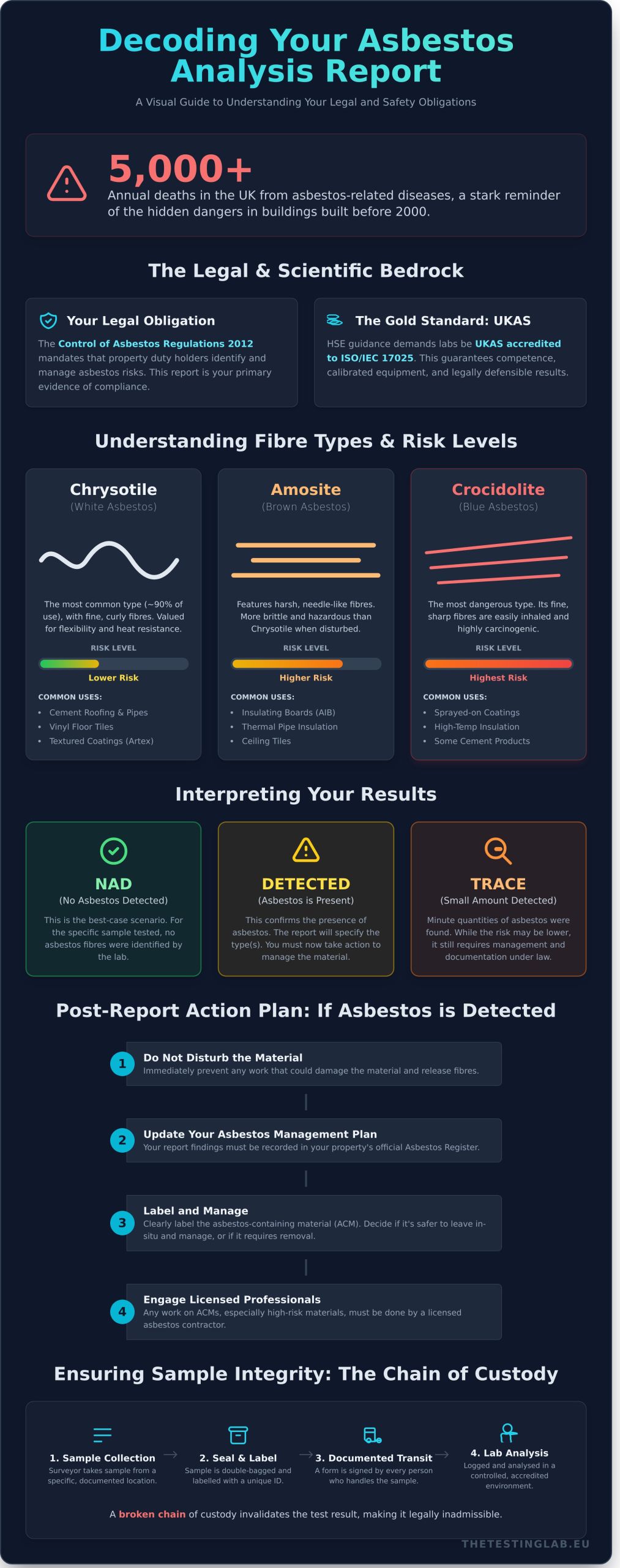
The Health and Safety Executive’s (HSE) guidance, specifically document HSG248, explicitly states that laboratories undertaking asbestos analysis must be accredited by the United Kingdom Accreditation Service (UKAS). This isn’t a ‘nice-to-have’ certification; it’s a fundamental requirement for legal compliance. The specific standard is ISO/IEC 17025, which outlines the general requirements for the competence of testing and calibration laboratories.
This accreditation guarantees that the laboratory operates under a stringent quality management system. It ensures that:
- Personnel are competent: Analysts are highly trained, regularly audited, and participate in ongoing proficiency testing schemes.
- Equipment is calibrated: Microscopes and all testing instruments are maintained and calibrated to precise, traceable standards.
- Methods are validated: The techniques used for analysis, primarily Polarised Light Microscopy (PLM), are proven to be accurate and reliable.
This meticulous process ensures your results are reproducible and, crucially, legally defensible. A report from an unaccredited lab could be dismissed by the HSE or in a court of law. You can and should verify any laboratory’s accreditation status and the specific tests they are approved for by searching their name or number on the official UKAS website.
Chain of Custody: Ensuring Sample Integrity
The ‘Chain of Custody’ is the unbroken, chronological paper trail that documents the life of a sample from collection to disposal. It is the bedrock of a legally valid test result. The process begins the moment a surveyor takes a sample from a ceiling tile in a Doncaster warehouse, for example. From that point, every step is meticulously recorded:
- The sample is sealed in a primary container (e.g., a plastic bag) and then a secondary one to prevent any fibre release.
- It is labelled with a unique identifier, the date, time, and the specific location from which it was taken.
- A Chain of Custody form is filled out, which must be signed by every person who handles the sample during its transit and analysis.
Once it arrives at the lab, this protocol continues. Samples are logged and stored in a secure area to prevent tampering. To eliminate cross-contamination, analysis is performed in dedicated, controlled environments, often using negative-pressure enclosures and decontaminated equipment for each new sample. A broken chain-a missing signature, a damaged seal, or an incomplete form-invalidates the sample. It creates reasonable doubt about its integrity, making the final asbestos analysis report inadmissible for legal or compliance purposes.
Decoding the Technical Jargon: Understanding Fibre Types and Material Categories
An asbestos analysis report can feel overwhelming, filled with technical terms that determine the level of risk within your property. Understanding this language is not just an academic exercise; it’s the first step in creating a safe, compliant management plan. This section breaks down the critical information your report contains about asbestos types and material conditions, giving you the clarity needed to make informed decisions.
The “Big Three” Fibre Types
While six types of asbestos are regulated under the UK’s Control of Asbestos Regulations 2012, your report will most likely identify one or more of the following three. Each has distinct properties and was used in different applications, which directly influences the risk they pose today.
- Chrysotile (White Asbestos): This is the most frequently encountered type, once accounting for over 90% of all asbestos used commercially. Its fine, curly fibres were valued for their flexibility and heat resistance, making it a common ingredient in asbestos cement products (roofing, pipes), vinyl floor tiles, and textured coatings. While it’s the least potent of the three, it is still a Class 1 carcinogen and presents a serious health risk when disturbed.
- Amosite (Brown Asbestos): Known for its harsh, needle-like fibres, Amosite was widely used for thermal and acoustic insulation. You’ll often find it in insulation boards (AIB), ceiling tiles, and pipe lagging. Its fibres are more brittle and break down easily, leading to a higher potential for airborne release compared to Chrysotile.
- Crocidolite (Blue Asbestos): The most hazardous of all asbestos types. Its fibres are extremely fine and sharp, making them easy to inhale deeply into the lungs. Though used less extensively than the other two, its exceptional heat resistance meant it was specified for high-temperature applications like sprayed insulation and pipe lagging. The presence of Crocidolite in a report always signals a high-priority risk.
Your report will also differentiate between friable and non-friable materials. Friable materials, like sprayed insulation, can be crumbled to dust by hand, releasing fibres with minimal effort. Non-friable or bonded materials, such as cement sheets, have fibres locked within a solid matrix. They pose a much lower risk unless they are cut, drilled, or damaged, at which point they can release dangerous fibres. This classification is a key factor in the material risk score assigned by the surveyor.
Bulk Identification vs. Soil Analysis
The method of analysis depends entirely on the sample type. For most building materials, a surveyor takes a physical piece for Bulk Identification. In the lab, we use a powerful technique called Polarised Light Microscopy (PLM) to positively identify the presence and type of asbestos fibres. Our UKAS-accredited laboratories follow the rigorous protocols defined in the HSE’s The Analysts’ Guide, ensuring every result is precise and legally defensible.
Asbestos in soil presents a far greater analytical challenge. Contamination from demolished buildings or historic waste requires a different approach. Here, analysis isn’t just about presence but also quantification, determining the percentage of asbestos by weight to classify the soil for safe disposal or remediation. This complex process demands specialist equipment and deep expertise. For such specialised scenarios, it’s vital to partner with a lab that has proven expertise in environmental testing. Our team can provide the clarity you need for complex site assessments, ensuring your project remains compliant and safe.
Interpreting Your Results: What ‘NAD’, ‘Detected’, and ‘Trace’ Mean
Once you receive your asbestos analysis report, you’ll be faced with technical terms and acronyms. These aren’t just lab jargon; they are precise classifications that dictate your legal obligations and safety strategy. Understanding these results is the critical next step in managing your property responsibly. Each result on the certificate of analysis will correspond to a unique sample ID, which you can cross-reference with your surveyor’s report or sampling plan. This allows you to pinpoint exactly which material in which room contains asbestos, for example, linking “Sample ID: KT-01” to the “Kitchen – Vinyl Floor Tiles”.
When the Report Says ‘Detected’
Seeing the word “Detected” can be unsettling, but it’s a trigger for a planned response, not immediate alarm. A positive result simply confirms the presence of asbestos-containing materials (ACMs). Your next actions depend entirely on two key factors detailed in the report: concentration and condition.
- Concentration: The report will identify the type of asbestos (e.g., Chrysotile, Amosite) and its percentage. Under UK’s Control of Asbestos Regulations 2012 (CAR 2012), a material is generally defined as an ACM if it contains more than 0.1% asbestos. The concentration level helps determine the risk; a cement sheet with 15% chrysotile requires a different management approach than textured coating with 2% content.
- Material Condition: The surveyor’s notes, which accompany the lab results, should describe the material’s condition. Is it intact and sealed, or is it damaged, flaking, or friable (easily crumbled)? An intact asbestos floor tile poses a minimal risk if left undisturbed. However, damaged asbestos insulation board (AIB) is a high-priority hazard because it can easily release fibres. The management plan must align with strict safety protocols, similar in principle to the OSHA standards for asbestos, to protect anyone who might disturb the material.
A “Trace” result is also a form of detection. It means asbestos was identified, but at a very low concentration (often <0.1%). While it may fall below the formal ACM threshold, this material must still be treated with caution. Any work performed on it could require air monitoring to ensure airborne fibres don't exceed the legal control limit.
Understanding ‘NAD’ and ‘NADIS’
A result of ‘NAD’ (No Asbestos Detected) is the outcome everyone hopes for. It means that after careful analysis using Polarised Light Microscopy (PLM), the laboratory found no asbestos fibres in the sample submitted. This is the gold standard for confirming a material is safe to handle.
You might also see ‘NADIS’ (No Asbestos Detected In Sample). This is a more precise and technically cautious statement. The laboratory is certifying that the specific material it received and tested is clear. It highlights the critical importance of the surveyor’s work. If the sample provided wasn’t representative of the entire material-for instance, if a sample was taken from a new patch on an old ceiling-asbestos could still be present elsewhere. “No Asbestos Detected” is not the same as “Asbestos Free.” A lab report clears a sample, but only a thorough survey of all suspect materials can provide confidence about an entire building.
If you receive a NAD result but have strong reasons to suspect asbestos is still present (e.g., the building’s age and construction records suggest it), don’t ignore your instincts. Review the survey report to confirm the correct material was sampled. If doubts remain, commissioning a second, targeted sample for analysis is a prudent and cost-effective way to ensure complete certainty.
Post-Report Action Plan: Meeting Your Duty to Manage Obligations
Receiving your asbestos analysis report isn’t the final step; it’s the critical starting point for your active management duties under the Control of Asbestos Regulations 2012. The data within this document is not for filing away. It’s a legally mandated blueprint for action, designed to protect everyone who uses your building. Your immediate responsibility is to translate these laboratory findings into a tangible, compliant safety strategy.
For large-scale projects, this safety strategy often extends beyond the building itself. Managing site logistics, vehicle access, and public safety during refurbishment or demolition requires another layer of specialized planning. For example, while asbestos is a primary concern internally, developers of major projects also rely on expert consultancies like ML Traffic Engineers Pty Ltd for crucial traffic and transport planning to ensure the site operates safely and efficiently.
This duty to protect people applies universally, from a simple warehouse to a grand historic palace. The diligent safety management of the UK’s heritage sites, for example, is what allows operators like Timescape Tours to offer public visits to these landmarks confidently.
The first priority is to assess the risk identified in the report. If asbestos-containing materials (ACMs) are found to be in poor condition or are likely to be disturbed, you must take immediate, documented steps to manage that risk. This could involve:
- Restricting access to the affected area.
- Arranging for professional encapsulation or sealing of the material.
- Planning for safe, controlled removal by qualified professionals.
Updating Your Asbestos Register
Your Asbestos Register is the central, live document for managing asbestos on your property. The findings from the lab report must be systematically logged into your register or risk management software. This includes the sample ID, exact location, asbestos type identified (e.g., Chrysotile, Amosite), and the material’s condition score. Under Regulation 4, this register must be readily available to any contractor before they perform work on site. Known ACMs must also be re-inspected at least every 12 months to monitor for any degradation.
Licensable vs. Non-Licensable Work
The report is your primary tool for determining the class of work required. Work on high-risk, friable materials like asbestos insulating board (AIB), sprayed coatings, or pipe lagging is almost always licensable and must be performed by a contractor holding a license from the Health and Safety Executive (HSE). The analysis report dictates the level of control required; removing friable amosite insulation demands far more stringent controls and higher-grade PPE than removing a non-friable chrysotile floor tile. Some lower-risk tasks may fall into the ‘notifiable non-licensed work’ (NNLW) category, which still requires notification to the HSE.
Communication is not optional. You have a legal duty to inform employees, tenants, and maintenance teams of the presence and condition of asbestos. This is a core part of your duty of care, and failing this duty can lead to serious health consequences and legal liability. In any situation where negligence leads to harm, from workplace exposure to a traffic collision, victims have legal recourse. For example, someone harmed in an accident might consult with a personal injury lawyer phoenix to seek justice and compensation for their injuries.
Finally, the report informs when to escalate controls. If damaged asbestos is identified in an occupied area, you may need immediate reassurance air monitoring to check if fibres are currently airborne. Following any licensable removal project, a 4-stage clearance process, conducted by an independent UKAS-accredited analyst, is mandatory to certify the area is safe for re-occupation. This isn’t just a suggestion; it’s a legal requirement. If your asbestos analysis report has revealed complex challenges, our experts can help you develop a clear, compliant action plan to ensure you meet every obligation.
Why UKAS Accreditation is the Gold Standard for Asbestos Testing
Receiving your asbestos analysis report is a critical step, but its value is entirely dependent on the integrity of the laboratory that produced it. That’s why at The Testing Lab PLC, our operations are built around the rigorous standards of UKAS (United Kingdom Accreditation Service) accreditation. This isn’t just a badge; it’s your guarantee of technically proficient, impartial, and consistently reliable results, audited to the international standard ISO/IEC 17025.
Our commitment to independence is absolute. Unlike testing facilities that are part of larger removal companies, we have no vested interest in the outcome of your results. Our sole focus is providing precise, unbiased data you can trust to make informed safety and financial decisions. This impartiality is the cornerstone of effective risk management. From our central laboratory in Doncaster, we provide this trusted service with logistical efficiency, ensuring fast sample turnaround for projects across the entire UK and Ireland. We are not just a service provider; we are your strategic partner in long-term compliance.
Expert Consultancy Beyond the Lab
An asbestos analysis report, especially one involving complex samples, requires expert interpretation. Our consultants help you understand the implications of challenging tests, such as fibre quantification in soils or water absorption tests for asbestos insulating board (AIB). We also offer customised reporting formats, perfect for facilities managers and property owners managing portfolios of 50+ sites, providing clarity and consolidating data for streamlined compliance and management action plans.
The data we provide forms the foundation of your entire asbestos management plan. We complement our laboratory services with a suite of on-site solutions designed to guide you from identification to final sign-off. This includes comprehensive surveys to identify potential asbestos-containing materials (ACMs) and, crucially, post-removal 4-stage clearance procedures. This four-step process, mandated by the Control of Asbestos Regulations 2012, is the only way to legally certify that a removal area is clean and safe for reoccupation. By integrating these services, we provide a seamless, end-to-end compliance pathway.
Next Steps with The Testing Lab PLC
Taking control of your asbestos management is straightforward. You can submit bulk material or soil samples directly to our lab for fast, accredited analysis. For a more comprehensive overview of your property, you can book an asbestos management survey or air monitoring test. We also offer integrated services, allowing you to schedule a Legionella risk assessment at the same time, ensuring your property complies with multiple health and safety regulations efficiently.
Don’t leave your safety and legal compliance to chance. Work with a UKAS-accredited partner dedicated to precision and integrity. Get professional help with your asbestos analysis today and ensure the safety of your environment.
Turning Your Asbestos Report into a Clear Action Plan
You now have the tools to decode the technical jargon and understand the legal weight behind your asbestos survey results. Comprehending terms like ‘NAD’ and recognising the importance of UKAS accreditation are the first critical steps in fulfilling your obligations under the Control of Asbestos Regulations 2012. This knowledge transforms a complex document into a straightforward roadmap for ensuring site safety and compliance.
Don’t let uncertainty dictate your next move. A precise and clearly communicated asbestos analysis report is your most powerful asset. As an independent, UKAS Accredited Laboratory (to ISO 17025), The Testing Lab PLC delivers the definitive clarity you need. With national coverage across the UK and Ireland, our specialists are your trusted partners in asbestos, water, and construction material testing. Request a UKAS-accredited asbestos analysis quote to get the certainty required to manage your property safely.
Take control of your compliance journey with confidence.
Frequently Asked Questions About Your Asbestos Analysis Report
Is an asbestos analysis report valid forever?
No, an asbestos analysis report isn’t valid forever because it only reflects the material’s condition at the moment of sampling. While the lab result for that specific sample is permanent, the material in your property can degrade or get damaged. The Health and Safety Executive (HSE) advises that any known asbestos-containing materials (ACMs) should be re-inspected every 6 to 12 months to monitor their condition and ensure they don’t pose a new risk.
How much does an asbestos analysis report cost in the UK?
The cost for laboratory analysis of a single asbestos sample in the UK typically ranges from £25 to £60 + VAT. The final price depends on the required turnaround time. A standard 3-5 day service is the most economical option, whereas an expedited 24-hour or same-day service can cost over £80 per sample. Many labs offer bulk discounts if you submit several samples at once, which reduces the per-sample cost.
Can I take my own samples and send them to the lab?
Yes, you are legally permitted to take your own samples, but it carries significant risk if not done correctly. The HSE outlines strict safety procedures, including wearing FFP3-grade respiratory protection, damping the material to minimise fibre release, and using sealed, double-bagged packaging. To guarantee safety and avoid contaminating your property, we always recommend hiring a qualified asbestos surveyor. They have the training and equipment to take samples without risking exposure.
What is the difference between an asbestos survey and a lab report?
An asbestos survey is a full inspection of a property to find and assess materials that might contain asbestos, while a lab report is the scientific result for a single sample. The survey report is a comprehensive document detailing the location, type, and condition of potential asbestos across your building. The asbestos analysis report is the specific document from the lab that confirms or denies the presence of asbestos fibres in the samples taken during that survey.
Does a positive asbestos report affect my property value?
Yes, finding asbestos can affect your property’s value, but the impact varies greatly. If the asbestos is non-friable and in good, stable condition, like in floor tiles or cement roofing, the effect on value may be minimal. However, materials that are damaged or high-risk, such as pipe insulation, will require professional removal. Buyers will likely deduct the remediation cost, which can be thousands of pounds, from their offer. Transparency is key. This is why a thorough pre-purchase assessment from a professional service like Lin Inspects is crucial, as it provides a complete picture of a property’s condition, including potential red flags that may require specialist analysis.
What happens if I ignore an asbestos report that shows “Detected”?
Ignoring a positive asbestos report has serious consequences. For commercial properties, the Control of Asbestos Regulations 2012 places a legal duty on you to manage it. Failure to comply can lead to HSE prosecution, with fines up to £20,000 or even imprisonment. For homeowners, ignoring the risk means knowingly endangering your family and any tradespeople working on your property, which can lead to fatal lung diseases years later.
How long does it take to get results from a UKAS lab?
You can typically expect to receive your results from a UKAS-accredited lab within 3 to 5 working days for a standard service. Most UK labs also provide faster, premium services for an additional fee. These often include a next-day or even a 4-hour express turnaround if you need an urgent result. Your official certificate of analysis, the formal asbestos analysis report, is almost always delivered electronically via email as soon as it’s ready.
Can I use a non-UKAS lab for my asbestos testing?
While you technically can, it’s strongly advised against. UKAS (United Kingdom Accreditation Service) accreditation to the ISO/IEC 17025 standard is the benchmark for quality and technical competence. A report from a non-UKAS lab may not be accepted for legal or regulatory purposes, and its accuracy can’t be guaranteed. For complete confidence and compliance, always insist on a UKAS-accredited laboratory. It’s the only way to be certain the analysis is precise and reliable.