

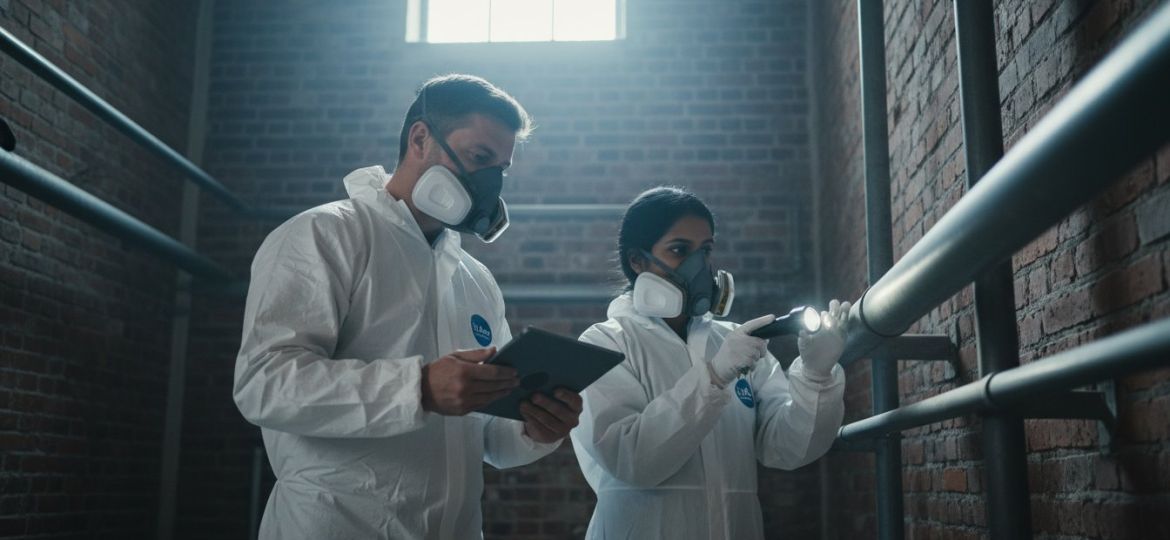
The Health and Safety Executive (HSE) 2023 report confirms that asbestos remains responsible for 5,000 deaths per year in the UK, making it the nation’s leading cause of work-related mortality. You likely feel the significant weight of this responsibility while managing your property portfolio. It’s natural to experience anxiety regarding the strict penalties of the Control of Asbestos Regulations 2012 or the safety of your building’s occupants. Identifying the different asbestos survey types often feels like a complex hurdle rather than a straightforward safety procedure.
Our goal is to apply a rigorous, engineering-led approach to simplify your compliance journey. You’ll gain a masterly understanding of current UK legislation and identify the precise survey your project requires to remain legally sound. This guide provides a transparent breakdown of Management and Refurbishment surveys; it offers a logical roadmap for securing a UKAS accredited testing partner for your UK-wide assets. We’ll replace your uncertainty with a methodical strategy for total site safety and quality assurance.
Key Takeaways
- Understand your mandatory obligations under the Control of Asbestos Regulations 2012 (CAR 2012) to ensure your UK-wide operations meet the highest standards of regulatory compliance.
- Learn how to select the correct asbestos survey types for your specific needs, balancing non-intrusive management with the deep technical requirements of R&D assessments.
- Identify the critical points where a fully intrusive survey becomes a legal necessity to safeguard workers and prevent project disruptions during refurbishment or demolition.
- Discover the role of annual re-inspections and specialist land surveys in maintaining a precise, data-driven asbestos management strategy for your property portfolio.
- Recognise why UKAS accreditation and laboratory expertise are the benchmarks for technical rigour and reliability in modern risk mitigation.
Understanding the Legal Framework: Why Asbestos Surveys Are Mandatory
An asbestos survey isn’t just a cursory walk-through of a property; it’s a systematic and highly technical audit designed to locate and assess Asbestos Containing Materials (ACMs). The primary objective is to provide enough information so that an effective asbestos management plan can be created. Under the Control of Asbestos Regulations 2012 (CAR 2012), this process is a cornerstone of workplace safety across the UK. These regulations ensure that no person is exposed to Asbestos fibres during their daily work or when conducting maintenance. Because the UK only finalised a total ban on all forms of the mineral in November 1999, every building constructed or renovated before the year 2000 is legally presumed to contain it until a professional inspection proves otherwise.
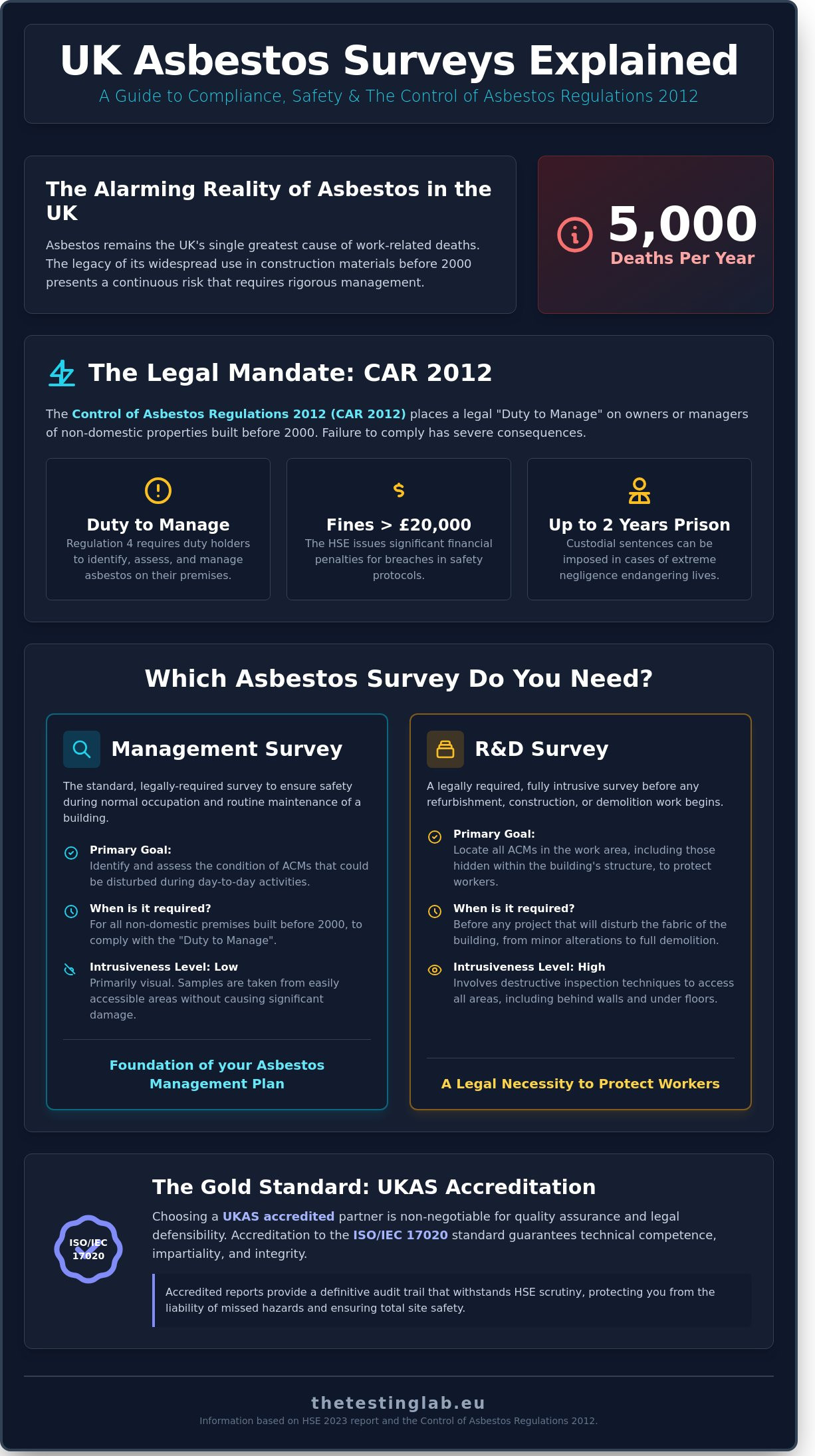
Regulation 4 of CAR 2012 introduces the “Duty to Manage,” which places a strict legal burden on those in charge of non-domestic premises. If you manage a commercial office, an industrial unit, or even the communal areas of a residential block, you’re likely the designated Duty Holder. Understanding the different asbestos survey types is essential for staying compliant with this mandate. Failing to identify and manage these materials carries severe penalties. The Health and Safety Executive (HSE) regularly issues fines exceeding £20,000 for safety breaches, and in cases of extreme negligence where lives are put at risk, custodial sentences of up to two years aren’t uncommon. Beyond the legal risks, the health implications are sobering; asbestos-related diseases currently claim approximately 5,000 lives per year in the UK.
The Duty Holder and Legal Responsibilities
In a commercial setting, the Duty Holder is typically the owner or the entity responsible for the building’s maintenance through a contract or tenancy agreement. For domestic properties, the responsibility falls on the landlord or managing agent for common parts like foyers and boiler rooms. Because 1.8 million tonnes of ACMs were imported into the UK during the 20th century, the law requires a live asbestos register for any pre-2000 structure. This register acts as a dynamic document that you must share with any contractor before they pick up a tool. Without this data, you’re essentially operating in the dark, risking both legal action and the health of your workforce.
UKAS Accreditation: The Gold Standard for Surveys
The United Kingdom Accreditation Service (UKAS) provides the only government-recognised accreditation for asbestos inspections. When you’re deciding which asbestos survey types your project requires, choosing a UKAS-accredited partner is non-negotiable for quality assurance. This accreditation ensures the laboratory and the surveyors meet the ISO/IEC 17020 standard for competence and integrity. There’s a massive difference between a cheap, unaccredited “sampling” visit and a comprehensive UKAS survey. Accredited reports offer a level of precision that protects you from the liability of missed hazards. They guarantee that every sample is analysed in a controlled environment, providing a definitive audit trail that stands up to HSE scrutiny and insurance requirements.
Choosing the right inspection method is the first step toward total site safety. By aligning your property management with CAR 2012 and insisting on UKAS-accredited expertise, you transform a complex legal obligation into a streamlined, manageable process. This proactive approach doesn’t just tick a box; it builds a foundation of trust and safety for everyone who enters your building.
The Asbestos Management Survey: Ensuring Safety During Normal Occupation
The Management Survey is the standard requirement for any non-domestic building constructed before the year 2000. Under the Control of Asbestos Regulations 2012, duty holders must identify the location and condition of any asbestos containing materials (ACMs) that could be disturbed during normal occupancy. It’s a strategic tool designed to ensure the safety of employees, tenants, and maintenance staff who use the building daily. Unlike more invasive asbestos survey types, this inspection is essentially non-intrusive. It focuses on materials that are likely to be disturbed during routine maintenance or everyday activities.
By following the protocols outlined in Asbestos: The survey guide, our surveyors ensure that every accessible area is systematically checked. This includes minimum requirements for inspecting ceiling voids, floor ducts, and loft spaces. The data gathered during this process forms the backbone of your ongoing Asbestos Management Plan. Without this foundational document, it’s impossible to maintain a compliant safety trail or protect building users from accidental exposure. It’s not just a box-ticking exercise; it’s a precision-led safety audit that provides a clear picture of your building’s health.
What to Expect During a Management Survey
Our surveyors conduct a thorough walk-through of the premises to identify any suspect materials. They’ll access areas like ceiling voids, service ducts, and lofts using standard hand tools. When they find a suspect material, they’ll take a small, discreet sample for laboratory analysis. The goal is to be as invisible as possible to your daily operations. Each identified material receives a “material score” between 1 and 3, based on the product type, its condition, and the level of surface treatment.
We then calculate a “priority score” on a scale of 1 to 12. This score assesses the likelihood of the material being disturbed based on its location and the type of activity in the room. Combining these two figures gives you a total risk rating. This laboratory-standard approach ensures you aren’t guessing which areas need urgent attention. It allows for a data-driven maintenance schedule that focuses resources where they’re needed most.
Organising Management for Multi-Site Portfolios
Managing a UK-wide estate presents unique logistical challenges. For organisations with hundreds of locations, consistency is the most critical factor. We recommend a centralised asbestos consultancy approach to ensure that every survey across your portfolio follows the same rigorous methodology. This creates a uniform dataset that can be easily integrated into a digital asbestos register. Having a single point of truth for your data prevents the fragmentation that often occurs when using multiple local contractors.
Large-scale projects require a sophisticated scheduling programme to minimise disruption. We’ve found that 85% of multi-site clients prefer surveys to be conducted during low-traffic periods or integrated into existing facilities management cycles. By centralising your records, you can track compliance across your entire estate in real-time. This transparency allows you to identify high-risk sites immediately and allocate your budget with engineering-level precision. If you’re looking to streamline your compliance across multiple regions, you can find more about our integrated testing and consultancy services to help manage your risks effectively. This methodical approach ensures that your asbestos survey types are correctly matched to each building’s specific needs and occupancy levels.
Refurbishment and Demolition Surveys: Essential Checks Before Construction
Before any contractor strikes a single wall or lifts a floorboard in a pre-2000 building, an R&D survey is a non-negotiable legal requirement. The Control of Asbestos Regulations 2012 (CAR 2012) dictates that you must locate and describe all asbestos-containing materials (ACMs) in the area where work will happen. It’s a level of scrutiny that goes far beyond daily building management. While other asbestos survey types focus on surface-level safety for occupants, the R&D survey is designed to protect those physically dismantling the structure. It’s an aggressive, thorough investigation that leaves no stone unturned.
A standard Management Survey won’t protect your site team during a renovation. These surface-level inspections only cover materials visible during normal occupancy. They don’t account for the pipe lagging buried inside a brick pillar or the bitumen adhesive hidden beneath layers of modern screed. Relying on a Management Survey for construction work is a breach of the Health and Safety at Work Act 1974. It exposes workers to airborne fibres, potentially leading to immediate site closures and heavy fines from the HSE. We’ve seen projects delayed by 14 days or more because a contractor hit “hidden” asbestos that should’ve been identified during the planning phase.
The 2015 CDM (Construction Design and Management) Regulations place a clear duty on the “Client” to provide pre-construction information to designers and contractors. This isn’t just about ticking a box; it’s about risk mitigation. By identifying the exact location and condition of ACMs, you can integrate removal costs into your initial budget. This prevents the 20% to 30% cost spikes often seen when asbestos is discovered mid-project. Our laboratory-led approach ensures that every sample is analysed with 99.9% precision, giving you a definitive roadmap for safe project execution.
The Scope of Intrusive Inspections
Intrusive inspections are destructive by design. Our surveyors use specialist tools to access structural voids, lift floorboards, and penetrate wall cavities that are usually inaccessible. We don’t just look at the surface; we look through it. Before we start, the area must be fully vacated to ensure zero risk to staff or the public. This methodology uncovers “hidden” asbestos, such as AIB ceiling packers or internal flue pipes, which are missed by 95% of visual-only inspections. It’s a forensic process that requires the building to be “prepped” or even partially stripped to allow full access to the fabric of the property.
Integrating Survey Results into Construction Planning
The data from an R&D survey serves as the foundation for your asbestos abatement tender. Instead of guessing, you provide contractors with exact quantities and types of ACMs, leading to more accurate and competitive bids. This transparency keeps your project on track and ensures site workers aren’t walking into a hazard. By identifying risks early, you avoid the “emergency stop-work” scenario, which can cost a large-scale UK development upwards of £5,000 per day in lost labour and equipment hire. Precise data isn’t just a safety measure; it’s a financial safeguard for your entire construction programme.
Beyond the Basics: Re-inspections, Specialist Surveys, and Asbestos in Soils
The Control of Asbestos Regulations 2012 (CAR 2012) makes it clear that managing risk is a continuous obligation. It isn’t enough to simply identify the material once; you’ve got to ensure it stays safe over time. While standard management or refurbishment assessments cover the structure, complex sites often require more nuanced asbestos survey types to address hidden risks in the ground or within industrial machinery. We move beyond the building fabric to look at the entire lifecycle of a site, from initial land purchase to daily facility management.
The Annual Re-inspection Process
If you’ve identified Asbestos Containing Materials (ACMs) and decided to manage them in situ, you’re legally required to monitor their condition. UK law mandates a re-inspection at least every 12 months. Our specialists don’t just tick a box. We conduct a rigorous assessment to see if encapsulated materials have deteriorated or if high-traffic areas have caused new damage. We then update your asbestos register with these fresh condition assessments. If a panel is cracked or a pipe wrap is fraying, the re-inspection triggers an immediate requirement for remedial action to prevent fibre release. This proactive approach keeps your building’s occupants safe and your business compliant with Health and Safety Executive (HSE) standards.
Asbestos in Soils and Land Remediation
Brownfield development presents a unique set of challenges because asbestos isn’t always found in the walls. It’s frequently buried in “made ground” from previous, unregulated demolitions. Identifying fragments or microscopic fibres in topsoil is a critical safety step before any groundworks begin. It’s vital to commission asbestos in soils testing through a UKAS accredited laboratory to quantify these risks. Soil analysis differs significantly from building material analysis; we look for mass percentage concentrations, often down to 0.001%, to determine if the land is suitable for its intended use. This data allows developers to create a precise remediation strategy, whether that involves “cap and cover” techniques or full soil removal.
Waste Acceptance Criteria (WAC) and Asbestos
Disposing of excavated material or construction debris requires absolute precision to avoid legal pitfalls. You can’t guess whether soil is hazardous. WAC testing is the industry standard for determining how waste is handled at UK landfills. In the UK wide market, misclassifying hazardous waste can lead to heavy fines, often exceeding £50,000, or even criminal prosecution for environmental breaches. We provide the chemical analysis needed to prove your waste meets specific acceptance criteria. This ensures you’re paying the correct landfill tax and using the right disposal route, protecting your project’s budget and your company’s reputation.
Beyond the ground and the walls, we also conduct targeted surveys for specialist plant machinery. Industrial boilers, kilns, and manufacturing lines often contain internal gaskets or insulation that standard building surveys overlook. By identifying these specific risks, we help you maintain a comprehensive safety profile for your entire operation.
Ensure your site remains compliant and your workers stay safe. Contact our expert team for a specialist site assessment.
Selecting a UKAS Accredited Partner for Your Asbestos Strategy
Choosing a partner for your asbestos management isn’t a simple procurement task; it’s a strategic decision that affects your legal liability under the Control of Asbestos Regulations 2012 (CAR 2012). A survey is only as reliable as the data backing it. When you evaluate different asbestos survey types, the technical competence of the provider determines your long-term risk profile. You need a partner who views asbestos through a laboratory lens, treating every sample with scientific rigour rather than just ticking boxes on a checklist.
A Public Limited Company (PLC) provides a level of standardisation that smaller firms often struggle to match. With UK-wide coverage, a national provider ensures that a retail unit in Belfast and a warehouse in Bristol receive the exact same quality of reporting. This scale allows for robust resource allocation. If a major refurbishment project uncovers suspicious materials, a national partner has the capacity to deploy teams immediately, preventing costly standing time for contractors. This structural stability means your records remain accessible and protected for the decades required by law.
To evaluate a report for accuracy, look beyond the executive summary. A compliant report must feature the UKAS (United Kingdom Accreditation Service) symbol for both inspection and testing. It should include high-resolution photography, clear CAD plans, and a definitive Material Assessment score for every identified item. If a report is vague or relies heavily on “presumptions,” it’s a liability. Professional consultancy moves you from a state where a “problem is identified” to one where a “solution is managed.” This transition involves turning raw data into a dynamic Asbestos Management Plan (AMP) that your site staff can actually use.
The Value of Independent Laboratory Analysis
Independence is your greatest safeguard against inflated costs. By using a laboratory that doesn’t perform removal, you eliminate the financial incentive for “false positives.” Our accredited labs use polarised light microscopy (PLM) to identify fibres with 99.9% accuracy. This precision prevents unnecessary £15,000 removal projects based on misidentified materials. For critical construction paths, 24-hour turnaround times keep projects on schedule. We treat every sample as a critical data point in your safety architecture, ensuring that “trace” amounts are never overlooked or exaggerated.
Ultimately, a successful compliance strategy relies not just on expert partners but on consistent execution from the Duty Holder. The principles of effective management are universal, and for professionals looking to sharpen their own systems for project delivery and accountability, coaching can provide the structure needed to Get Focused. Take Action. See Results.. For those managing the intricate details of another kind of major project, it can be helpful to explore Stag Do Celebrations to see how expert planning creates a memorable experience.
Next Steps: Securing Your Compliance
Compliance starts with a clear “Scope of Works.” Before a surveyor sets foot on site, define the boundaries to avoid “presumed” asbestos entries that clutter your register and confuse contractors. You can request a professional quote tailored to your specific building type to begin this process. As we look toward 2026 compliance goals, duty holders must ensure their management plans are live digital documents, not static PDFs gathering dust on a shelf. Use this final checklist to verify your current standing:
- Verify UKAS accreditation for ISO 17020 (surveying) and ISO 17025 (testing).
- Ensure the survey covers 100% of the agreed area, including voids and lift shafts.
- Update your Asbestos Management Plan (AMP) within 30 days of receiving any new report.
- Confirm that all “strongly presumed” materials are either sampled or managed as high-risk.
- Schedule annual re-inspections for all identified asbestos-containing materials (ACMs) to monitor condition changes.
A proactive strategy reduces the “asbestos tax” on your maintenance budget. By identifying the correct asbestos survey types for your specific needs, you move from reactive crisis management to a controlled, engineering-led methodology. This precision protects your occupants, your reputation, and your bottom line.
Master Your Asbestos Compliance Strategy Today
Navigating the legalities of the Control of Asbestos Regulations 2012 requires more than just awareness; it demands a precise technical approach. Selecting the correct asbestos survey types for your specific property ensures you meet mandatory safety standards while avoiding costly project delays. Whether you’re maintaining a commercial building or preparing for a major structural overhaul, having a robust management or refurbishment plan is essential for UK compliance.
The Testing Lab has been a trusted strategic partner since 2002, providing the technical confidence you need to manage risk effectively. As a UKAS Accredited Laboratory (ISO 17025) with over 20 years of specialist expertise, we deliver rigorous, scientific analysis across the entire UK and Ireland. We don’t just provide data; we offer a laboratory-grade methodology that simplifies complex quality assurance for your peace of mind. Our national coverage means expert technicians are always available to secure your site’s safety.
Get a professional quote for your UK-wide asbestos survey today and let our team handle the technical heavy lifting for you. It’s time to build a safer future with a partner you can trust.
Frequently Asked Questions
How do I know which asbestos survey type I need?
You determine the required asbestos survey types by assessing the current use of your building and any planned construction work. If you’re managing a property for daily occupancy, a Management Survey is the standard requirement under the Control of Asbestos Regulations 2012. If you’re planning structural changes or demolition, you must commission a Refurbishment and Demolition (R&D) Survey. This ensures compliance with UK health and safety laws across all property sectors.
What is the difference between a Management Survey and an R&D Survey?
The primary difference lies in the level of intrusion and the scope of the investigation. A Management Survey is a standard, non-destructive inspection used to locate asbestos-containing materials (ACMs) that could be disturbed during normal occupancy. An R&D Survey is a fully intrusive, destructive investigation required before any building work. It targets all hidden asbestos within the fabric of the structure to ensure worker safety before tools hit the site.
Is an asbestos survey a legal requirement for domestic properties?
An asbestos survey isn’t a legal requirement for individual homeowners living in their own properties, but it’s mandatory for common areas of domestic blocks under CAR 2012. If you’re hiring contractors for renovations, the Construction (Design and Management) Regulations 2015 require you to provide asbestos information. Most UK contractors won’t start work on houses built before 2000 without a professional survey to manage their legal liability and health risks.
How long is an asbestos survey valid for in the UK?
There’s no specific expiry date on a survey report, but Management Surveys must be reviewed at least every 12 months to remain valid. The Health and Safety Executive (HSE) recommends these annual re-inspections to monitor the condition of identified asbestos. If the building’s layout changes or damage occurs, you’ll need a new assessment. Keeping your asbestos register updated is a continuous legal obligation for duty holders UK wide.
Can I carry out my own asbestos sampling for analysis?
You shouldn’t attempt your own sampling because it risks releasing dangerous fibres into your property. UK legislation requires a competent person to handle asbestos, typically someone with P402 certification. Professional surveyors use specialised equipment and wetting agents to prevent fibre release. Taking your own samples can invalidate your insurance and lead to decontamination costs exceeding £2,000 if a cross-contamination event occurs during the process.
What happens if asbestos is found during a survey?
If the surveyor identifies asbestos, they’ll record its location, type, and condition in a formal asbestos register. You don’t always have to remove it. If the material is in good condition and unlikely to be disturbed, you can manage it in situ through regular monitoring. However, if the risk assessment shows a high chance of fibre release, you’ll need to hire a licensed contractor for removal or encapsulation to maintain safety standards.
How much does a professional asbestos survey cost in 2026?
In 2026, the cost for a standard Management Survey on a three-bedroom semi-detached house typically ranges from £250 to £450 plus VAT. For commercial properties, prices start around £500 for small retail units and increase based on floor area. These figures include the site inspection and laboratory analysis of samples. R&D surveys cost approximately 35% more due to the intensive, destructive nature of the work required to access hidden voids.
Does a Management Survey involve any damage to the building?
A Management Survey is designed to be as non-intrusive as possible and won’t cause structural damage. Surveyors take small, discreet samples from materials like floor tiles or ceiling textures to confirm asbestos content. They seal these sample points immediately to ensure the area remains safe for occupants. Unlike R&D surveys, this process doesn’t involve breaking into walls or lifting floorboards, making it suitable for occupied buildings and offices.