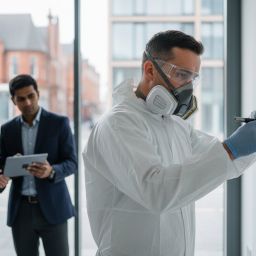


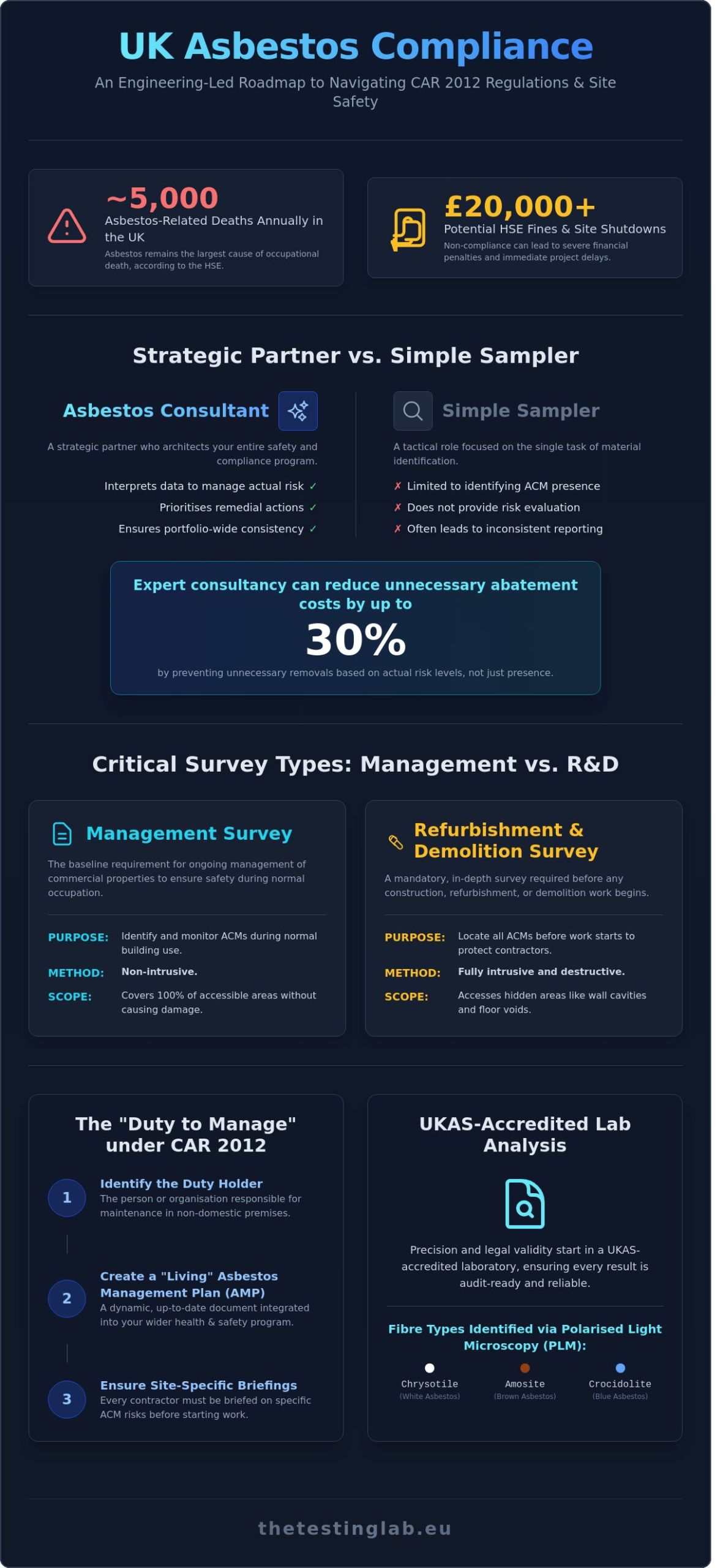
Could a single overlooked floor tile in your 1990s warehouse lead to a £20,000 HSE fine and an immediate site shutdown? With the Health and Safety Executive reporting approximately 5,000 asbestos-related deaths annually in the UK, the pressure to maintain perfect records hasn’t been higher. You’re likely aware that managing asbestos-containing materials (ACMs) is a complex regulatory challenge where confusion over survey types often leads to expensive project delays. It’s a burden that many property managers find overwhelming, especially when the safety of contractors and employees is on the line.
By partnering with a professional asbestos consultant, you’ll ensure your UK property remains fully compliant with the Control of Asbestos Regulations 2012 (CAR 2012) through precision surveys and UKAS-accredited laboratory analysis. This guide provides a clear, engineering-led roadmap for achieving total legal compliance across your UK-wide portfolio. We’ll examine the technical requirements of Management and Refurbishment surveys, explain how to interpret laboratory results, and show you how to secure a safe environment for everyone on site.
Key Takeaways
- Understand why a strategic asbestos consultant is essential for navigating complex UK-wide regulations and providing deeper insights than basic surveying.
- Learn the technical importance of UKAS accredited laboratory analysis in ensuring the legal validity and precision of your asbestos identification.
- Discover advanced risk management protocols, including 4-stage clearance procedures and the critical identification of asbestos in soils across the UK.
- Master the “Duty to Manage” requirements under CAR 2012 to ensure your UK property remains fully compliant with current safety legislation.
- Explore how a laboratory-led approach provides superior data accuracy and faster results to streamline your UK-wide safety compliance.
The Essential Role of an Asbestos Consultant for UK-Wide Compliance
An asbestos consultant acts as the technical architect of your safety strategy. While a surveyor’s job often ends with identification, a consultant interprets data to protect both your workforce and your legal standing. This role is fundamental because asbestos remains the largest cause of occupational death in the UK, with HSE figures consistently showing over 5,000 fatalities annually. For a comprehensive overview of asbestos and its historical impact on construction, understanding its physical properties and associated risks is vital for any property manager.
For UK-wide organisations, the challenge isn’t just safety; it’s consistency. Managing a portfolio of 50 or more sites across different regions requires a unified methodology. A consultant ensures that the risk assessment conducted in a Manchester warehouse mirrors the precision of an inspection in a London office. This standardised approach eliminates the “compliance gap” that often occurs when using multiple local contractors with varying reporting standards. It’s about moving from reactive sampling to proactive risk management.
Strategic Partner vs. Simple Sampler
Sampling is a tactical task, but consultancy is a strategic one. A simple sampler might identify chrysotile in a ceiling tile; however, an asbestos consultant evaluates the material’s condition and the likelihood of fibre release. They provide independent advice that prevents unnecessary removals. During large-scale refurbishment projects, this expertise can reduce unforeseen abatement costs by up to 30%. They don’t just find problems; they prioritise remedial actions based on actual risk levels rather than just presence.
The Duty to Manage Asbestos in 2026
The “Duty Holder” is defined under the Control of Asbestos Regulations 2012 as the person or organisation responsible for maintenance in non-domestic premises. In 2026, the HSE’s focus has intensified on the requirement for a “living” Asbestos Management Plan (AMP). It’s no longer enough to have a dusty report on a shelf. A consultant facilitates the creation of a dynamic AMP, integrating it into your wider health and safety programme. This ensures that every contractor stepping onto your site is briefed on specific risks, fulfilling your legal obligations and preventing accidental exposure. We treat this process with laboratory-grade precision, ensuring your documentation is audit-ready at all times.
Technical Excellence in UK-Wide Asbestos Surveys and Lab Analysis
Managing asbestos risk requires more than a visual inspection; it demands a rigorous, laboratory-led approach to ensure every sample collected from a UK-wide site is analysed with absolute precision. An asbestos consultant acts as the bridge between on-site reality and scientific data. Under the Control of Asbestos Regulations 2012, duty holders must identify the presence of asbestos-containing materials (ACMs) before any work begins. This legal requirement serves as a critical safety barrier for 100% of commercial properties built before the year 2000.
Management Surveys vs. Refurbishment and Demolition (R&D) Surveys
Choosing the correct survey type is the first step in risk mitigation. A Management Survey is the baseline for any UK commercial property. It’s designed to locate ACMs that might be damaged or disturbed during normal occupancy. Conversely, an R&D survey is mandatory before any construction or demolition work starts. This is a fully intrusive inspection that reaches into the building’s fabric, such as floor voids and wall cavities, where hidden hazards often reside.
- Management Survey: Non-intrusive; covers 100% of accessible areas; used for ongoing building management.
- R&D Survey: Fully intrusive; required for any structural changes; involves destructive access to voids and cavities.
- Compliance: Both survey types must be conducted by a competent asbestos consultant to meet HSE HSG264 standards.
The Laboratory Process: Precision and Accreditation
Reliable data starts in a UKAS-accredited environment. We use Polarised Light Microscopy (PLM) to perform bulk asbestos identification, identifying specific fibre types like Chrysotile, Amosite, or Crocidolite. Each sample follows a strict chain of custody. This ensures that materials collected from a site in Glasgow or Birmingham are tracked with the same level of forensic detail as those from a London-based project. A valid lab certificate must display the UKAS logo and specific sample references to meet HSE HSG248 requirements.
The integrity of your safety strategy depends on the quality of the initial testing. When results are delivered, they provide a definitive roadmap for remediation or management. If you’re unsure which survey your project requires, our team can provide a tailored compliance assessment to keep your site safe and legal.
Advanced Risk Management: Clearance and Asbestos in Soils across the UK
A completed asbestos removal project doesn’t automatically mean a site is safe for occupancy. The transition from a restricted work zone to a safe environment requires a scientific, data-driven approach. This is where the role of an asbestos consultant becomes critical, providing the objective verification needed to protect building users and site staff.
The 4-Stage Clearance Procedure
The 4-stage clearance is a mandatory, rigorous protocol designed to ensure no residual fibres remain after abatement. UK-wide site managers must understand that this isn’t a mere formality; it’s a technical barrier against exposure.
- Stage 1: Preliminary check of the site condition and job completeness.
- Stage 2: A meticulous visual inspection inside the enclosure to ensure all asbestos materials are gone.
- Stage 3: Clearance air monitoring, where air samples are tested to ensure fibre levels are below 0.01 f/ml.
- Stage 4: Post-enclosure teardown inspection to ensure no debris was trapped behind the containment.
Legally, the consultant performing these checks must be independent of the removal contractor. This separation of duties is a core requirement under The Control of Asbestos Regulations 2012. Once the consultant is satisfied, they issue a Certificate of Re-occupation, the only document that legally permits the site to be handed back to the client.
Environmental Asbestos: Soil and Ground Investigation
Hidden hazards often lurk beneath the surface of UK construction sites, particularly on brownfield land. Legacy demolition waste or historic poor practice can leave soil heavily contaminated with fragments or free fibres. Identifying these risks early prevents environmental contamination and protects ground workers from accidental exposure.
Technical challenges arise when quantifying asbestos in complex soil matrices. Unlike building materials, soil requires specific laboratory techniques to separate and count fibres accurately. Engaging a professional asbestos consultant ensures that ground-work risks are managed before they become a liability.
For developers, utilising asbestos in soils testing is a strategic move. It prevents project delays that can cost upwards of £5,000 per day in standing time. By mapping out contamination zones during the initial site investigation, you can implement a precise remediation strategy that keeps your project on track and compliant.
UK Compliance Framework: CAR 2012 and the Duty to Manage
The Control of Asbestos Regulations 2012 (CAR 2012) remains the primary legislative framework governing UK-wide safety. Regulation 4 specifically mandates the ‘duty to manage’ asbestos in non-domestic premises. This legal obligation falls on the duty holder; typically the building owner or the person responsible for maintenance contract obligations. While private domestic dwellings are exempt, the ‘common parts’ of multi-occupancy blocks, such as corridors, lift shafts, and boiler rooms, fall strictly under these regulations. Engaging an asbestos consultant ensures these nuances aren’t overlooked, preventing accidental exposure during routine maintenance or renovation works.
Failure to comply carries severe penalties that can dismantle a business’s operational viability. Under the Health and Safety at Work etc. Act 1974, non-compliance can lead to unlimited fines and up to two years’ imprisonment for directors. In 2023, the HSE prosecuted dozens of firms, with some fines exceeding £200,000 for systemic failures in asbestos management. Beyond the financial hit, the reputational damage often proves terminal; 68% of UK-wide clients now prioritise safety records when selecting long-term strategic partners. It’s a risk that no modern organisation can afford to take.
Maintaining this professional reputation is crucial, and for many firms, this includes ensuring their on-site teams are identifiable and smartly presented, often turning to specialists like The Staff Uniform Company for corporate attire.
Five Steps to Asbestos Compliance
- 1. Identify: Commission a Management Survey to locate Asbestos Containing Materials (ACMs) across the entire UK-wide estate.
- 2. Assess: Evaluate the condition of each identified material and the likelihood of fibre release.
- 3. Record: Maintain a live asbestos register, ideally using digital floor plans for pinpoint accuracy.
- 4. Manage: Draft a written Asbestos Management Plan (AMP) that details how risks will be mitigated.
- 5. Communicate: Provide the register to every contractor or employee likely to disturb the fabric of the building.
Legislative Updates for 2026
By 2026, the transition to digital-first compliance will be the industry standard. Paper-based registers are increasingly seen as a liability because they lack the version control needed for complex UK-wide portfolios. Modern digital systems provide real-time updates and geofenced alerts for on-site contractors. While the UK statutory limit for airborne fibres remains 0.01 f/cm3, your asbestos consultant should be monitoring the push toward the more stringent 0.002 f/cm3 standards seen in neighbouring jurisdictions. Proactive adoption of these tighter controls future-proofs your assets against upcoming HSE regulatory shifts.
The Testing Lab PLC: Your Strategic Partner for UK-Wide Asbestos Safety
Choosing the right asbestos consultant isn’t just a box-ticking exercise for 2026 compliance; it’s a strategic decision that affects your bottom line and safety record. The Testing Lab PLC integrates technical laboratory precision with on-site expertise. We don’t just identify risks. We engineer solutions that keep your projects moving. Our UK-wide reach ensures that whether you’re in Doncaster, London, or Belfast, you receive the same high standard of engineering-led consultancy and data-driven results.
The Lab-First Advantage
Our Doncaster-based UKAS accredited facility eliminates the standard industry middleman. Many consultancies outsource their samples, which typically adds 48 to 72 hours to your lead times. We process samples in-house, reducing turnaround times by 40% compared to standard providers. This lab-first approach allows us to maintain absolute data integrity from the moment a sample is taken. Our expertise extends to complex materials, including water absorption and structural testing, where precision is non-negotiable. We operate with a transparent fee structure. You’ll receive a clear breakdown of sample fees and site survey charges, ensuring your budget remains predictable and manageable.
Booking Your UK-Wide Consultation
Managing a national portfolio requires a unified, logical approach to risk. When you hire us as your asbestos consultant, we coordinate multi-site surveys across the UK and Ireland from our central hub. This ensures every report follows the same rigorous quality framework. Our team provides clear, actionable reports that non-technical managers can use immediately to make safety decisions. Beyond standard surveys, we offer comprehensive services ranging from WAC testing for soil disposal to integrated fire risk assessments. This holistic view of property compliance simplifies your management chain and reduces administrative overhead.
It’s time to move beyond basic compliance and embrace a partnership built on scientific accuracy and professional reliability. Contact The Testing Lab PLC today to secure your property and streamline your safety protocols. You can start your journey by submitting a professional quote request for your next project or national survey programme.
Future-Proofing Your UK-Wide Asbestos Compliance Strategy
Navigating the Control of Asbestos Regulations 2012 (CAR 2012) requires more than a simple checklist; it demands a rigorous technical partnership. Managing complex multi-site portfolios UK wide means you need a specialised asbestos consultant who understands the nuances of soil contamination and high-volume laboratory analysis. With over 20 years of experience as an independent PLC, we’ve refined a scientific approach that eliminates the guesswork from your duty to manage. Our Doncaster-based, UKAS accredited laboratory provides the precision needed for rapid clearance and technical excellence. We maintain full coverage across the UK and Ireland, ensuring your compliance isn’t just a legal formality but a robust safety framework. We don’t just identify risks; we provide the engineering-led solutions that keep your projects moving safely. It’s time to transition from reactive testing to a strategic safety methodology that protects both your people and your commercial reputation.
Request a Professional Asbestos Consultancy Quote
We’re ready to help you achieve total peace of mind for your 2026 safety goals.
Frequently Asked Questions
Is it a legal requirement to hire an asbestos consultant in the UK?
The Control of Asbestos Regulations 2012 (CAR 2012) requires duty holders to manage asbestos risks with competent assistance. Engaging a professional asbestos consultant from a specialised firm like AFN Industrial Services Ltd ensures you meet the legal duty to manage in non-domestic premises across the UK. Failing to comply can lead to unlimited fines or up to 2 years in prison under Health and Safety Executive enforcement protocols.
How much does a professional asbestos consultancy service typically cost?
Basic management surveys for small UK-wide commercial units typically start at £250, while full consultancy services often range between £75 and £150 per hour. Costs depend on the building’s age and the 1999 ban on asbestos usage. A comprehensive 4-stage clearance process for removal projects might cost between £600 and £1,200 depending on the site’s complexity and location.
What is the difference between an asbestos surveyor and an asbestos consultant?
An asbestos surveyor focuses on identifying and sampling materials, whereas an asbestos consultant provides strategic oversight for long-term risk management. Consultants interpret survey data to design remediation plans and ensure 100% compliance with CAR 2012. Think of the surveyor as the diagnostic technician and the consultant as the lead engineer who manages the entire safety lifecycle.
Can I take my own asbestos samples and send them to your lab?
You can technically take samples, but we strongly advise against it due to the 0.1% airborne fibre limit risk. Standard UK-wide safety protocols require professional sampling to prevent accidental exposure and ensure the chain of custody remains valid for legal records. Our laboratory processes professional samples within 24 to 48 hours to maintain high precision and safety standards.
How often should an asbestos management survey be updated in the UK?
The HSE’s HSG264 guidance recommends reviewing your asbestos management plan every 12 months to account for material degradation. If your building was constructed before the November 1999 total ban, an annual inspection ensures any changes in the 14 known types of asbestos-containing materials are documented. You’ll need more frequent checks if the building undergoes structural changes or high-traffic usage.
What happens if an asbestos consultant finds hazardous materials in my building?
If hazardous materials are identified, we immediately update your asbestos register and conduct a formal risk assessment. We categorise the materials based on their condition, with high-risk items requiring removal by a licensed contractor within a 30-day window. Most stable materials stay in place under a managed monitoring programme to ensure they don’t become friable or dangerous over time.
Does UKAS accreditation matter when choosing a consultant?
UKAS accreditation is vital because it proves a firm meets ISO 17020 standards for inspections and ISO 17025 for laboratory testing. Over 95% of reputable UK-wide firms hold this accreditation to guarantee their results stand up in a court of law. Choosing an unaccredited provider creates a liability gap that can invalidate your insurance coverage during a safety audit.