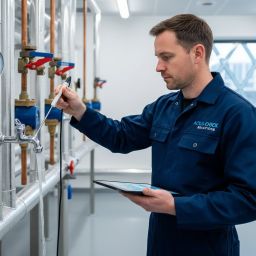

Could a single overlooked parameter in your microbiological water testing be the difference between a compliant facility and a £20,000 HSE fine? You likely recognise that maintaining water safety is a non-negotiable duty, yet the technical density of UK legislation often creates more confusion than clarity. It’s stressful to scan a complex laboratory certificate while wondering if your results actually satisfy the strict requirements of ACoP L8 or HSG274. We’ve designed this guide to remove that technical burden from your shoulders and provide the precision your role requires.
You’ll gain a clear, engineering-led understanding of your UK-wide legal obligations and learn how to identify a UKAS-accredited partner that delivers data you can actually use. We’re going to break down the specific bacteria you must monitor, from Legionella to Pseudomonas aeruginosa, and show you how to transform raw analytical results into a robust risk management strategy. By the end of this guide, you’ll have the tools to manage your water hygiene risks with total professional confidence.
Key Takeaways
- Understand your statutory duties under UK legislation to maintain “Wholesome Water” standards and ensure full compliance for all building managers and water providers.
- Identify the critical roles of TVCs, Coliforms, and Legionella, and why specific temperature-controlled testing is essential for an accurate hygiene profile.
- Discover why UKAS-accredited microbiological water testing is the only way to ensure your data remains legally defensible during HSE investigations or court proceedings.
- Master professional sampling best practices, from selecting sterile containers with neutralising agents to deciding between “Flush” and “First Draw” methodologies.
- Learn how to streamline your UK-wide compliance by partnering with a high-capacity laboratory that prioritises technical precision and rapid turnaround times.
What is Microbiological Water Testing and Why is it Critical in the UK?
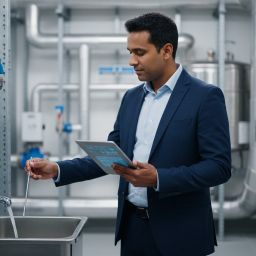
Microbiological water testing is the rigorous scientific analysis of water samples to detect, identify, and quantify microscopic organisms. These include bacteria, viruses, and protozoa that can compromise human health. In the UK, this process ensures that water meets the “wholesome” standard required for human consumption and hygiene. It’s a critical pillar of public safety. The analysis involves taking precise volumes of water and incubating them under specific conditions to encourage the growth of target organisms. This allows technicians to count Colony Forming Units (CFU) per millilitre, providing a clear metric of contamination levels. Without regular screening, pathogens like Legionella pneumophila or Escherichia coli can colonise complex plumbing systems undetected.
Independent laboratories provide the necessary third-party verification that water systems remain safe. They act as strategic partners for building managers. By using established bacteriological water analysis methods, these labs offer an unbiased view of a building’s water health. This level of precision is vital. It moves water safety from guesswork to a data-driven engineering discipline. A professional lab doesn’t just provide a result; it provides the empirical evidence required to prove that a site’s water management plan is actually working.
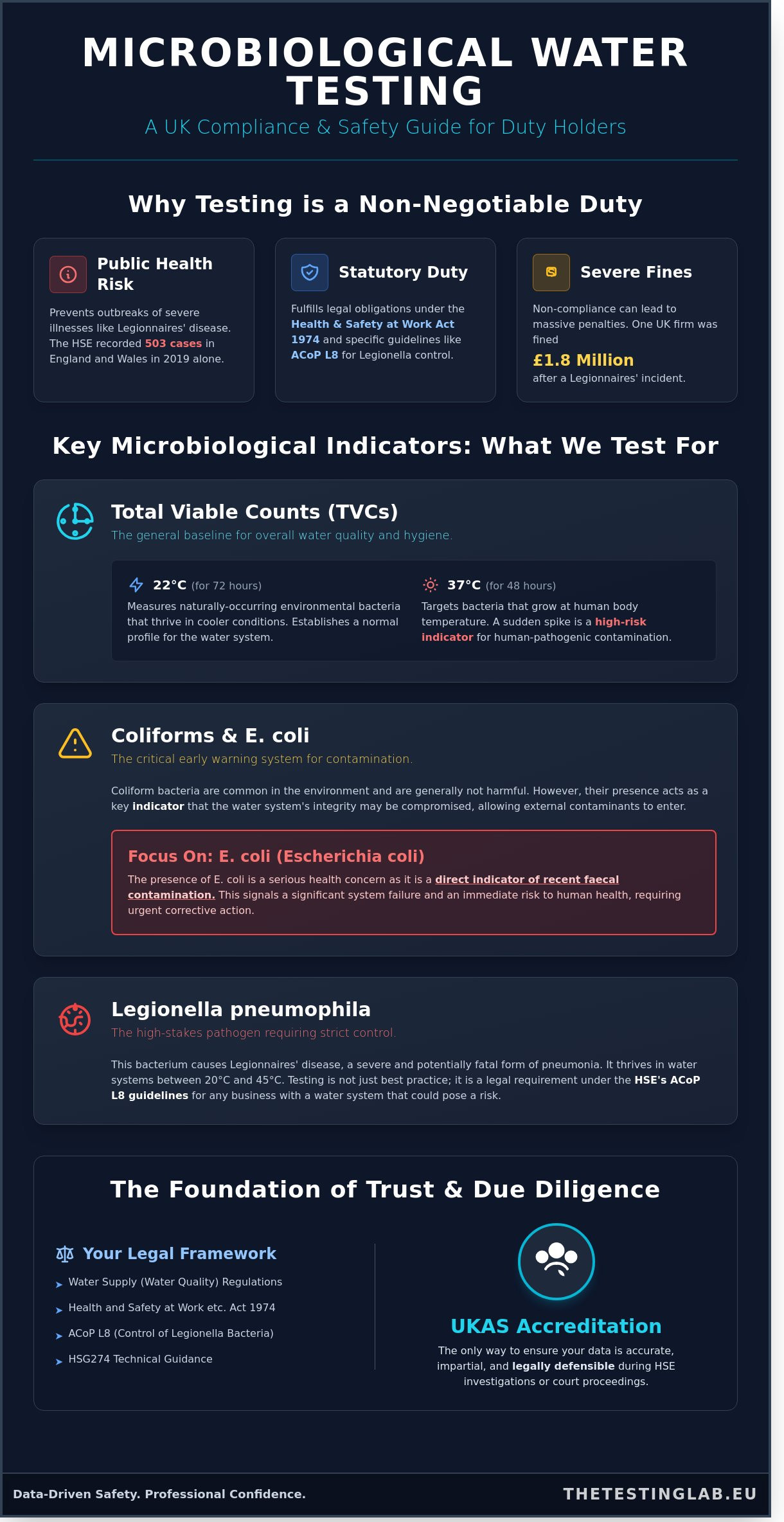
The stakes are high for public health. Legionnaires’ disease, a severe form of pneumonia, is caused by inhaling droplets from contaminated water systems. The Health and Safety Executive (HSE) recorded 503 cases of Legionnaires’ disease in England and Wales in 2019 alone. Regular microbiological water testing identifies these risks before they become outbreaks. It’s not just about compliance; it’s about protecting lives through methodical, laboratory-grade scrutiny. When a lab identifies a spike in E. coli or coliforms, it serves as an early warning system for potential faecal contamination or system failure.
The Legal Framework: UK-Wide Compliance
UK-wide compliance relies on two primary sets of legislation. The Water Supply (Water Quality) Regulations and the Private Water Supplies Regulations 2016 set the standard for what constitutes “wholesome” water. Additionally, the Health and Safety at Work Act 1974 requires employers to manage risks to health. This includes the risk of exposure to biological agents. Failure to comply with these UK laws isn’t just a safety risk; it’s a legal liability. The 2013 Approved Code of Practice (L8) specifically outlines how to control Legionella bacteria in water systems. Following these guidelines ensures that every drop of water in a facility is fit for purpose.
Who is Responsible for Water Safety?
UK law identifies a “Responsible Person” or “Duty Holder” for every commercial or multi-residential building. This is often the landlord, employer, or a designated facilities manager. Their obligation is clear. They must conduct regular risk assessments and implement a monitoring programme. Microbiological water testing is a central component of this programme. If a water system causes an outbreak, the consequences are severe. In 2017, a UK firm was fined £1.8 million following a Legionnaires’ disease incident. Beyond the financial hit, the reputational damage can be permanent for a brand. Professional testing removes this burden from the manager’s shoulders by providing documented proof of due diligence.
Common Micro-organisms in Water: What We Test For
Effective microbiological water testing isn’t about finding every single microbe; it’s about identifying specific indicators that signal a breakdown in system control. We categorise these into the “Big Three” indicators: TVCs, Coliforms, and Legionella. Each provides a different lens through which we view water hygiene. The 2018 UK Water Supply Regulations mandate strict compliance for these parameters to ensure public safety across all UK-wide installations.
Total Viable Counts (TVCs) act as the baseline for water quality. We use temperature-controlled testing at two specific points to profile the sample. Incubation at 22°C for 72 hours encourages the growth of natural, environmental bacteria. In contrast, incubation at 37°C for 48 hours targets bacteria that thrive at human body temperature. A sudden spike in the 37°C count often indicates a high risk of human-pathogenic contamination.
We distinguish between indicator organisms and actual pathogens. Indicators like Coliforms don’t always cause disease themselves, but their presence suggests that more dangerous pathogens could survive in the system. Our laboratory focus is on enumeration; we count the specific Colony Forming Units (CFU) per millilitre. Simple “presence/absence” tests are binary and don’t provide the granular data required for long-term trend analysis or engineering adjustments. Knowing you have 100 CFU/ml versus 10,000 CFU/ml changes the entire remediation strategy.
Legionella and Pseudomonas: The Specialist Risks
Legionella pneumophila remains the primary focus for UK building services because it thrives in the complex pipework of man-made water systems. It’s the causative agent of Legionnaires’ disease, a severe form of pneumonia. While Legionella is a system-wide threat, Pseudomonas aeruginosa represents a specific threat in healthcare environments. It’s a common culprit in endoscope rinse water and augmented care units, where it can cause life-threatening infections in vulnerable patients. Professional Legionella risk assessment services are vital for mapping these risks before they manifest as a health crisis.
Enteric Pathogens: E. coli and Coliforms
Total Coliforms and E. coli are the gold standard for detecting faecal contamination. While Coliforms can originate from soil or vegetation, E. coli is exclusively found in the gut of warm-blooded animals. Finding E. coli in a 100ml sample is a critical failure. The presence of Enterococci or Clostridium perfringens suggests even deeper issues; Clostridium spores are highly resistant and often indicate historical or intermittent contamination that other tests might miss. In the UK, the action level for E. coli is clear: any result above 0 per 100ml requires immediate system disinfection and a full investigation into the source of the breach. You can rely on The Testing Lab to provide the rapid, precise data needed to make these critical safety decisions.
The Importance of UKAS Accreditation in Water Analysis
The United Kingdom Accreditation Service (UKAS) operates as the sole national body recognised by the British government to assess the competence of organisations providing testing and calibration services. When you commission microbiological water testing, the UKAS symbol acts as a guarantee that the laboratory operates to the ISO 17025:2017 standard. This international benchmark isn’t a simple tick-box exercise. It requires rigorous annual audits to prove technical competence, impartiality, and the validity of every test result produced. Without this accreditation, data remains anecdotal rather than evidentiary.
Off-the-shelf DIY kits often promise quick results at a fraction of the cost, yet they frequently fail to meet the stringent requirements of a Health and Safety Executive (HSE) investigation. In a legal setting, these kits lack a “chain of custody” and the precision required to stand up in court. Since the update to The Water Supply (Water Quality) Regulations in 2018, the demand for verifiable, high-accuracy data has become a mandatory shield for UK businesses. Relying on unaccredited methods leaves the organisation vulnerable to prosecution if a waterborne pathogen like Legionella is detected during an audit.
Accreditation ensures that the equipment used is calibrated against national standards and that the staff performing the analysis possess the specific engineering mindset required for complex microbiological water testing. It eliminates the variables that lead to false negatives, which can be catastrophic for public health. We treat every sample with a laboratory-grade precision that transforms raw data into a strategic asset for your facility management team.
The “UKAS Shield”: Legal Defensibility
For any “Responsible Person” designated under ACoP L8, an accredited report is their primary line of defence. It’s vital to check that both the laboratory and the specific testing method are accredited. A lab might hold UKAS status for chemistry but not for microbiology; using the wrong one renders your compliance void. Our reports ensure your data is accepted by the Drinking Water Inspectorate (DWI), providing 100% confidence during local authority inspections or insurance renewals across the UK.
Beyond Water: Holistic Accredited Testing
Environmental safety is rarely a standalone issue. On brownfield sites, for instance, water safety is often inextricably linked to ground contaminants. This is why we integrate specialised services like asbestos in soils testing to provide a comprehensive risk profile for developers. From our central hub in Doncaster, The Testing Lab PLC maintains these nationwide standards, ensuring that whether you are testing a cooling tower in London or soil in Glasgow, the precision remains identical. Our approach removes the burden of quality assurance from your shoulders, allowing you to focus on core operations while we handle the technical rigour.
Best Practices for Water Sampling and Results Interpretation
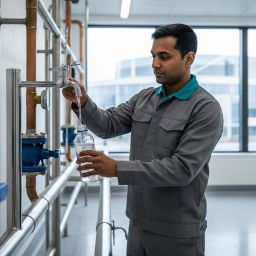
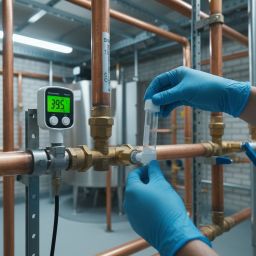
Accuracy in microbiological water testing begins long before the sample reaches the incubator. You must use 500ml or 1,000ml sterile PET or glass bottles pre-dosed with Sodium Thiosulphate. This neutralising agent is vital. It stops the action of residual oxidising biocides like chlorine immediately upon collection. Without it, the disinfectant continues to kill bacteria during transit, leading to a false negative that masks a potential 100% failure rate in your system’s safety protocols.
Choosing your sampling method depends on your specific objective. A “first draw” sample captures the water that has been sitting in the tap or showerhead. This identifies local biofilm issues or problems with the fixture itself. A “flushed” sample, taken after running the water for 2 minutes, assesses the water quality within the recirculating pipework. Under BS 7592:2022 guidelines, both methods are often required to pinpoint whether a 1,000 cfu/l Legionella count is a localised or systemic issue.
Logistics are just as critical as the sampling technique. Samples must be transported in insulated cool boxes and reach the laboratory within 24 hours. They need to stay between 2°C and 8°C throughout the journey. If the temperature exceeds 20°C during transit, the microbial population can double every 20 minutes. This renders the final report useless for legal compliance and safety validation.
The Critical Chain of Custody
A Chain of Custody (CoC) isn’t just paperwork; it’s a legal necessity for UK health and safety compliance. This document tracks the sample from the moment of collection to the laboratory login. It records the sampler’s name, the precise time of collection, and the site temperature. Professional labs like The Testing Lab PLC use these forms to guarantee sample integrity. If your CoC is incomplete, your microbiological water testing results won’t hold up during an HSE audit or a RIDDOR investigation.
Interpreting Your Lab Report
Your Certificate of Analysis (CoA) will list Total Viable Counts (TVC) at two temperatures. High counts at 22°C often indicate environmental contamination, while high counts at 37°C suggest human-pathogenic activity. If you see a result listed as “<10 cfu/ml”, it means the laboratory’s detection limit was reached and no colonies grew. A sudden 10-fold increase in TVCs over two consecutive months is a red flag. This should trigger an immediate review of your Legionella Written Scheme of Control. You might need to decommission the outlet or perform a chemical shock dose if counts exceed 1,000 cfu/l as per HSG274 Part 2 requirements.
Partnering with The Testing Lab PLC for National Compliance
Selecting a laboratory partner isn’t just about obtaining a test certificate. It’s about ensuring your facility remains fully compliant with the Health and Safety at Work etc. Act 1974 and specific guidance like HSG274. At The Testing Lab PLC, we operate with a high-volume capacity that processes thousands of samples weekly. We deliver precision through ISO 17025 accredited methods, ensuring every result stands up to regulatory scrutiny. Most clients receive initial reports within 24 to 48 hours. This rapid turnaround is vital when you’re managing potential Legionella outbreaks or urgent contamination events.
We don’t just provide raw numbers. We provide the empirical data you need to maintain an effective written scheme of control. Our strategic partnership approach means we help you interpret microbiological water testing results against the latest UK health and safety legislation. This ensures your risk assessments are grounded in scientific fact. Our UK-wide service coverage means our technicians reach any site from Cornwall to the Highlands, maintaining a strict cold chain for all samples. This geographical reach ensures consistency for national organisations managing multiple assets.
Our capabilities extend beyond the microscope. We offer comprehensive chemical and material analysis to protect your infrastructure. We investigate pipework corrosion, scale formation, and heavy metal concentrations that can compromise water quality. By identifying these issues early, we help you prevent long-term system degradation and expensive remedial works. Our laboratory acts as a technical extension of your team, taking the burden of quality assurance off your shoulders.
This model of using a specialist partner to take the burden of quality assurance is a crucial strategy in many industries. For businesses managing international supply chains, for example, services from The Inspection Company provide similar peace of mind by verifying product quality before it ever ships.
Specialist Environmental Testing Services
Industrial operations face complex environmental hurdles that require more than basic sampling. We support industrial clients with Effluent Discharge Permit Monitoring to ensure stay within the legal limits set by the Environment Agency. For those in the construction sector, managing site waste is a critical compliance path. We streamline this process through WAC and Waste Acceptance Criteria testing. Using a single accredited laboratory for water, soil, and asbestos reduces administrative overhead by approximately 18% for most project managers. It ensures data remains consistent across all environmental vectors of a project.
Getting Started with Professional Water Testing
Arranging a site survey or sample collection across the UK is a straightforward process. Our logistics network ensures samples reach our facility in temperature-controlled conditions within 6 hours of collection. We build tailored microbiological water testing schedules that reflect the specific risks of your building type. Healthcare facilities often require rigid monthly sampling for Pseudomonas aeruginosa in augmented care units. Conversely, residential blocks might focus on annual Legionella checks and temperature monitoring. Every building has a unique risk profile, and our schedules adapt to that reality. Request a professional quote for water testing today to secure your facility’s safety and ensure total regulatory peace of mind.
Securing Your Facility’s Compliance and Safety Standards
Ensuring your site meets the strict requirements of ACOP L8 and HSG274 isn’t just a legal box-ticking exercise; it’s a fundamental safety priority under the Health and Safety at Work etc. Act 1974. Reliable microbiological water testing provides the data-driven foundation needed to manage risks like Legionella and Pseudomonas effectively. By using a UKAS-accredited laboratory, you’re choosing a partner that understands the technical precision required for accurate analysis. We operate a nationwide network across the UK and Ireland, delivering results that help you maintain 100% regulatory compliance. Our laboratory approach means we don’t just provide numbers; we provide the scientific certainty required to protect your personnel and assets. We’ve designed our services to take the burden of quality assurance off your shoulders, allowing you to focus on your core operations. You’ll find that proactive monitoring is always more cost-effective than reactive remediation. Let’s work together to build a robust safety culture that stands up to the closest regulatory scrutiny.
Request a UKAS-Accredited Water Testing Quote
Frequently Asked Questions
How often should commercial buildings conduct microbiological water testing?
Commercial buildings must determine testing frequency through a formal Legionella risk assessment, though high-risk systems like cooling towers require sampling at least every 3 months under HSG274 guidelines. For standard domestic systems, annual testing often suffices unless the risk profile changes or a system modification occurs. We recommend monthly temperature monitoring as a primary control measure to supplement your microbiological water testing schedule.
Is it a legal requirement to have UKAS-accredited water testing in the UK?
While UK legislation doesn’t explicitly name UKAS accreditation as a criminal requirement, the HSE ACoP L8 and HSG274 strongly recommend using UKAS-accredited laboratories to ensure results are legally defensible. Choosing a non-accredited lab risks non-compliance during a Health and Safety Executive audit. Using an ISO 17025 accredited facility ensures your data meets the precision standards required for UK-wide safety regulations.
What is the difference between a TVC test at 22°C and 37°C?
The 22°C test identifies environmental bacteria that grow naturally in water systems, while the 37°C test targets “human-friendly” pathogens that thrive at body temperature. A significant discrepancy between these two counts often indicates system stagnation or a breach in the supply line. We use these two data points to build a complete profile of your water’s biological health and identify potential biofilm build-up.
Can I take my own water samples for microbiological analysis?
You can take your own samples, but we don’t recommend it for compliance purposes because improper technique often leads to false positives. A single touch to the bottle rim can contaminate a sample with 1,000 or more colony-forming units, rendering the test invalid. Our technicians follow BS 7592:2008 sampling protocols to ensure every result reflects the true state of your water system.
What happens if Legionella is found in my building’s water supply?
If Legionella levels exceed 1,000 cfu/l, you must immediately implement the remedial actions outlined in your written scheme, which usually involves system disinfection and restricted access. During this downtime, ensuring a supply of safe, potable water is crucial, and for facilities needing a temporary solution, bulk water delivery services from providers like A Clear Alternative can be a vital resource. You’ll need to conduct follow-up microbiological water testing 7 to 10 days after treatment to confirm the bacteria’s eradication. We partner with you to manage this process, ensuring your building remains compliant with the Control of Substances Hazardous to Health Regulations.
What is the “wholesome water” standard in the United Kingdom?
The wholesome water standard is defined by the Water Supply (Water Quality) Regulations 2016, which mandates that water must contain zero E.coli and Enterococci per 100ml. It also sets strict chemical limits, such as a maximum of 50mg/l for nitrates and 200mg/l for sodium. Meeting these 50 parameters ensures the water is safe for human consumption and domestic purposes across the UK.
How long does it typically take to get microbiological water test results?
Standard TVC results are typically available within 3 days, but Legionella analysis takes 10 to 14 days due to the slow-growing nature of the bacteria. We provide preliminary reports as soon as they’re available, allowing you to react quickly if high counts are detected. This structured timeline ensures the laboratory can accurately count every colony-forming unit without rushing the biological process.
Does a pass in a water test mean my system is permanently safe?
A passing test result is only a snapshot of your system’s health at the specific moment the sample was collected. Water quality fluctuates based on usage patterns, ambient temperatures, and local supply changes. Maintaining a consistent monitoring programme is the only way to ensure long-term safety and prevent the sudden colonisation of harmful microbes.