

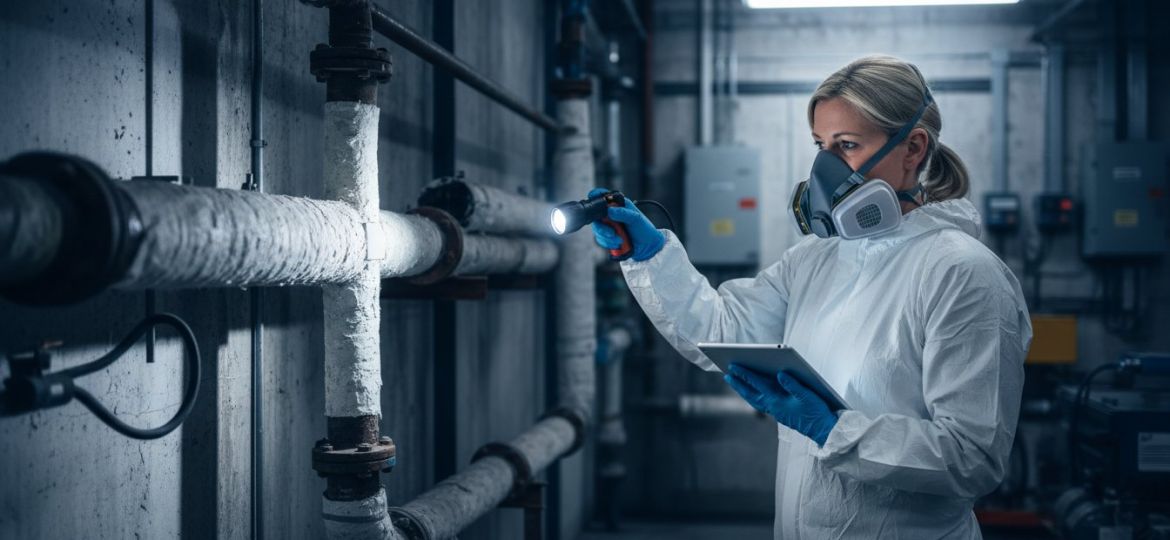
Could a single overlooked floor tile or a forgotten ceiling void lead to a £20,000 fine and an immediate HSE prohibition notice? For many UK building managers, the fear of hidden liabilities is a daily reality. You likely understand that maintaining a safe environment is non-negotiable, yet the technical complexity of an asbestos management survey often creates more questions than answers. It’s stressful to manage these risks when you’re worried about site disruptions or the high costs of non-compliance. In 2024 alone, the HSE issued over 2,000 enforcement notices related to poor material management, making precision more vital than ever.
We’ve designed this guide to remove that burden from your shoulders and provide a strategic partnership in safety. You’ll master the intricacies of CAR 2012 and secure your UK-wide operations for the 2026 regulatory cycle. By following our precision-led methodology, you’ll establish a robust asbestos register and ensure total safety for your contractors and staff. We’ll examine the specific steps to achieve full legal compliance while keeping your facility running smoothly, ensuring your documentation is audit-ready at a moment’s notice.
Key Takeaways
- Understand your legal “duty to manage” under the Control of Asbestos Regulations 2012 to maintain full compliance across your UK wide property portfolio.
- Learn the systematic process of an asbestos management survey, from initial desk studies to the precise on-site assessment of material conditions.
- Identify the critical triggers that necessitate a transition from a standard management survey to a mandatory Refurbishment and Demolition (R&D) survey.
- Discover how to translate complex survey data into a functional Asbestos Register, creating a vital “living document” for ongoing building safety.
- Recognise why UKAS accreditation is the essential benchmark for technical precision and meeting the rigorous standards expected by the HSE.
Understanding the Asbestos Management Survey and UK Legal Requirements
An asbestos management survey serves as the primary document for managing health risks in non-domestic premises. It’s a comprehensive, non-intrusive inspection designed to locate, as far as reasonably practicable, the presence and extent of any suspect asbestos-containing materials (ACMs). Because asbestos was widely used in the construction industry until its total ban in 1999, any UK building constructed or renovated before 2000 must have a valid survey on record. This ensures that materials remain in good condition and aren’t accidentally disturbed during daily occupancy or routine maintenance.
The primary objective is to create an asbestos register. This living document helps you assess the risk of fibre release and implement a plan to manage those risks safely. Without this baseline data, you can’t provide the necessary information to workers or contractors who might encounter hazardous materials. It’s a foundational step in building safety that applies UK wide, across every commercial sector from retail units to industrial warehouses.
The Legal Framework: CAR 2012 Explained
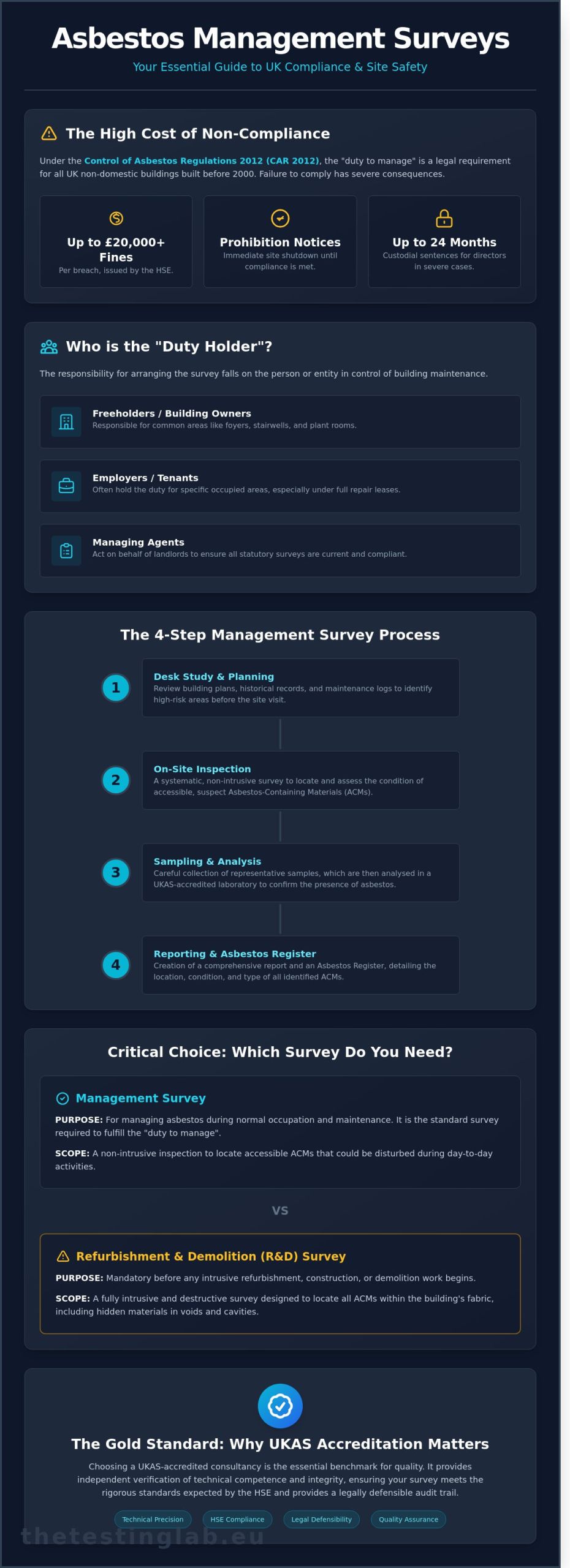
Regulation 4 of the Control of Asbestos Regulations 2012 (CAR 2012) mandates the “duty to manage” asbestos. This legislation requires a systematic approach to identifying and recording ACMs in all non-domestic buildings. The Health and Safety Executive (HSE) monitors compliance through targeted inspections and incident investigations. Breaches are treated with extreme gravity. In 2023, several UK firms faced fines exceeding £20,000 for failing to provide adequate asbestos information to contractors. Severe negligence can even result in custodial sentences of up to 24 months for directors. Beyond criminal prosecution, non-compliance almost always invalidates building insurance policies, leaving your organization exposed to total financial liability in the event of a claim.
Who is Responsible for Arranging the Survey?
Identifying the “Duty Holder” is the first step in achieving compliance. This role usually falls to the person or entity that has the primary responsibility for the building’s maintenance and repair. The exact identity of the duty holder depends on the terms of the tenancy agreement or the ownership structure.
- Freeholders or building owners: Typically responsible for common areas like foyers, stairwells, and plant rooms.
- Employers or tenants: Often hold the duty for the specific areas they occupy, especially under full repair and maintenance leases.
- Managing agents: They frequently act on behalf of landlords to ensure all statutory surveys are up to date.
In complex multi-tenanted buildings, responsibilities are often shared between the landlord and the individual business owners. This makes clear communication and shared access to the asbestos management survey essential. To ensure the highest level of precision and legal defensibility, it’s vital to hire a UKAS accredited asbestos consultancy. Their technical expertise ensures that the survey meets the rigorous standards required by the HSE, effectively taking the burden of quality assurance off your shoulders.
This principle of engaging accredited experts applies to all areas of business compliance. For example, while UK property managers focus on HSE standards, businesses operating internationally must navigate complex financial regulations, often relying on specialized firms like CTC Tax & Accounting for their tax and bookkeeping needs.
Similarly, professionals in the agricultural sector depend on specialized producers like ROfert România for high-quality plant nutrition solutions to ensure optimal growth and yield.
In the same vein, many UK businesses must also manage the security of their vehicle fleets. To protect these valuable assets and meet insurance mandates, managers often explore Insurance Approved Vehicle Trackers as a key part of their risk management strategy.
Likewise, when these commercial spaces are used for conferences or exhibitions, the technical production requires its own form of specialized expertise. For those interested in the professional standards of event execution, you can discover TPG Events (The Technical Production Group).
Additionally, for those managing specialized environments like tattoo studios where hygiene and equipment quality are paramount, you can discover Tatt Lab, a leading provider of professional tattoo and medical supplies.
The Process: What Happens During an Asbestos Management Survey?
A professional asbestos management survey is a structured, engineering-led operation that prioritises data accuracy and site safety. The process begins with a rigorous desk study. Our experts review your building’s historical records, floor plans, and previous maintenance logs to identify high-risk areas before we arrive on site. This preparation ensures the survey is targeted and efficient; it prevents unnecessary sampling and focuses resources where they matter most. Approximately 75% of UK commercial properties built before 1999 still contain some form of asbestos, making this initial intelligence gathering a critical step for UK wide compliance.
Once the desk study is complete, the physical inspection begins. The surveyor systematically moves through the property, following a pre-defined methodology to ensure no area is overlooked. This phase is about more than just finding materials; it is about quantifying the risk they pose to occupants and contractors. If you need expert guidance on how these findings impact your long-term safety strategy, our asbestos consultancy services can help you interpret the data and plan your next steps.
On-Site Inspection Protocol
Surveyors inspect all accessible areas, including ceiling tiles, wall panels, floor finishes, and service voids. They record the “extent” and “condition” of any suspected materials, noting whether the material is damaged or likely to release fibres. This data is vital for your risk assessment under the Control of Asbestos Regulations 2012. We understand that your business needs to stay operational. Our teams work discreetly, often using “shadowing” techniques or out-of-hours scheduling to ensure the inspection causes zero disruption to your daily workflows.
Laboratory Analysis and Sample Identification
When we identify a suspect material, we collect a small physical sample using controlled wetting and sealing techniques to prevent fibre release. These samples travel directly to our specialized facility in Doncaster. Utilising UKAS accredited asbestos testing is non-negotiable; it is the only way to ensure your results are legally valid and scientifically accurate.
Inside the lab, technicians use Polarised Light Microscopy (PLM) to identify the specific mineral types present. This scientific precision allows us to distinguish between different fibres, such as Chrysotile (white), Amosite (brown), or Crocidolite (blue). We maintain a standard 24 to 48-hour turnaround for accredited results, providing you with a clear, evidence-based report that forms the foundation of your ongoing management plan. If you are unsure about the requirements for your specific property, you can request a bespoke quote to get started with a compliant inspection today.
Management Survey vs. Refurbishment & Demolition: Choosing the Right Type
Choosing between a standard asbestos management survey and a Refurbishment and Demolition (R&D) survey depends entirely on your planned activity. A management survey is your baseline. It ensures safety during everyday building occupation. You need this to manage Asbestos Containing Materials (ACMs) under the Control of Asbestos Regulations 2012 (CAR 2012). If you’re planning any construction, the rules change. The Health and Safety Executive (HSE) mandates an R&D survey before any UK-wide renovation or demolition project begins.
Using a management survey for construction works is a critical error. It doesn’t look behind walls or under floors. If a contractor hits hidden asbestos, you face immediate site closure, potential HSE prosecution, and decontamination costs that often exceed £10,000. While a management survey for a 200sqm office might cost between £250 and £500, an R&D survey for the same space could range from £600 to £1,200 due to the increased labour and sampling requirements. Planning these surveys at least 4 to 6 weeks before your project start date prevents costly delays.
This principle of securing specialist reports early extends to other areas of planning compliance. For instance, many development projects also require detailed transport assessments to gain local authority approval, a process managed by experts like ML Traffic Engineers.
The Scope of Management Surveys
The asbestos management survey focuses on surface materials and easily accessible areas. Its primary goal is to ensure that ACMs aren’t disturbed during normal building use. This includes routine maintenance or cleaning. It’s a visual inspection with minor sampling that doesn’t involve breaking into the building fabric. For educational facilities, following the UK government guidance on asbestos management is essential to ensure student and staff safety during term time. This survey level is insufficient for any activity that penetrates walls, ceilings, or floors.
The Intrusive Nature of R&D Surveys
R&D surveys are intrusive and destructive. Surveyors must access every cavity, ceiling void, and floor duct. This often involves breaking through partition walls or lifting floorboards. Legal frameworks require this before any UK-wide structural changes. You can’t simply “upgrade” a management survey report. Building owners must commission a project-specific R&D survey that covers the exact footprint of your planned works. This ensures no hidden risks remain before the first hammer falls. If you’re unsure which level you need, seeking professional asbestos consultancy can prevent costly compliance gaps and ensure your site remains safe.
Post-Survey Actions: Creating Your Asbestos Register and Management Plan
Receiving your asbestos management survey report is the beginning of a proactive safety cycle rather than the end of a process. Under the Control of Asbestos Regulations 2012, duty holders must use this data to actively manage risks within their UK wide premises. The report provides two critical metrics: the Material Assessment, which measures the potential for fibre release, and the Priority Assessment, which considers the building’s use and occupant activity. Both scores range from 0 to 12. Combined, they create a total risk rating out of 24. This data allows you to prioritise remediation work, focusing on high-risk items first.
Beyond the data, you’re legally required to maintain a written Asbestos Management Plan (AMP). This document outlines who’s responsible for asbestos management, the schedule for monitoring, and the procedures to follow if materials are accidentally disturbed. It’s a strategic roadmap that ensures every stakeholder, from the site manager to the cleaning staff, understands their role in maintaining a safe environment.
This level of internal clarity is a cornerstone of a healthy safety culture. For organizations looking to strengthen these foundations of trust and transparency, resources from firms like Core Integrity can provide a broader framework for building accountability.
Similarly, a comprehensive safety strategy often includes physical and corporate security. Businesses facing complex threats may engage a professional security and private investigation agency like Palisade International LLC to provide high-level protection and risk mitigation.
Furthermore, navigating the organizational shifts required for total compliance often demands expert leadership. To support your team through these transitions, you can discover Intact Academy.
The Asbestos Register: Your Compliance Foundation
An asbestos register serves as a living record of every identified or presumed Asbestos Containing Material (ACM). It must detail the specific location, material type, current condition, and total risk score. For UK wide organisations managing multiple sites, digital registers are the gold standard. They allow for real-time updates and instant accessibility for visiting maintenance staff. Before any contractor starts work, they must review this register. This prevents accidental disturbance of materials like asbestos insulating board (AIB) or pipe insulation, which remain common in pre-2000 builds.
This is particularly critical for contractors like heating and gas engineers, who often work on older pipework and boiler systems where asbestos insulation can be present. For building managers seeking reliable trade professionals who understand these safety protocols, you can learn more about Plumbing & Boilers London.
Ongoing Management and Monitoring
Compliance isn’t a one-off event. You’ll need to establish a re-inspection schedule, typically occurring every 6 to 12 months, to monitor material degradation. If you remove or encapsulate materials, update the register immediately to reflect the new site status. Strategic facility management often involves integrating this data with other safety protocols. For example, aligning your asbestos monitoring with Legionella risk assessments creates a unified approach to building health and safety. This holistic method ensures that no compliance gap puts your staff or contractors at risk.
Effective management requires technical precision and a deep understanding of UK legislation. If you’re unsure how to translate your survey findings into an actionable strategy, our consultants can help. Consult with our expert team to develop your Asbestos Management Plan.
Professional Compliance: Why UKAS Accreditation Matters for Your Survey
UKAS accreditation isn’t just an optional badge of quality; it’s the gold standard for safety and legal defensibility in the United Kingdom. The United Kingdom Accreditation Service (UKAS) acts as the sole national body recognised by the government to assess organisations against international standards. For an asbestos management survey, this means evaluating a provider against ISO/IEC 17020. The Health and Safety Executive (HSE) explicitly recommends using UKAS accredited inspection bodies in their HSG264 guidance to ensure competence and impartiality.
The Testing Lab PLC delivers laboratory-led precision for UK wide compliance. We don’t just look for suspect materials; we apply a scientific methodology to every site visit. By choosing an accredited partner, you’re ensuring that the data used to build your management plan is accurate and reproducible. You can verify any provider’s status by checking their unique four-digit accreditation number on the UKAS website before you book. This simple step prevents the risk of hiring unverified contractors who might miss critical hazards.
Quality Assurance in Asbestos Management
There’s a significant difference between a “trained” surveyor and an “accredited” organisation. A surveyor might hold a BOHS P402 qualification, but without company-wide UKAS accreditation, there’s no external audit of their quality management systems or equipment calibration. This gap can lead to your survey being rejected by insurers or the HSE during a routine inspection. Our laboratory-led approach provides a seamless link between site inspection and sample analysis. This expertise is particularly vital for complex sites, such as those requiring specialised analysis for asbestos in soils during brownfield redevelopment. For broader environmental challenges, including comprehensive soil pollution studies, specialized firms such as HYDPOLL exemplify the deep expertise required for such complex projects.
- Accreditation ensures rigorous annual audits by independent technical assessors.
- It guarantees that the asbestos management survey report meets the strict requirements of the Control of Asbestos Regulations 2012.
- It provides a clear chain of custody for every sample taken from your premises.
- Accredited reports are essential for securing professional indemnity insurance for large scale construction projects.
Booking Your Survey with The Testing Lab
We provide tailored survey solutions across the commercial, industrial, and public sectors UK wide. We understand that a 200-page report is useless if it doesn’t offer clear direction. That’s why our reporting is designed to be actionable, highlighting immediate priorities and long-term management actions. Our pricing is transparent, based on the specific footprint and complexity of your building, so you won’t face unexpected costs mid-project. We act as your strategic partner, taking the weight of compliance off your shoulders through technical excellence and engineering precision. Request a professional asbestos survey quote today to ensure your property remains compliant throughout 2026 and beyond.
Future-Proof Your UK Compliance Strategy
Navigating the Control of Asbestos Regulations 2012 requires more than just a cursory check; it demands a precise, data-driven approach to safety. By now, you understand that an asbestos management survey is the foundation of your legal duty to manage, providing the necessary data for a robust asbestos register and management plan. Choosing a partner with the right credentials prevents the risk of non-compliance and ensures your property remains safe for all occupants throughout 2026 and beyond.
The Testing Lab has provided expert consultancy since 2002, delivering UK-wide coverage from our central headquarters in Doncaster. Our UKAS Accredited Laboratory (ISO 17025) ensures every finding is backed by scientific rigour and technical excellence. We don’t just provide reports; we offer a strategic partnership that removes the burden of quality assurance from your shoulders. Our team is ready to guide you through every technical detail with the precision your project deserves.
Get a professional quote for your Asbestos Management Survey
We’re here to help you achieve total peace of mind with your property’s safety standards.
Frequently Asked Questions
Is an asbestos management survey a legal requirement for my building?
Yes, an asbestos management survey is a legal requirement for all non-domestic premises built before 1999 under Regulation 4 of the Control of Asbestos Regulations 2012. This duty to manage applies UK wide to employers, landlords, and building managers. Failure to comply can result in fines up to £20,000 or 12 months imprisonment. We treat every inspection with laboratory precision to ensure your site meets these strict HSE standards.
How long does an asbestos management survey typically take to complete?
A standard survey for a 200 square metre office typically takes 4 to 6 hours to complete on-site. Larger industrial complexes or multi-storey buildings require 2 to 5 days of intensive field work. We provide a detailed report within 5 working days of the site visit. Our agile methodology ensures we minimise disruption while maintaining 100% accuracy in our findings across the UK.
What is the difference between a management survey and a refurbishment survey?
A management survey locates asbestos containing materials (ACMs) that could be disturbed during normal occupancy. In contrast, a refurbishment survey is a fully intrusive investigation required by HSG264 before any construction work starts. While management surveys involve minor sampling, refurbishment surveys involve aggressive techniques to access structural voids. Choosing the right asbestos management survey ensures you don’t face the £10,000 daily costs of project delays.
Do I need to vacate the building while the asbestos survey is being carried out?
You don’t usually need to vacate the entire building during the inspection. Our surveyors work in specific zones, cordoning off 10 to 15 square metre areas while taking samples to prevent cross-contamination. We often schedule visits outside of 09:00 to 17:00 hours to keep your operations running smoothly. This strategic approach allows us to function as a seamless partner in your facility management.
How often should an asbestos management survey be updated or re-inspected?
You must re-inspect the condition of known asbestos at least every 12 months to remain compliant with UK law. If a building’s usage changes or 20% of the interior is renovated, you’ll need an immediate update. We track these cycles for our partners to ensure no compliance gaps occur. Regular monitoring prevents the degradation of materials, which reduces the 5,000 annual deaths currently linked to asbestos exposure in the UK.
Can I carry out my own asbestos management survey if I own the building?
You can’t legally carry out your own survey unless you possess a P402 qualification and professional indemnity insurance. The HSE requires a competent person to conduct the asbestos management survey to ensure technical accuracy. Our team uses a rigorous, engineering-led process that goes beyond basic checklists. DIY surveys lack the laboratory-grade analysis needed to identify 100% of microscopic fibres in textured coatings or floor tiles.
What happens if asbestos is found during the management survey?
If we find asbestos, we immediately categorise the risk using a numerical scale from 1 to 12 based on the material’s condition. You won’t always need to remove it; 75% of identified materials can be safely managed in situ through encapsulation or monitoring. We help you draft an Asbestos Management Plan within 48 hours of the final report. This document outlines exactly how to protect the 10 or 1,000 people using your building.
Does a management survey cover every single part of the building?
A management survey covers all accessible areas including floor voids, ceiling tiles, and storage cupboards. It doesn’t typically involve breaking into structural walls or digging 50cm into foundations unless specifically requested. We document any no access areas clearly in your report to ensure 100% transparency. Our surveyors use a systematic grid-based approach to ensure no corner of your UK wide property portfolio is overlooked.