
Did you know that the Health and Safety Executive (HSE) issued over £3.5 million in fines during 2023 for failures related to hazardous material management? It’s a staggering cost that proves why a thorough Asbestos Refurbishment and Demolition Survey is the most critical component of your pre-construction phase. You already know that hitting an unidentified pocket of crocidolite can halt a project for weeks, yet the confusion between standard management surveys and fully intrusive R&D investigations persists across the industry. We recognise that for your UK-wide projects, the goal isn’t just to avoid penalties; it’s to protect your team and your bottom line with absolute certainty.
We’ve designed this guide to help you master the legal frameworks of CAR 2012 and the technical rigour required for 2026 compliance. You’ll gain the expertise to eliminate the risk of undiscovered ACMs while benefiting from the predictability of fixed-fee survey costs. We’ll break down the intrusive testing protocols, clarify your legal obligations as a duty holder, and provide a clear pathway to maintaining a safe, uninterrupted working environment on every site you manage.
Key Takeaways
- Understand your legal obligations under the Control of Asbestos Regulations 2012 and why an intrusive inspection is mandatory before any UK construction work begins.
- Learn how an Asbestos Refurbishment and Demolition Survey identifies hidden hazards through destructive access to voids and partitions to ensure total site safety.
- Discover the critical differences between standard management surveys and R&D requirements, including the necessity of vacating premises for deeper investigation.
- Master your responsibilities as a dutyholder to provide safe access and manage the risks of potential exposure throughout the surveying process.
- Explore how leveraging an independent accredited laboratory with UK-wide coverage can accelerate your project timelines and ensure rigorous compliance.
What is an Asbestos Refurbishment and Demolition Survey?
An Asbestos Refurbishment and Demolition Survey is a rigorous, fully intrusive inspection required by law before any structural alterations or site clearances begin. It’s not a surface-level check; it’s a deep-dive diagnostic process designed to identify every trace of hazardous material hidden within a building’s fabric. At The Testing Lab, we view this as a critical phase of project quality assurance. It’s the only way to ensure that your site team isn’t exposed to lethal fibres once the first sledgehammer swings.
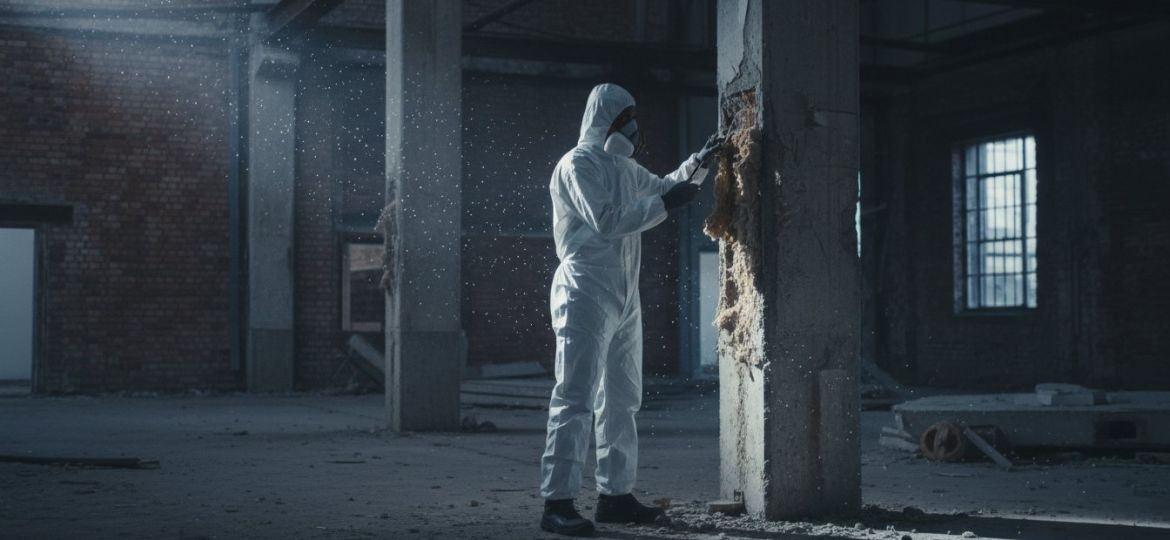
The primary objective is simple: locate all asbestos-containing materials (ACMs) before they’re disturbed. This survey involves destructive techniques, meaning surveyors will access floor voids, wall cavities, and structural cladding. Because of this, the area must be vacated and ideally sealed off. It’s a precision-led operation that prevents the accidental release of fibres, which can lead to project shutdowns and massive financial liabilities. If you find asbestos mid-way through a build, costs typically spike by 25% to 40% due to emergency decontamination and unplanned remedial work.
Legal Framework: HSG 264 and the Duty to Manage
The Control of Asbestos Regulations 2012 (CAR 2012) sets the legal benchmark for all UK-wide construction projects. Specifically, the Health and Safety Executive (HSE) guidance document HSG 264 dictates how these surveys must be executed. You can’t rely on a standard Management Survey for construction work. Management Surveys are designed for normal occupancy; they don’t look behind the walls. For any structural change, the Asbestos Refurbishment and Demolition Survey is the mandatory standard.
Non-compliance carries heavy penalties. In 2023, the HSE continued to prosecute directors and firms for failing to provide adequate survey data to contractors. Fines are often unlimited, and custodial sentences are a real risk for those who ignore the “Duty to Manage.” Our asbestos consultancy team focuses on removing this legal burden from your shoulders, ensuring every report is technically robust and compliant with current UK legislation.
When is an R&D Survey Mandatory?
The trigger for an R&D survey is any work that disturbs the fabric of a building. It’s a common misconception that “modern” buildings are exempt. In reality, any UK-wide structure built or renovated before the year 2000 requires a survey. Even if you’re only removing a single internal partition or upgrading the HVAC system, the law requires a targeted intrusive inspection of those specific areas.
- Structural changes: Removing load-bearing walls, chimneys, or floor slabs.
- Demolition: Full site clearance or partial removal of outbuildings.
- Refurbishment: Re-wiring, re-plumbing, or window replacements that penetrate original cavities.
- Pre-2000 Assets: Any building constructed before the 1999 total ban on asbestos use in the UK.
These rules apply to a wide range of common residential and commercial projects. For example, before you can even begin to explore House Extensions with a professional practice like Advance Architecture, undertaking a full R&D survey is a non-negotiable legal requirement to ensure the safety of the construction team.
It doesn’t matter if you don’t suspect asbestos is present. The Asbestos Refurbishment and Demolition Survey must be conducted to prove its absence. Without this document, your Principal Designer and contractors cannot legally produce a safe Construction Phase Plan. It’s a foundational step in any professional development programme.
The Technical Process: How R&D Surveys are Conducted UK Wide
Executing an Asbestos Refurbishment and Demolition Survey requires a methodology that prioritises exhaustive discovery over aesthetics. Unlike standard management surveys, this process is fully intrusive and intentionally destructive. Surveyors use heavy-duty tools to break through wall partitions, lift floorboards, and penetrate structural voids to identify hidden Asbestos Containing Materials (ACMs). This level of rigour ensures that no fibre remains undetected before contractors begin work on-site. Following the framework established in HSE’s Asbestos: The survey guide, the inspection covers every accessible area within the defined scope of works across the UK.
Technical competence isn’t optional in this high-stakes environment. All surveyors must operate under UKAS accreditation to ISO 17020 standards, ensuring they possess the engineering mindset needed to assess complex building layers. It’s not just about finding the material; it’s about understanding how it integrates with the building’s infrastructure. Once the survey concludes, the site must be carefully managed. If the building isn’t scheduled for immediate demolition, surveyors must ensure it’s fit for reoccupation. This involves thorough cleaning and, in many cases, air clearance monitoring to confirm that the intrusive works haven’t left behind hazardous airborne fibres.
Sampling and Laboratory Analysis
Precision is the cornerstone of our laboratory approach. Every material sample collected during an Asbestos Refurbishment and Demolition Survey undergoes rigorous microscopic examination. We utilise polarised light microscopy (PLM) to identify specific fibre types with absolute certainty. Maintaining a secure chain of custody is a legal necessity for evidence in UK health and safety audits. You can find more detail on our UKAS accredited asbestos testing protocols which define our commitment to quality. This data-driven process eliminates guesswork for site managers and provides a clear audit trail.
Asbestos in Soils and Sub-structures
Demolition projects often uncover risks beneath the surface that aren’t visible during a standard walkthrough. Brownfield sites across the UK frequently contain fragments of asbestos cement sheets or lagging buried within foundations and made ground. Our teams conduct specialised testing for asbestos in soils to mitigate these underground hazards before heavy machinery disturbs the earth. Managing contaminated land during the demolition phase prevents the spread of fibres into the surrounding environment and avoids costly project delays. If you’re planning a complex site clearance, our asbestos consultancy services provide the technical roadmap needed for safe land remediation and regulatory compliance.
After the site is declared safe from asbestos contamination, the focus shifts to preparing the ground for construction. This is a critical stage where professional groundworks and civil engineering services are required. Companies such as GCS Contractors Ltd specialize in this phase, handling everything from site clearance to laying foundations, ensuring the project starts on a solid footing.
Managing these site-level risks is critical, and so is ensuring the operational integrity of the machinery used for the demolition. Modern heavy equipment relies on complex electronic systems, and keeping them in top condition is essential for both safety and efficiency. For those interested in the diagnostic side of construction machinery, Mechnician provides advanced diagnostic tools for vehicles like forklifts and excavators.
Similarly, managing the external impact of a demolition is just as critical. Large projects require comprehensive traffic and transport planning to handle vehicle movements and ensure public safety. This is a specialized field in itself, with expert consultancies like the Australian-based ML Traffic Engineers Pty Ltd providing the necessary analysis and plans to keep projects moving smoothly and safely in the public domain.
Beyond logistics and safety, environmental responsibility in waste disposal is paramount during site preparation. To manage the efficient removal of industrial rubber products often left behind on complex sites, you can discover Tired Tyres for professional scrap tire collection and disposal solutions.
Management vs. Refurbishment and Demolition Surveys
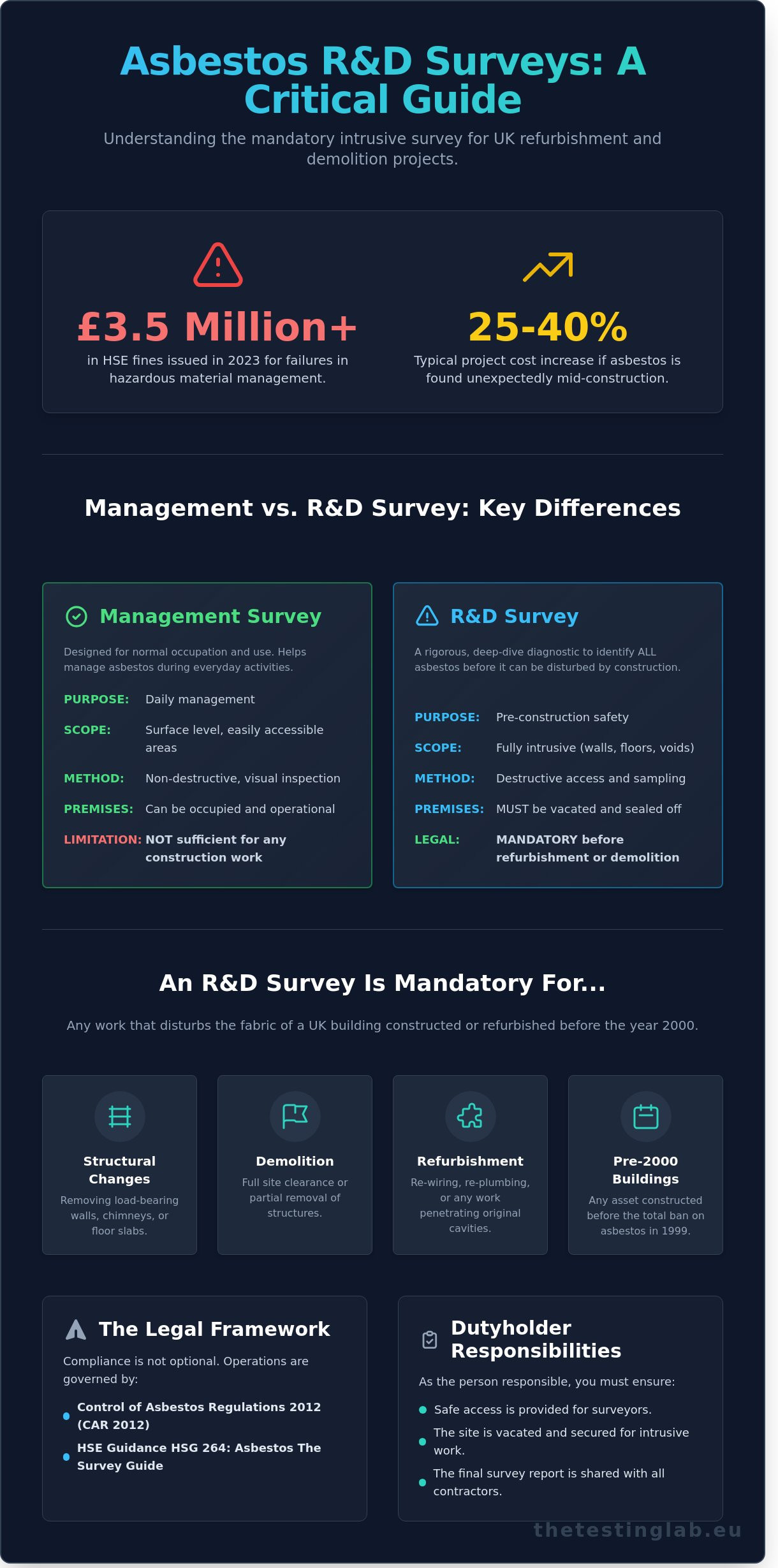
A standard management survey focuses on identifying asbestos containing materials (ACMs) that might be disturbed during normal daily occupancy. It’s largely non-intrusive and serves as the foundation for your ongoing health and safety file. In contrast, an Asbestos Refurbishment and Demolition Survey is a legal requirement under the Control of Asbestos Regulations 2012 before any structural work begins. This survey is fully intrusive, designed to locate all ACMs within the specific project area, including those hidden deep behind walls, under floor screeds, or inside structural cavities.
Because this process involves breaking into the building’s fabric, the premises must be vacant. You can’t have staff or the public present while surveyors are aggressively opening up partitions or lifting floorboards. From a financial perspective, R&D surveys require a higher initial investment. While a management survey for a 300-square-metre office unit might cost around £500, a comprehensive Asbestos Refurbishment and Demolition Survey for the same footprint often exceeds £1,400. This price difference reflects the increased labour hours, specialised equipment, and higher volume of laboratory samples required to ensure 100% compliance UK wide.
The “Destructive” Element Explained
Surveyors operate under the mandate of “as far as reasonably practicable,” which means they must access every area scheduled for work, even if it requires significant force. We use heavy-duty tools like reciprocating saws, borescopy cameras for void inspections, and crowbars to expose the building’s skeleton. Since the goal is often demolition or total renovation, the aesthetic impact isn’t a priority. However, for partial refurbishments, we plan access points strategically to minimise damage to areas that are staying, ensuring the structural integrity remains intact.
Reporting and the Asbestos Register
Once the field work finishes, the data must update your site-wide asbestos management plan immediately. We translate complex lab results into a prioritised action plan for your contractors, ensuring they know exactly where risk zones exist before they pick up a tool. This data shouldn’t exist in a vacuum. By integrating these findings with construction material testing, project managers gain a 360-degree view of site safety. This holistic approach ensures that hazardous materials are accounted for before the main works programme starts, preventing 95% of accidental exposure incidents on site.
- Management Survey: For daily building use; identifies surface-level risks.
- R&D Survey: For construction projects; involves structural penetration.
- Vacant Site: Essential for R&D surveys to protect occupants from dust and debris.
- Costing: Expect to pay 2-3 times more for an R&D survey due to the depth of investigation.
Dutyholder Responsibilities: Preparing for your UK Survey
The dutyholder carries the legal burden under Regulation 4 of the Control of Asbestos Regulations 2012. This role requires more than just hiring a contractor; it involves active preparation to ensure the Asbestos Refurbishment and Demolition Survey is conducted safely and thoroughly. You’re responsible for providing safe, unrestricted access to every part of the structure, including voids, lofts, and sub-floors. Failure to do so often leads to incomplete reports and hidden risks remaining on-site, which can stall a project later.
Safety is a non-negotiable priority during intrusive works. You must ensure the work area is completely vacated before the survey begins. This isn’t merely a suggestion; it’s a necessity to prevent accidental exposure to airborne fibres during destructive sampling. Additionally, all utilities, including gas, electricity, and water, must be isolated. Surveyors will be opening up fabric and structural elements, so live services represent a significant health and safety hazard. Providing historical asbestos data and original building plans helps our team map out high-risk areas with precision, reducing the time spent on-site.
A Checklist for Site Preparation
- Organise all necessary keys, fobs, and security codes for UK-wide locations to prevent delays.
- Distribute the survey schedule to all stakeholders, ensuring tenants or staff are aware of the restricted zones.
- Arrange for specialist access equipment, such as scaffolding or mobile towers, for areas higher than 3.5 metres.
- Clear all furniture, equipment, and debris from the survey area to allow for a 100% inspection of floor surfaces and wall partitions. For guidance on managing the logistics of a site clearance, you can read more.
A key part of this preparation involves controlling site access through reliable lock and key management. For professional locksmith services to secure your site, especially for projects in the capital, you can check out London Locks.
Ensuring the site is properly secured and that access is managed effectively during the survey is a key part of this preparation. If you require professional assistance with site security, lock changes, or access control systems, you can find out more about comprehensive property maintenance services.
Selecting a Competent UKAS Accredited Partner
Choosing a partner isn’t just about the lowest price; it’s about technical rigour. You should always verify a firm’s UKAS credentials by checking their official schedule of accreditation against ISO/IEC 17020 standards. A firm with an in-house testing laboratory accredited to ISO/IEC 17025 provides a distinct advantage. It ensures a seamless chain of custody for samples and significantly faster turnaround times for results. This laboratory-led approach removes the uncertainty from your project timeline. If you’re planning a major project, you can request a bespoke quote for asbestos services to ensure your specific compliance needs are met.
Our team operates with a precision-first mindset, treating every Asbestos Refurbishment and Demolition Survey as a critical engineering task. We don’t just find risks; we provide the data you need to manage them effectively. Contact us today to secure your site’s safety at thetestinglab.eu.
Comprehensive Asbestos Solutions by The Testing Lab PLC
The Testing Lab PLC operates from a central head office in Doncaster, providing expert coverage across the UK and Ireland. We understand that timing is a critical factor in construction and demolition schedules. Our independent, UKAS-accredited laboratory allows us to maintain rapid turnaround times, often delivering results within 24 to 48 hours of sample collection. This internal capability removes the delays typically associated with third-party testing facilities, ensuring your project remains on track.
Our approach is defined by engineering-led precision. We don’t view a survey as a simple checklist exercise. Instead, we treat it as a technical assessment that requires scientific rigor. Every Asbestos Refurbishment and Demolition Survey we conduct follows a strict quality management protocol. This ensures that the data provided in our reports is accurate, actionable, and fully compliant with the latest 2026 UK health and safety regulations. We focus on providing clarity so that site managers can make informed decisions regarding risk mitigation and removal strategies.
For complex or high-risk sites, our professional asbestos consultancy provides the technical depth required to manage intricate contamination issues. We act as a strategic partner, helping you navigate the technicalities of the Control of Asbestos Regulations 2012 and subsequent updates. Our consultants bring decades of combined experience to every site, ensuring that even the most challenging industrial environments are assessed with total accuracy.
Managing risk in such environments goes beyond structural hazards like asbestos; it also includes maintaining the operational integrity of critical machinery. To prevent equipment failure and costly downtime, many industrial operators rely on specialized maintenance like hot oil flushing services australia to keep lubrication systems pristine.
Beyond Surveys: Full Compliance Support
Compliance is rarely a standalone requirement. We offer an integrated approach by aligning asbestos surveys with fire and water risk assessments. This holistic view of building safety streamlines the management process for property owners. We also support 4-stage clearances and air monitoring to ensure that areas are safe for re-occupation following removal works. You can also access our Legionella risk assessment services to manage waterborne pathogens alongside your hazardous material obligations. This unified service model reduces administrative burden and ensures no aspect of building compliance is overlooked.
This comprehensive view of building performance often extends beyond safety compliance. For modern construction projects, architects and developers also rely on specialist consultants to manage factors like architectural acoustics. For instance, firms such as Focus Acoustics provide expert guidance to ensure new buildings meet stringent noise control and sound quality standards, another critical layer in delivering a successful project.
For many firms, this duty of care extends beyond the site, especially when staff travel for projects. Ensuring team members are protected with the right travel health advice and vaccinations is another key aspect of corporate responsibility, with specialist resources like vaccinesfortravels.co.uk providing necessary services.
Contact Our UK-Wide Team Today
Starting your refurbishment or demolition project with a professional assessment is the only way to guarantee safety and legal compliance. We maintain a transparent pricing structure, offering fixed-fee survey and laboratory charges so you can budget with confidence. There are no hidden costs or unexpected laboratory surcharges. Our UK-wide team is ready to deploy to your site, providing the technical expertise needed to secure your project’s success. Visit The Testing Lab PLC to learn more about our methodology or to book a consultation with our Doncaster-based technical team.
When you choose us, you’re choosing a partner committed to precision and safety. We’ve built our reputation on the quality of our data and the reliability of our reports. Let us take the weight of compliance off your shoulders so you can focus on the delivery of your project.
Securing Your Project Lifecycle with Technical Precision
Navigating UK health and safety regulations requires more than just a tick-box approach; it demands absolute precision. Failing to conduct a thorough Asbestos Refurbishment and Demolition Survey before starting structural work can lead to project halts and legal penalties under CAR 2012. Our team at The Testing Lab PLC brings over 20 years of independent consultancy experience to every site. We operate from our Doncaster-based HQ, providing UK wide coverage through our ISO 17025 UKAS Accredited Laboratory. This technical foundation ensures every sample we analyse meets the highest scientific standards. You’ll gain peace of mind knowing your site is safe and fully compliant with 2026 standards. Don’t risk the safety of your contractors or the integrity of your development timeline. We’re here to take the burden of quality assurance off your shoulders with a strategic partnership built on transparency.
Request a UKAS Accredited R&D Survey Quote
We’re ready to help you navigate these complex requirements and ensure your next project starts on solid, safe ground.
Frequently Asked Questions
Is an Asbestos Refurbishment and Demolition Survey a legal requirement?
Yes, an Asbestos Refurbishment and Demolition Survey is a mandatory requirement under Regulation 5 of the Control of Asbestos Regulations 2012. You’re legally obligated to identify all asbestos-containing materials before any structural work or demolition begins on buildings constructed before 2000. Failing to secure this survey can lead to HSE enforcement action, including unlimited fines or custodial sentences of up to 24 months for duty holders.
What is the difference between a Type 2 and Type 3 asbestos survey?
Under the HSG264 guidance updated in 2012, the old Type 2 is now called a Management Survey, while Type 3 is the Refurbishment and Demolition Survey. Management surveys are non-intrusive and designed for normal building occupation. In contrast, the R&D survey is a fully intrusive, destructive inspection that’s necessary to locate asbestos hidden inside walls, floor voids, or structural columns before construction teams start work.
Can I stay in the building while an R&D survey is being carried out?
You shouldn’t remain in the building while the surveyors are working. Since the process involves destructive techniques to access hidden cavities, there’s a heightened risk of releasing microscopic fibres into the air. Health and Safety Executive guidelines state that the work area must be vacant to prevent accidental exposure. For a typical 200 square metre UK-wide commercial site, expect the building to be cleared for 1 to 2 days.
How long does it take to receive the results of an R&D survey?
You’ll typically receive your comprehensive report within 5 to 10 working days after the site inspection. This window allows for the 24 to 48 hours required for UKAS accredited laboratory analysis of any bulk samples collected. While we can often provide a verbal summary of major findings immediately, the full technical document is vital for your CDM 2015 health and safety file and project planning phases.
What happens if asbestos is found during the demolition survey?
If the Asbestos Refurbishment and Demolition Survey identifies hazardous materials, you must update your risk assessments and project timelines immediately. Depending on the material’s condition and type, you might need a licensed contractor to remove it. Under CAR 2012, high-risk removals, such as asbestos lagging or insulation board, require a 14 day notification period to the HSE before any removal work can legally commence on your site.
Does an R&D survey cover the entire building or just the work area?
The survey can be targeted to a specific area or cover the entire premises, depending on your defined scope of works. If you’re only renovating a single floor of a UK-wide office block, the survey can focus solely on that zone. However, any area not included in the survey must be managed as if it contains asbestos. We usually suggest including a 5 metre buffer zone around the work site to ensure safety.
How much does an asbestos refurbishment and demolition survey cost in the UK?
Costs for a standard three bedroom residential property generally start from £350, while commercial R&D surveys typically begin at £750. Prices fluctuate based on the building’s footprint, the complexity of the structure, and the number of samples requiring laboratory testing. For a 1,000 square metre industrial warehouse, you should budget between £1,500 and £3,000 to ensure the inspection meets all 2026 compliance standards and safety protocols.