

Did you know that the Health and Safety Executive (HSE) issued over £3.5 million in fines for health and safety breaches in the last reporting year? For many facility managers, the constant worry isn’t just the safety of their staff; it’s the technical ambiguity of the law. You’re likely already aware that maintaining water safety is non-negotiable, yet the distinction between a routine risk assessment and actual water sampling remains a significant point of confusion. When you’re managing multiple sites UK wide, the question of how often do i need a legionella test becomes a critical pillar of your risk management strategy.
We understand that you need more than just vague advice; you require a precise, engineering-led approach to compliance. This guide simplifies the complexities of ACOP L8 and the HSWA 1974 to give you a concrete schedule for your water safety obligations. We’ll outline the specific legal frequencies for testing, identify the exact triggers that necessitate an immediate re-assessment, and provide the technical confidence you need to ensure your organisation stays on the right side of the law.
Key Takeaways
- Understand your mandatory legal obligations under the Health and Safety at Work Act 1974 and COSHH to ensure your UK-wide operations remain fully compliant.
- Learn precisely how often do i need a legionella test by distinguishing between routine temperature monitoring and the quarterly laboratory sampling required for high-risk systems.
- Identify the “significant change” triggers in building occupancy or water usage patterns that necessitate an immediate re-assessment of your current safety protocols.
- Discover how to implement a robust written scheme of control and maintain a compliant logbook to provide a transparent audit trail for HSE inspectors.
- Explore how a laboratory-led, precision engineering approach to water management can streamline safety protocols and mitigate risk across multiple business sites.
Understanding Legionella Testing Requirements under UK Law
Compliance in the UK isn’t a suggestion; it’s a strict mandate governed by the Health and Safety at Work Act 1974. Under this legislation, alongside the Control of Substances Hazardous to Health (COSHH) Regulations 2002, employers and landlords have a ‘duty of care’ to prevent exposure to biological agents. When stakeholders ask, how often do i need a legionella test, they’re often looking for a simple calendar date, but the answer is rooted in a structured legal framework. This framework requires the appointment of a Duty Holder, the person with ultimate accountability, and an Appointed Competent Person who possesses the technical expertise to manage the system. Whether you operate in London, Belfast, or Edinburgh, UK-wide compliance demands a consistent approach to prevent the growth of bacteria that causes Legionnaires’ disease in man-made water systems.
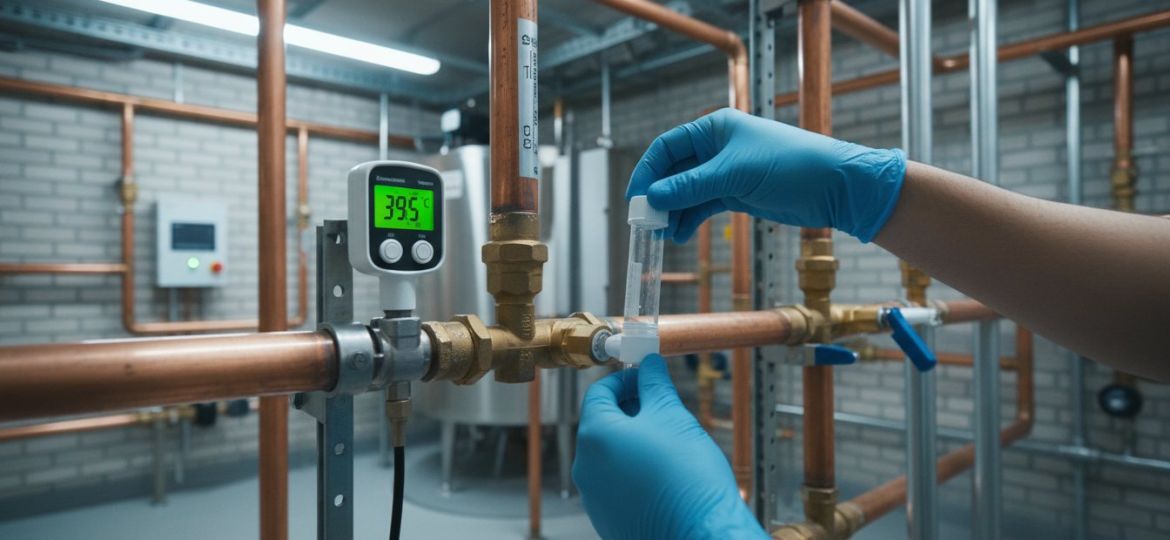
It’s vital to distinguish between physical monitoring and laboratory sampling. Monitoring involves routine tasks like checking water temperatures to ensure they stay above 50°C at outlets or below 20°C for cold water storage. Testing, however, refers to the actual collection of water samples for microbiological analysis in a UKAS-accredited laboratory. The law doesn’t treat these as interchangeable. While monitoring is a monthly or quarterly requirement for most, the frequency of laboratory testing depends on the specific risks identified in your building’s water system. Failing to meet these standards can lead to unlimited fines or prosecution, especially if an outbreak occurs due to negligence.
The ACOP L8 Code of Practice
The Fourth Edition of the Approved Code of Practice (ACOP L8), updated in 2013, serves as the definitive guide for Legionella management. While it isn’t a law itself, it has a special legal status in UK courts. If you’re prosecuted for a breach of health and safety law and it’s proved you didn’t follow the provisions of ACOP L8, you’ll need to show you complied with the law in some other way. It applies to any premises where water is stored or used and where there’s a risk of aerosol formation, including offices, factories, and residential rentals.
Risk Assessment vs. Water Sampling
A Legionella Risk Assessment is a living document that identifies potential hazards, evaluates control measures, and outlines a specific scheme of precautions to ensure ongoing regulatory compliance.
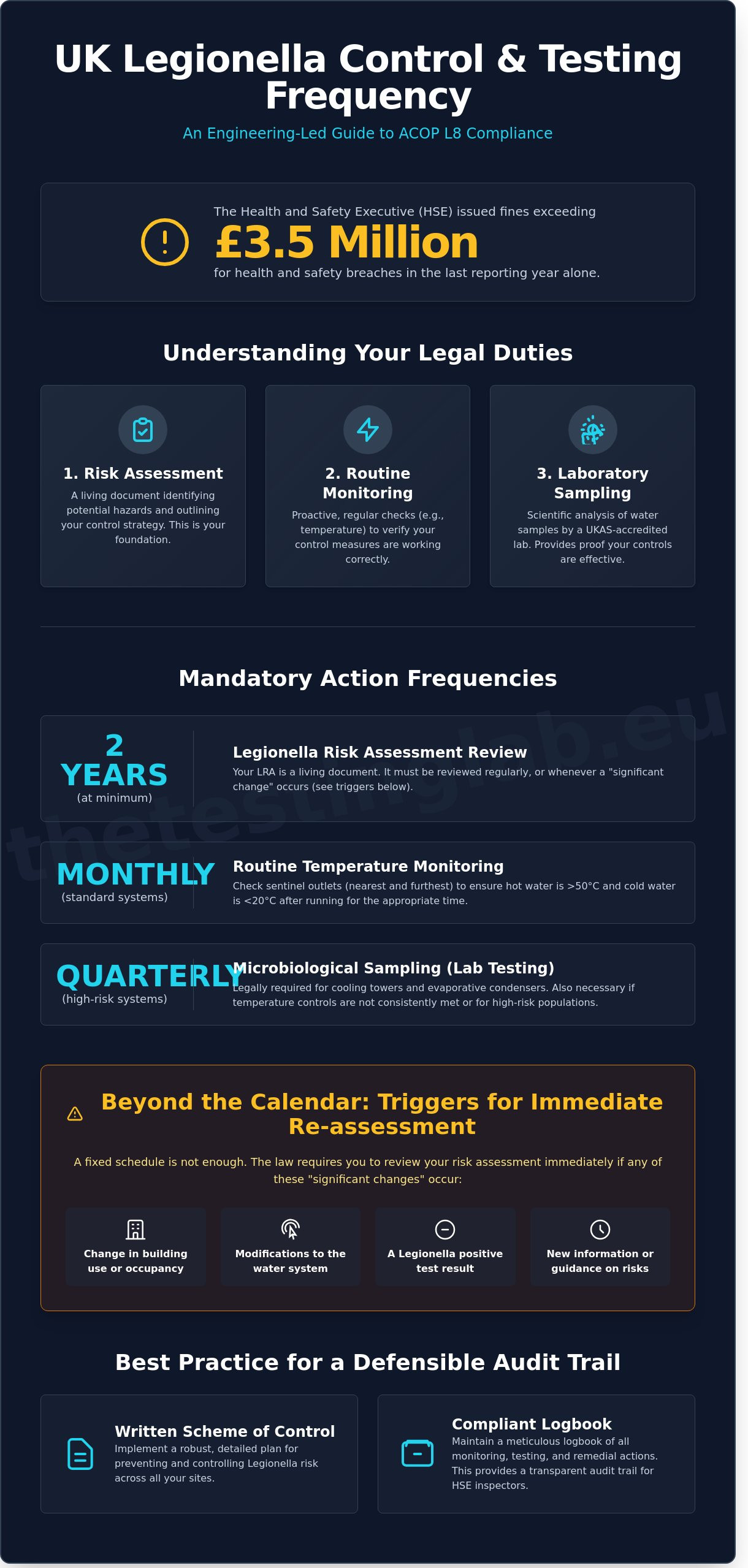
While the risk assessment determines the overall strategy, laboratory sampling becomes a legal necessity in specific scenarios rather than just a best-practice choice. You must conduct lab testing if you have cooling towers, evaporative condensers, or if your control measures, like temperature regimes, aren’t consistently met. In a regulatory context, ‘monitoring’ is the proactive verification that your system is under control, whereas ‘testing’ provides the scientific proof that your efforts are working. If you’re wondering how often do i need a legionella test for a standard office block, the answer usually starts with a review of your risk assessment every two years, or whenever the water system undergoes a significant change. Data from 2023 shows that 15% of commercial buildings required more frequent testing due to aging pipework or low occupancy rates, proving that a static approach to safety simply doesn’t work.
- Monitoring: Monthly temperature checks and visual inspections.
- Testing: Quarterly or six-monthly laboratory analysis for high-risk systems.
- Review: Updating the risk assessment following any plumbing modifications.
Mandatory Frequencies: How Often to Test Different Water Systems
Determining how often do i need a legionella test depends entirely on the complexity of your infrastructure and the vulnerability of your building’s occupants. In the UK, the legal framework doesn’t just suggest frequencies; it demands a proactive management strategy. The foundational rule is that your Legionella Risk Assessment (LRA) must be a living document. While many organisations aim for a review every two years, the ACoP L8 regulations actually require a review whenever there’s a reason to suspect the current assessment is no longer valid. This could be due to changes in the water system, a change in the building’s use, or new information about risks.
For standard domestic hot and cold water systems, temperature is your primary line of defence. If you’re consistently hitting 50°C at the outlets (55°C in healthcare) and keeping cold water below 20°C, routine sampling might not be a monthly requirement. However, the HSE guidance on water testing frequency clarifies that sampling becomes mandatory if your temperature control regime fails or if your system is treated with biocides rather than heat. In healthcare and care home settings, the stakes are higher. These environments house “susceptible” populations, meaning the HTM 04-01 standards often necessitate more frequent microbiological monitoring to prevent an outbreak before it starts.
Open Systems and Industrial Processes
Cooling towers and evaporative condensers are high-risk assets because they inherently create aerosols. Under HSG274 Part 1, these systems require quarterly laboratory testing for Legionella as a minimum standard. If a test returns a count exceeding 1,000 cfu/l (colony forming units per litre), immediate corrective action is required. For commercial spa pools and hot tubs, the frequency is even tighter. These systems should undergo microbiological testing at least monthly, with daily pH and disinfectant checks. We also pay close attention to ‘dead legs’-sections of pipework where water doesn’t flow. These require weekly flushing or, ideally, physical removal to prevent them from becoming bacterial breeding grounds.
Residential Landlord Responsibilities
Many UK landlords fall into the trap of believing “simple” domestic systems don’t require formal oversight. This is a misconception that can lead to legal liability. While you might not need monthly lab samples for a single-occupancy flat, you still need a formal risk assessment. Most landlords should review these assessments every two years or at the start of a new tenancy. A vital part of your safety frequency isn’t just a physical test; it’s tenant education. Providing residents with advice on flushing showerheads after a holiday or reporting issues with water temperature is a critical, ongoing component of your risk management strategy. If you’re unsure how your property portfolio fits into these regulations, a professional water safety audit can clarify your exact legal position.
Precision in testing frequency isn’t just about ticking a box for the Health and Safety Executive. It’s about engineering a system where data drives decisions. When you ask how often do i need a legionella test, you’re really asking how to maintain a safe environment for your staff, tenants, or patients. By following the specific intervals outlined in HSG274 and ACoP L8, you move from a reactive “emergency” mindset to a controlled, scientific approach to water safety. This level of rigour ensures that your facility remains compliant and, more importantly, that the people inside it remain safe from preventable harm.
Beyond the Calendar: Triggers for Immediate Legionella Re-Assessment
The Health and Safety Executive (HSE) guidelines, specifically ACoP L8, make it clear that a risk assessment is a living document. While many site managers aim for a biennial review, this schedule becomes obsolete the moment your system undergoes a “significant change.” If you’re questioning how often do i need a legionella test, you must look at your building’s operational reality rather than just the date on your last certificate. Relying on an outdated assessment during a period of system flux exposes your organisation to both health risks and legal liabilities across its UK wide operations.
A significant change isn’t always a major construction project. It can be as simple as a shift in how a room is used or a failure in your water heating equipment. When your current control measures, such as maintaining hot water above 50°C, fail consistently over a 30-day period, the calendar cycle is no longer relevant. You’re now in a high-risk phase that demands an immediate engineering review and potential sampling to ensure the safety of your tenants or employees.
Structural and Systemic Changes
Modifying your plumbing is the most common trigger for a re-assessment. Adding new outlets or capping off old pipework frequently creates “dead legs.” These are lengths of pipe where water no longer flows, allowing it to stagnate and reach temperatures between 20°C and 45°C. This range is the primary incubation zone for Legionella bacteria. Any alteration to your water storage, such as replacing an old galvanised steel tank with a modern plastic cistern, also requires a professional review to verify the new configuration doesn’t introduce new risks.
When undertaking such modifications, it’s crucial to partner with a reputable construction firm that understands how these changes impact water safety. Professional building companies like Swiss Build Ltd have experience in executing projects that adhere to modern health and safety standards, helping to minimize risks from the outset.
Another critical systemic trigger is a change in personnel. The “Responsible Person” is legally tasked with oversight. If this individual leaves the business or changes roles, the new appointee must conduct a review to ensure they understand the system’s complexities and their legal duties. For a deeper look at the legal framework, you can consult this complete guide to UK Legionella regulations. This ensures your water management plan remains robust and compliant with the latest standards.
Environmental and External Factors
Your risk profile isn’t static; it fluctuates with the weather and building usage. UK heatwaves can quickly raise the temperature of “cold” water stored in roof tanks above the safe 20°C threshold. If your monthly monitoring shows that your temperature controls are failing, a one-off test isn’t enough. You need a full re-assessment to identify why your system isn’t resilient to external heat. It’s about finding a permanent solution, not just a temporary fix.
Stagnation is equally dangerous. If a building or even a specific floor has been vacant for more than 7 days, the risk of biofilm development increases significantly. This often happens after school holidays or office refurbishments. Before re-occupying these spaces, you should ask yourself how often do i need a legionella test when usage patterns drop. The answer is always “before the taps are turned back on.” You can learn more about our Legionella Risk Assessment services to see how we handle these high-risk scenarios with precision and technical expertise.
Best Practice for Organising Your Water Management Plan
Effective water safety isn’t a reactive task; it’s a structured engineering process. Under the Health and Safety at Work etc. Act 1974 and the Management of Health and Safety at Work Regulations 1999, UK employers must maintain a written scheme of control. This document acts as your operational roadmap. It details the specific measures required to control the risk from Legionella bacteria within your water systems. Without this written scheme, you’re not just risking public health; you’re operating outside of UK law.
Your ‘Log Book’ serves as the definitive history of your compliance. It’s the first thing an HSE inspector will request during a site visit. A robust log book records every temperature check, every showerhead descale, and every flushing regime. It provides the evidence that your written scheme is actually being followed. When you’re determining how often do i need a legionella test, the frequency will be dictated by this plan, based on the specific risks identified in your initial assessment.
A comprehensive approach to facility hygiene supports your water safety plan by preventing the buildup of scale and biofilm where bacteria can thrive. For managers overseeing properties in the South West, for instance, you can discover That’s Cleaning for professional support with these essential maintenance tasks.
Choosing a laboratory is a critical decision for legal certainty. You must select a facility with UKAS accreditation to ISO 17025 standards. This accreditation ensures that the lab’s methods are validated, their equipment is calibrated, and their staff are technically competent. Using a non-accredited lab means your results might be inadmissible in a legal dispute, leaving your organisation vulnerable to prosecution even if you’ve been testing regularly.
The Laboratory Approach to Water Safety
When your sample reaches a UKAS accredited lab, it undergoes a controlled incubation process that typically lasts 10 days. Analysts look for a ‘mathematical detection limit’ of 100 colony forming units per litre (cfu/l). This 100 cfu/l limit is the standard reporting threshold in the UK. If your report shows ‘Not Detected’, it signifies that Legionella levels are below this specific concentration. To ensure your facility meets these rigorous standards, you can explore our microbiological water testing capabilities for detailed analysis.
Training and Competency
The HSE defines a ‘competent person’ as someone with sufficient theoretical and practical knowledge. Taking a sample isn’t just about filling a bottle. DIY testing often leads to false negatives because untrained staff fail to neutralise biocides. If your water is treated with chlorine, you must use bottles containing sodium thiosulfate to stop the chemical from killing bacteria during transit. Furthermore, your team must be trained to recognise Legionnaires’ disease symptoms, such as a high fever or a persistent cough, to trigger emergency protocols immediately. Relying on untrained personnel creates a false sense of security that can have fatal consequences.
Don’t leave your compliance to chance. Contact our expert team for professional water management strategies that keep your site safe and legally sound.
Professional Legionella Services: Ensuring Compliance UK Wide
The Testing Lab PLC approaches water safety with a methodology rooted in precision engineering. We don’t just collect samples; we apply scientific rigour to every millilitre of water we analyse. Based in Doncaster, our operations extend across the entire United Kingdom, supporting businesses from Cornwall to the Highlands. This national reach is vital for multi-site organisations that require a consistent, high standard of testing across their entire estate. By using an independent laboratory, you gain the certainty of unbiased results. We have no commercial interest in recommending expensive, unnecessary plumbing repairs or chemical treatments. Our only goal is to provide the accurate data you need to satisfy HSE inspectors and comply with ACoP L8 regulations.
Determining how often do i need a legionella test is a critical part of your health and safety strategy. While a basic risk assessment might suggest annual checks, high-risk environments or systems with complex pipework often require monthly or quarterly monitoring. We help you map out these frequencies across multi-site portfolios. This ensures that no single tap, showerhead, or cooling tower is overlooked. Our logistics network ensures that samples are transported under temperature-controlled conditions, arriving at our lab ready for immediate analysis. This level of precision is why 92% of our clients report improved confidence during their external health and safety audits.
Integrated Compliance Solutions
Managing environmental risks shouldn’t involve juggling multiple contractors. We streamline your safety protocols by combining Legionella monitoring with other critical requirements. You can request a quote for Legionella or Asbestos testing through our unified portal to consolidate your compliance tasks. Our team doesn’t just hand over a certificate filled with technical jargon. We interpret the 10 to 12 day incubation data into actionable outcomes. If a sample returns a count above the 100 CFU/L threshold, we tell you exactly what it means for your specific system and what steps you should take next.
Why Choose The Testing Lab PLC?
Our UKAS accredited status represents the gold standard in laboratory testing. We operate with a laboratory-first mentality, meaning every sample undergoes rigorous validation against ISO 17025 standards. Budgeting is simpler with us because we use transparent, per-sample fee structures. You won’t find hidden admin fees or travel surcharges that inflate your compliance costs. We act as a strategic partner rather than a simple service provider. We help you manage risk by identifying trends in your water data, such as consistent temperature drops, before they become a biological hazard. This proactive stance has helped our long-term partners reduce their remedial maintenance costs by an average of 15% over a three-year period.
Choosing a partner who understands the intricacies of UK legislation is essential for long-term safety. Whether you’re managing a single care home or a national retail chain, our team provides the same level of engineering-grade precision. We take the burden of quality assurance off your shoulders, allowing you to focus on your core operations while we handle the science of safety. When you ask how often do i need a legionella test, we provide an answer backed by data, legislation, and a commitment to UK-wide public health.
Take Control of Your Water Management Strategy
Maintaining compliance with the Health and Safety at Work etc Act 1974 isn’t just about ticking boxes; it’s about mitigating biological risks with engineering precision. Under the L8 Approved Code of Practice (ACOP) and HSG274 guidelines, you’re required to review your risk assessment at least every 2 years, or immediately if your water system undergoes significant structural changes. While monthly temperature monitoring remains a baseline requirement for most commercial properties, high-risk systems like cooling towers demand quarterly sampling. Determining exactly how often do i need a legionella test depends on your unique site profile and the specific findings of your written scheme of control.
The Testing Lab PLC acts as your strategic partner, removing the complexity of quality assurance. We provide independent professional advice through our UK wide coverage, ensuring your facility meets every legal benchmark. As a UKAS Accredited Laboratory, we apply a scientific approach to every sample we process. Book your UKAS accredited Legionella risk assessment today to ensure your premises remain safe and fully compliant. We’re here to help you build a more resilient and transparent safety culture.
Frequently Asked Questions
Is Legionella testing a legal requirement for UK landlords?
Yes, UK landlords have a legal duty to assess and manage Legionella risks under the Health and Safety at Work etc. Act 1974. The Management of Health and Safety at Work Regulations 1999 also mandates this responsibility for all residential and commercial properties. Landlords must ensure the safety of tenants by identifying potential risks in the water system. While a laboratory test isn’t always mandatory for simple domestic systems, a formal risk assessment is a strict legal requirement across the UK.
How often should a cooling tower be tested for Legionella?
Cooling towers require Legionella testing at least every 3 months according to the HSE HSG274 Part 1 guidelines. This quarterly schedule ensures that microbial growth is monitored before it reaches dangerous levels. Systems with a history of contamination or high complexity might require monthly sampling to maintain safety. Maintaining this 90 day interval helps prevent outbreaks and confirms that your chemical treatment regime is functioning correctly.
What are the ‘significant changes’ that require a new Legionella risk assessment?
A new risk assessment is required if you make 3 specific types of changes: physical alterations to the pipework, a change in the building’s use, or a shift in the water source. Adding a new wing or removing 5 or more dead legs constitutes a physical change. If a building’s occupancy drops by 50 percent, the resulting stagnation also triggers the need for a fresh review to ensure previous control measures remain effective.
Can I take my own water samples for Legionella testing?
You can technically take your own samples, but it’s not recommended because UKAS accreditation requires specific collection protocols to be valid. Inaccurate sampling leads to 15 percent higher rates of false negatives, which puts occupants at risk. Professional technicians use sterile containers and precise thermal monitoring during collection. This ensures the laboratory results reflect the actual biological state of your water system rather than contamination from the sampling process itself.
What happens if a Legionella test comes back positive?
If a test returns a positive result above 1,000 cfu/l, you must immediately implement the emergency procedures outlined in your written scheme. This usually involves chemical or thermal disinfection of the entire system within 24 hours. You’ll need to resample the water 7 to 10 days after treatment to verify the bacteria is gone. It’s vital to notify the site manager and restrict access to high risk areas like showers during this recovery period.
Do I need to test for Legionella if my water is always kept hot?
You still need to consider testing even if water is kept hot, as Legionella can survive in dead legs where water doesn’t reach 60°C. Stagnant sections of pipework often drop below the 50°C safety threshold, creating a breeding ground. You should ask yourself how often do i need a legionella test based on the complexity of your system rather than just the boiler temperature. Regular monitoring ensures that heat actually reaches every outlet in the building.
How long does a Legionella risk assessment stay valid in the UK?
There’s no fixed expiry date for a Legionella risk assessment in the UK, but the HSE recommends a review whenever you suspect it’s no longer valid. Most professional bodies suggest a full review every 2 years to account for minor system drifts or wear. If your building has 10 or more outlets, an annual review is often more appropriate. This proactive 24 month cycle keeps your safety documentation aligned with current UK health and safety standards.
What is the difference between a Legionella test and a risk assessment?
A Legionella risk assessment is a comprehensive survey of your entire water system to identify hazards, whereas a test is a laboratory analysis of a specific water sample. Think of the assessment as the diagnostic blueprint and the test as a single data point. The assessment is a legal requirement for all UK businesses. To determine how often do i need a legionella test, you must first complete the risk assessment to establish your system’s specific vulnerability.